Why Use a Butt Weld Union?
A butt weld union joins two pipe ends with welded tailpieces and a removable union nut. The welds stay in place, but workers can undo the nut to separate the pipe for maintenance. This makes the fitting useful near equipment that needs regular cleaning, inspection, or replacement, especially where a threaded connection may not suit the service.
The key distinction is simple: the pipe ends are welded, but the connection between them can be opened. The right union still depends on the pipe size, wall thickness, material, and the system’s pressure and temperature requirements.
I’m Lance Vanover, CEO of Lynco Flange & Fitting. After more than 26 years in industrial fittings and operations, I’ve seen how choosing the right butt weld union can make maintenance easier without overlooking the demands of the piping system.
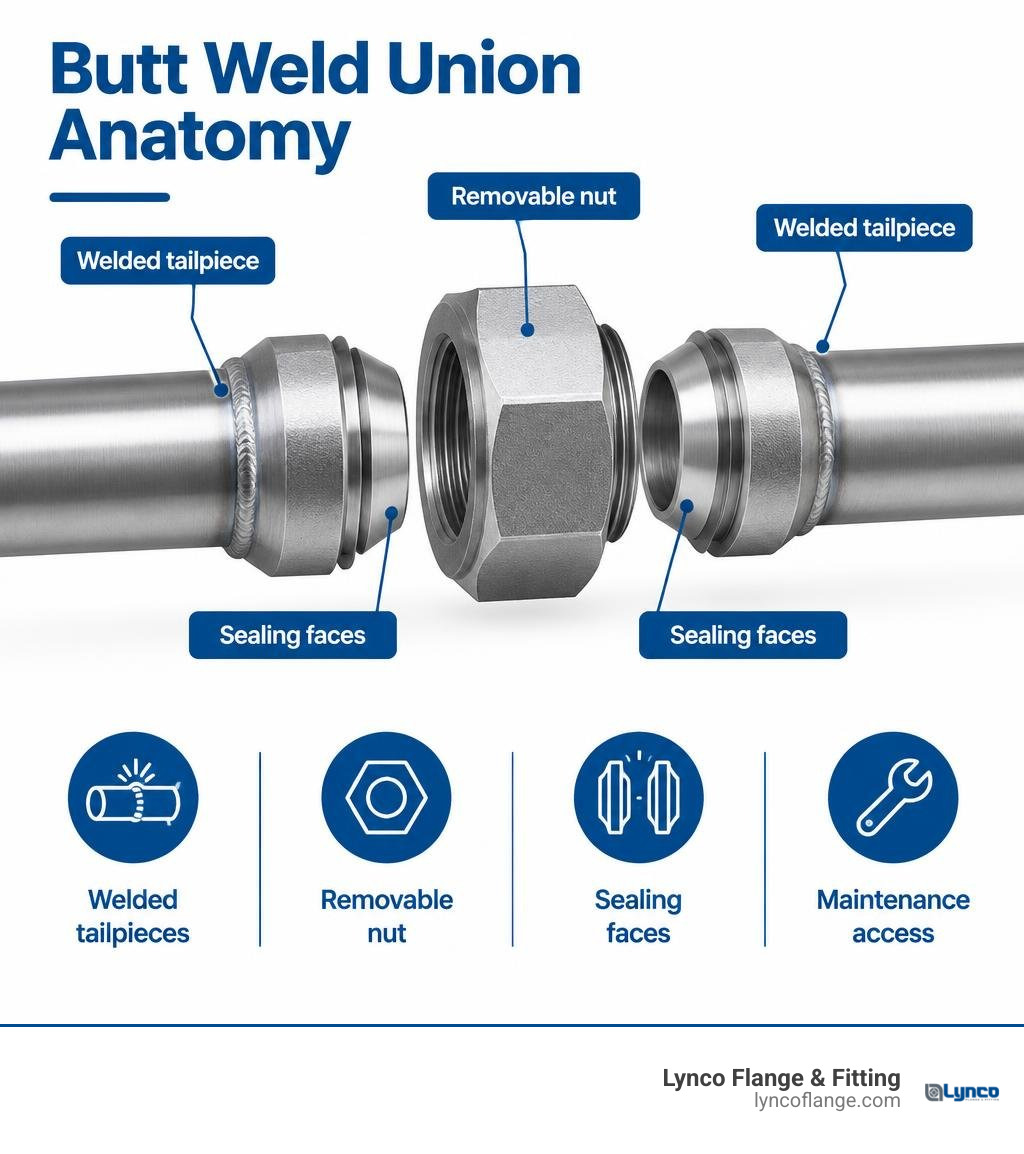
Understanding the Butt Weld Union and Its Core Design
In demanding industrial facilities, piping systems must endure severe operational stresses while still allowing maintenance crews easy access to essential machinery. A standard fully welded joint offers permanent strength, but it forces technicians to cut lines with torches or saws whenever a pump, control valve, or meter requires servicing. Conversely, standard mechanical joints can become leak risks under extreme thermal cycling or mechanical vibration.
The butt weld union bridges this operational gap. It acts as a semi-permanent, inline coupling designed for full-penetration butt welding directly to adjacent pipe ends. By matching the pipe schedule and bore diameter perfectly, this specialized fitting preserves laminar fluid flow while offering a mechanical separation point.
Key Components of a Butt Weld Union
A complete butt weld union assembly consists of three primary mechanical components engineered to work in harmony under high pressure:
- The Male Tailpiece (Head): Welded to one pipe section, this piece features a precision-machined external sealing contour (such as a spherical ball face or ground bevel).
- The Female Tailpiece (Tail): Welded to the opposing pipe spool, it incorporates a complementary internal sealing seat (typically a conical angle) designed to mate with the male piece.
- The Union Nut: A heavy-duty, internally threaded collar that slips over one tailpiece shoulder and threads onto the external threads of the other. As technicians torque the nut, it draws the two mating tailpieces together under high axial compression.
The primary sealing mechanism is a ground, metal-to-metal contact face. Because the metal seats are lapped to micro-inch precision, tightening the union nut creates a fluid-tight barrier without relying on soft elastomeric seals that degrade over time. In specialized low-pressure or chemical lines, an integrated O-ring or flat gasket may supplement this joint, but industrial high-pressure lines rely overwhelmingly on metal-to-metal seating. This robust mechanical junction reinforces the overall structural integrity of piping systems across severe processing runs.
Butt Weld Union Connection Characteristics
Butt weld unions provide distinct engineering advantages when compared to standard threaded unions, socket weld unions, and bolted companion flanges:
| Characteristic | Butt Weld Union | Threaded Union (NPT) | Socket Weld Union | Bolted Flange Pair |
|---|---|---|---|---|
| Joining Method | Full penetration butt weld | Screwed male/female threads | Fillet weld around hub socket | Welded neck or slip-on flange |
| Leak Integrity | Exceptional; no crevice paths | Prone to thread leaks & galling | Moderate; crevice at pipe socket | High; depends on gasket compression |
| Pressure Boundary | High (up to Class 6000 / 3000+ psi) | Limited (usually Class 2000/3000) | High (Class 3000 to Class 6000) | Extreme (Class 150 to Class 2500) |
| Internal Bore Step | Smooth internal transition | Internal obstruction & turbulence | Expansion gap causes turbulence | Smooth bore (Weld Neck style) |
| Thermal Cycling | Handles severe expansion/contraction | Prone to loosening over time | Susceptible to stress at fillet weld | High performance; heavy footprint |
| Physical Weight | Compact, light profile | Compact, light profile | Compact, moderate weight | Bulky, heavy, high clearance needed |
The continuous, uninterrupted internal bore helps maintain fluid velocity and dramatically reduces turbulence, making these fittings vital for designing leak-free connections in gas lines where fugitive emissions must be prevented.
Technical Specifications, Materials, and Pressure Ratings
Butt weld unions are engineered under strict manufacturing codes to guarantee performance across critical systems. Dimensions, tolerances, and mechanical requirements generally follow ASME B16.11 (for forged fittings) alongside guidelines derived from ASME B16.9 for wrought butt welding components.
Fitting ends are machined with a standard 37.5-degree bevel (plus or minus 2.5 degrees) to facilitate complete weld penetration into matching pipe wall schedules, including Schedule 40, Schedule 80, Schedule 160, and Schedule XXS.
Material Grades and Standards for a Butt Weld Union
Choosing the correct metallurgy prevents premature corrosion, stress cracking, and system failures. The most common alloys used in industrial applications include:
- Carbon Steel (ASTM A105 / A105N): The industry workhorse for non-corrosive petroleum, natural gas, steam, and industrial water systems. Normalized carbon steel (A105N) provides superior notch toughness in low-temperature services.
- Stainless Steel (ASTM A182 F304/304L & F316/316L): The standard selection for chemical processing, offshore marine environments, food and beverage processing, and corrosive chemical delivery. The low-carbon (“L”) designations prevent sensitization and intergranular corrosion during welding.
- Low-Alloy Chromium-Molybdenum Steel (ASTM A182 F11, F22, F91): Designed specifically for power generation and refinery catalytic cracking units subject to extreme operating temperatures exceeding 1000°F (538°C).
- Duplex and Super Duplex Stainless (ASTM A182 F51, F53, F55): Combines austenitic and ferritic grain structures for high yield strength and pitting resistance in aggressive chloride and marine environments.
To determine which composition best balances cost with operational longevity, engineers evaluate diverse material options for weld fittings prior to final piping design.
Pressure Classifications and Temperature Limits
Forged butt weld unions fall into standard pressure classifications—predominantly Class 3000 and Class 6000. In standard carbon steel applications, Class 3000 unions comfortably handle cold working pressures up to 3000 psi (pounds per square inch). As operational temperatures rise, the maximum allowable working pressure decreases according to ASME pressure-temperature derating tables.
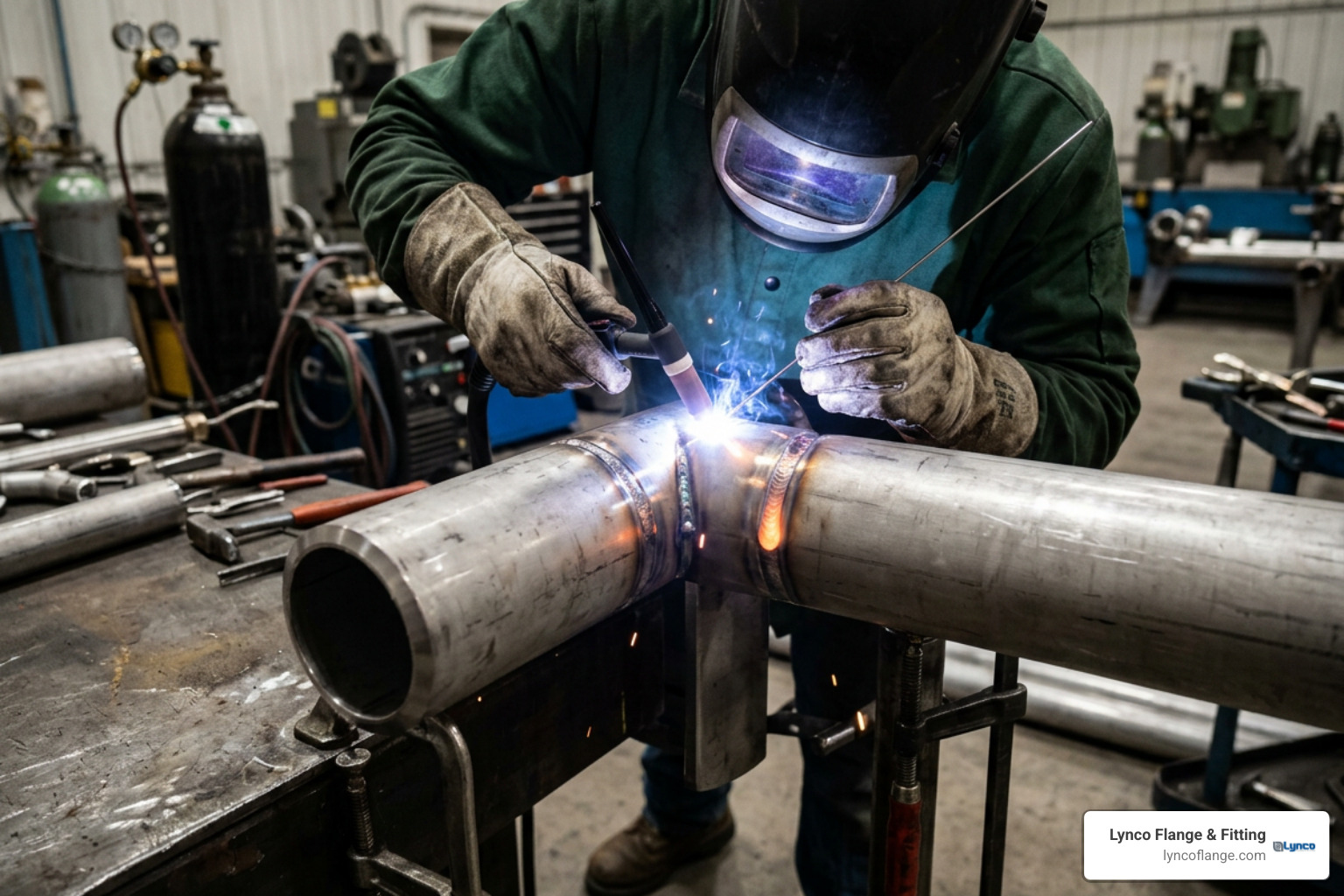
When piping engineers design high-pressure applications, butt weld unions offer dependable pressure containment without the bulk and clearance issues of heavy Class 600 or Class 900 bolted flange assemblies.
Industrial Applications and Operational Advantages
Butt weld unions are essential across heavy industrial sectors that balance pressure containment with quick system modularity.

Primary Sectors Utilizing Butt Weld Joints
Industrial piping systems in oil and gas refineries, petrochemical plants, offshore drilling platforms, chemical manufacturing plants, and nuclear or thermal power generation facilities rely heavily on these fittings. Notably, butt weld unions are used in over 60% of industrial piping systems where frequent disassembly is required for equipment maintenance or cleaning cycles.
When configuring complex process piping manifolds, project managers must carefully choose the right weld fittings to avoid restrictive flow bottlenecks or unnecessary maintenance overhead.
Lifecycle Benefits and Cost Efficiency
Beyond simple pressure ratings, butt weld unions lower overall total cost of ownership through several direct operational advantages:
- Accelerated Installation Time: Butt weld unions reduce installation time by up to 30% compared to threaded unions in high-pressure piping systems. Welders make straightforward circumferential butt welds rather than cutting threads, managing thread sealant pastes, or wrestling with high-torque alignment issues.
- Reduced Structural Weight and Footprint: Unlike heavy companion flanges that require wide bolt circles and room for hydraulic wrenches, a butt weld union fits into tight process skids.
- Superior Vibration and Fatigue Resistance: Threaded pipe joints create severe notch stress concentrations at thread roots, which frequently crack under cyclic pump vibration. Butt welds distribute stress evenly across the full pipe wall thickness.
- Lower Downtime During Maintenance: Operators can quickly isolate meters, valves, or process pumps by loosening a single union nut, without removing rings of rusted flange bolts.
Investing in high-quality weld fittings avoids expensive field rework, unplanned shutdowns, and premature replacement cycles.
Step-by-Step Installation and Welding Guidelines
A butt weld union performs only as well as its installation. Because the joint integrates directly into the piping wall, welders must follow qualified Welding Procedure Specifications (WPS) and strict joint preparation protocols.
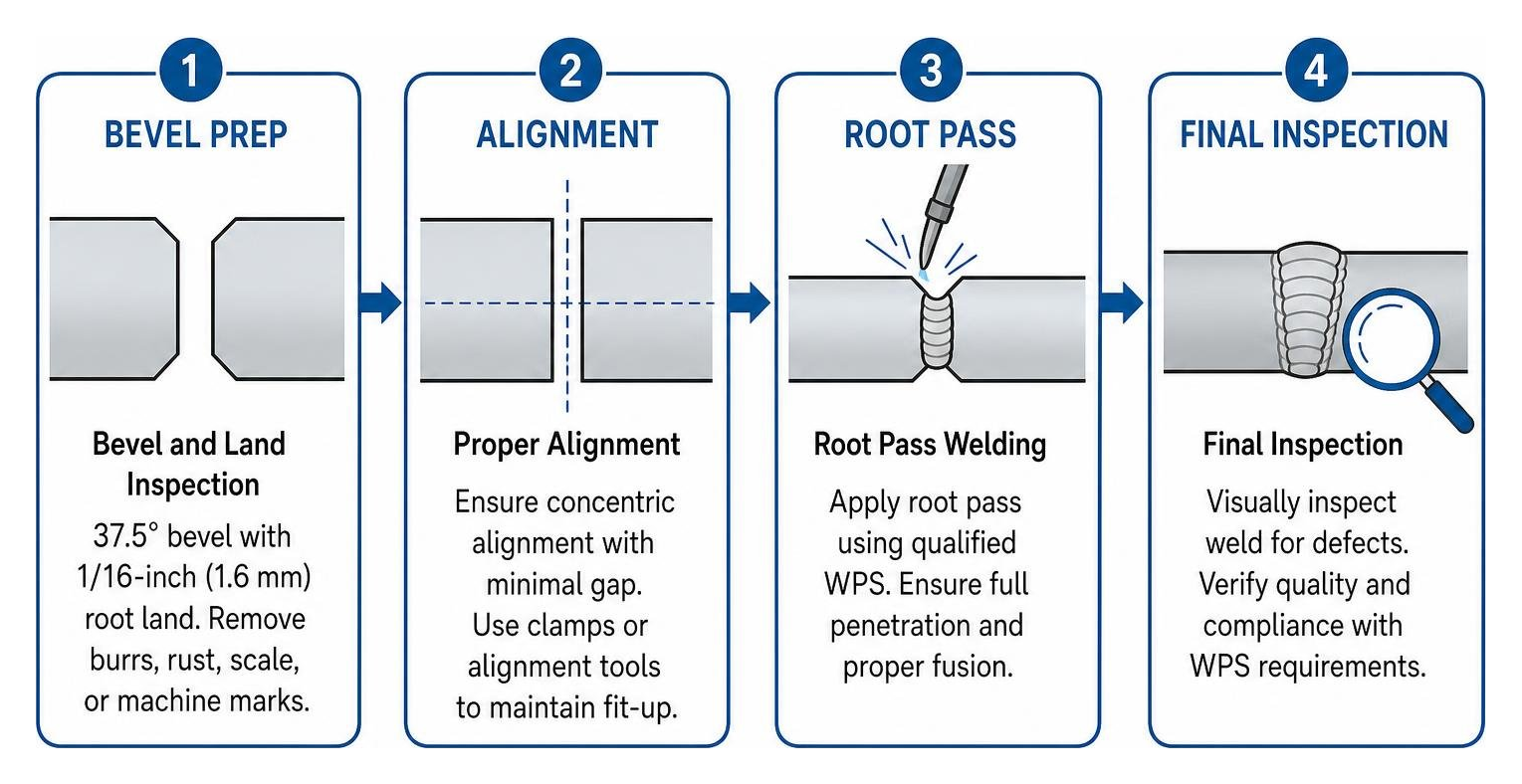
Pre-Weld Joint Preparation and Alignment
Field research indicates that approximately 85% of butt weld union failures are attributed to improper welding technique or inadequate joint preparation. Proper installation requires disciplined prep:
- Bevel and Land Inspection: Ensure the pipe and tailpiece bevels measure 37.5 degrees with a 1/16-inch (1.6 mm) root land. Grind away burrs, rust, scale, or machine marks.
- Surface Cleaning: Mechanically clean the interior and exterior of the weld prep zone at least 1 inch (25 mm) back from the bevel using a dedicated stainless steel wire brush and solvent to eliminate oil, grease, and moisture.
- Disassemble the Union Before Welding: Crucial Step! Never weld a butt weld union while it is assembled and tightened. High welding heat can distort the internal metal-to-metal seating faces, fuse the threads, or anneal pre-compressed seating shoulders. Always remove the union nut and set the opposing tailpiece aside. Slide the nut onto the appropriate pipe section facing the correct direction before making the final weld.
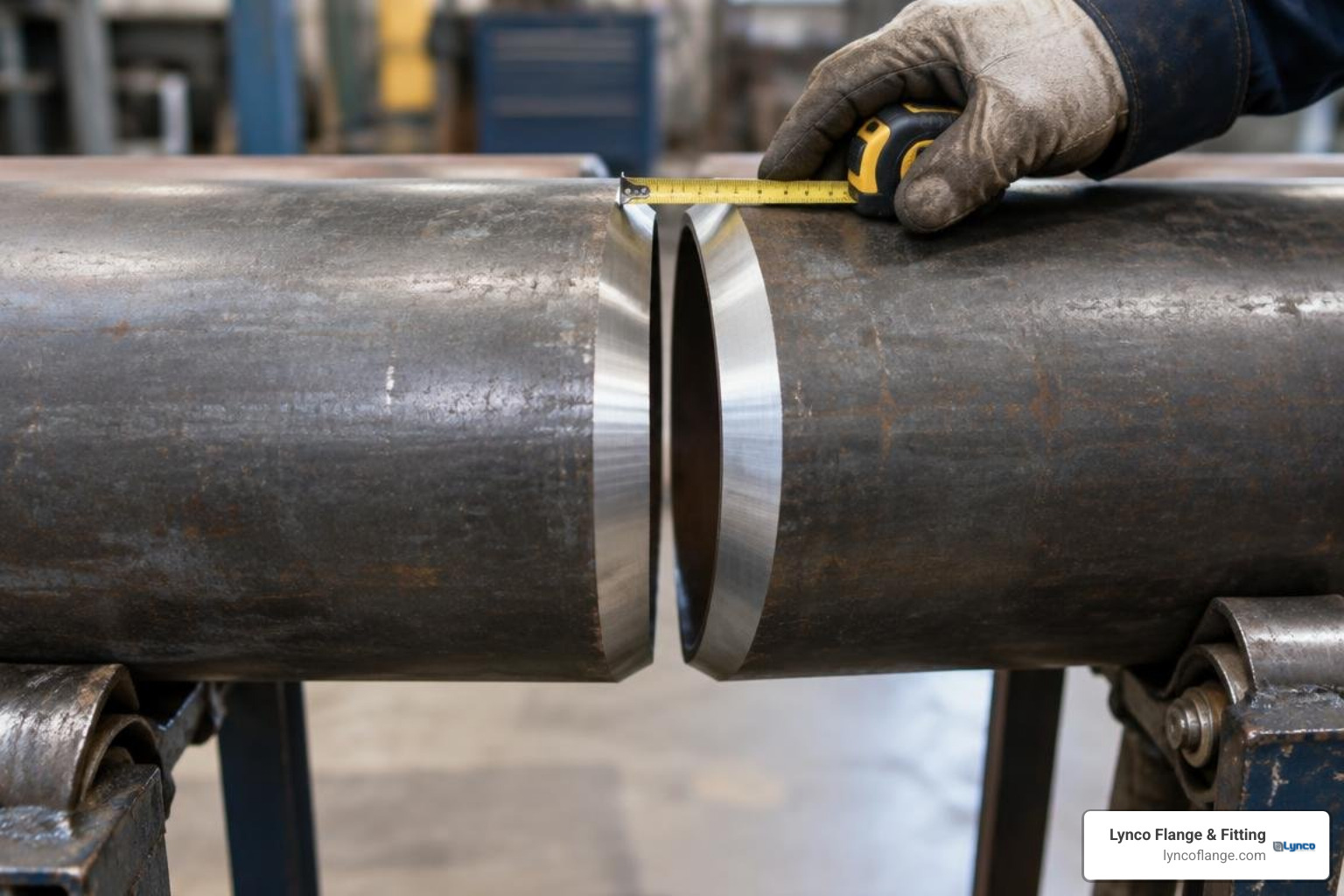
- Fit-Up and Root Gap: Align the tailpiece with the pipe spool, maintaining an even root gap of 1/16 to 1/8 inch (1.6 to 3.2 mm). Check for high-low internal misalignment, which should not exceed 1/16 inch.
- Tack Welding: Apply small, bridge-style tack welds within the weld bevel using GTAW (TIG) to keep the fitting squarely aligned with the pipe axis.
Proper Welding Techniques and Heat Control
To maintain dimensional stability and metallurgical integrity across the fitting:
- Root Pass Application: Utilize Gas Tungsten Arc Welding (GTAW / TIG) for the initial root pass to achieve smooth, defect-free internal root penetration without burn-through.
- Purge Gas Management: When welding stainless steel, duplex, or chrome-moly alloys, use high-purity argon backing gas inside the pipe spool to prevent oxidation (sugaring) on the root side.
- Fill and Cap Passes: Use Shielded Metal Arc Welding (SMAW / Stick) or continue with GTAW for subsequent fill passes. Keep heat input within WPS limits to avoid warping the union housing.
- Interpass Temperature: Monitor and maintain specified interpass temperatures (typically under 350°F / 175°C for stainless grades) to prevent metallurgical degradation.
- Cooling and Thread Inspection: Allow the joint to cool completely in ambient air. Never quench welded unions with water. Once cool, clean the threads thoroughly and apply an approved anti-seize lubricant before reassembly.
For detailed component dimensions, schedules, and pressure tolerances across all sizes, review our full weld fittings catalog.
Maintenance, Inspection, and Failure Prevention
While butt weld unions offer robust reliability, proactive inspection routines ensure they remain leak-free over decades of continuous operation.
Common Failure Modes and Prevention Tactics
Most field issues stem from mechanical mishandling or improper installation rather than internal pressure overloads:
- Thread Galling and Seizure: Stainless steel threads are notoriously prone to cold-welding (galling) when torqued dry. Always use high-temperature, nickel-based anti-seize compound on union threads.
- Seat Face Scoring and Erosion: High-velocity particulate matter or overtightening can gouge the micro-finished seating faces. If the seat is damaged, fluid will bypass the metal-to-metal joint.
- Piping Misalignment Stress: Forcing a union nut to draw together two severely misaligned pipe runs places asymmetric bending loads across the threads and seats, causing leaks or thread stripping.
- Thermal Distortion: Welding the fitting fully assembled distorts spherical seating profiles, preventing proper mating.
Following established industry best practices for maintaining and inspecting weld fittings protects critical piping infrastructure from unexpected failures.
Safe Disassembly and Inspection Protocols
When servicing a line connected by butt weld unions, adhere strictly to these procedural safety rules:
- System Depressurization and Drain Down: Verify that the system is fully depressurized, isolated, and drained. Never loosen a union nut on a pressurized or hot line.
- Lockout-Tagout (LOTO): Ensure all upstream and downstream isolation valves are locked, tagged, and tested.
- Controlled Loosening: Use appropriate spanner or pipe wrenches with smooth, even leverage. Avoid striking union nuts with heavy sledgehammers, which can ovalize the collar.
- Visual Seating Inspection: Once opened, inspect the male ball and female cone seating faces for scratches, pitting, erosion, or corrosion. Clean the sealing faces with non-abrasive pads.
- Re-Torquing: Reapply clean lubricant to the threads and draw the nut down hand-tight. Finish with incremental wrench torque to bring the metal seats into full, concentric contact.
Adopting regular tips for properly maintaining your weld fittings helps plant personnel spot minor seat wear before it turns into a process shutdown.
Frequently Asked Questions About Pipe Unions
What is the maximum pressure rating for standard weld unions?
Forged carbon steel and stainless steel butt weld unions manufactured to Class 3000 ratings typically handle up to 3000 psi under ambient conditions (cold working pressure). Class 6000 variants are available for high-pressure hydraulic and deep-well petrochemical applications. The maximum allowable working pressure decreases at elevated operational temperatures in accordance with ASME B16.11 pressure-temperature derating guidelines.
How often should union seating surfaces be inspected?
Seating surfaces should undergo visual and tactile inspection whenever the union is opened during regular turnaround schedules, equipment servicing, or system modifications. In high-vibration environments or erosive slurry services, inspect the seating faces and threads at least annually for signs of scoring, wash-out, or mechanical wear.
Can union components be reused after disassembly?
Yes, the primary advantage of a butt weld union is its reusability. As long as the union nut threads show no signs of stretching or galling, and the spherical or conical seating faces remain free of scratches and erosion, the union can be reassembled and torqued back into service repeatedly. If a seating face is gouged, it must be lapped or the tailpiece replaced to guarantee a leak-free seal.
Conclusion
The butt weld union provides high structural strength, vibration resistance, and convenient maintenance access for demanding fluid and gas systems. By combining permanent butt-welded pipe ends with a serviceable metal-to-metal seating core, it gives engineers the pressure containment of a welded system alongside the modularity of a mechanical joint.
At Lynco Flange & Fitting, we manufacture and distribute an extensive inventory of high-integrity industrial flange and pipe fittings—including carbon steel, stainless steel, and custom alloy weld fittings. Operating from Houston, Texas, our engineering-focused sales team offers direct technical guidance, strict ISO-compliant quality control, and rapid order fulfillment to keep your operations running smoothly.
For more information on selecting heavy-duty components for your piping assemblies, explore our detailed forged steel pipe fittings guide or contact our technical sales team directly to discuss your project specifications.