Why ASTM A671 Pipe Matters in Refineries
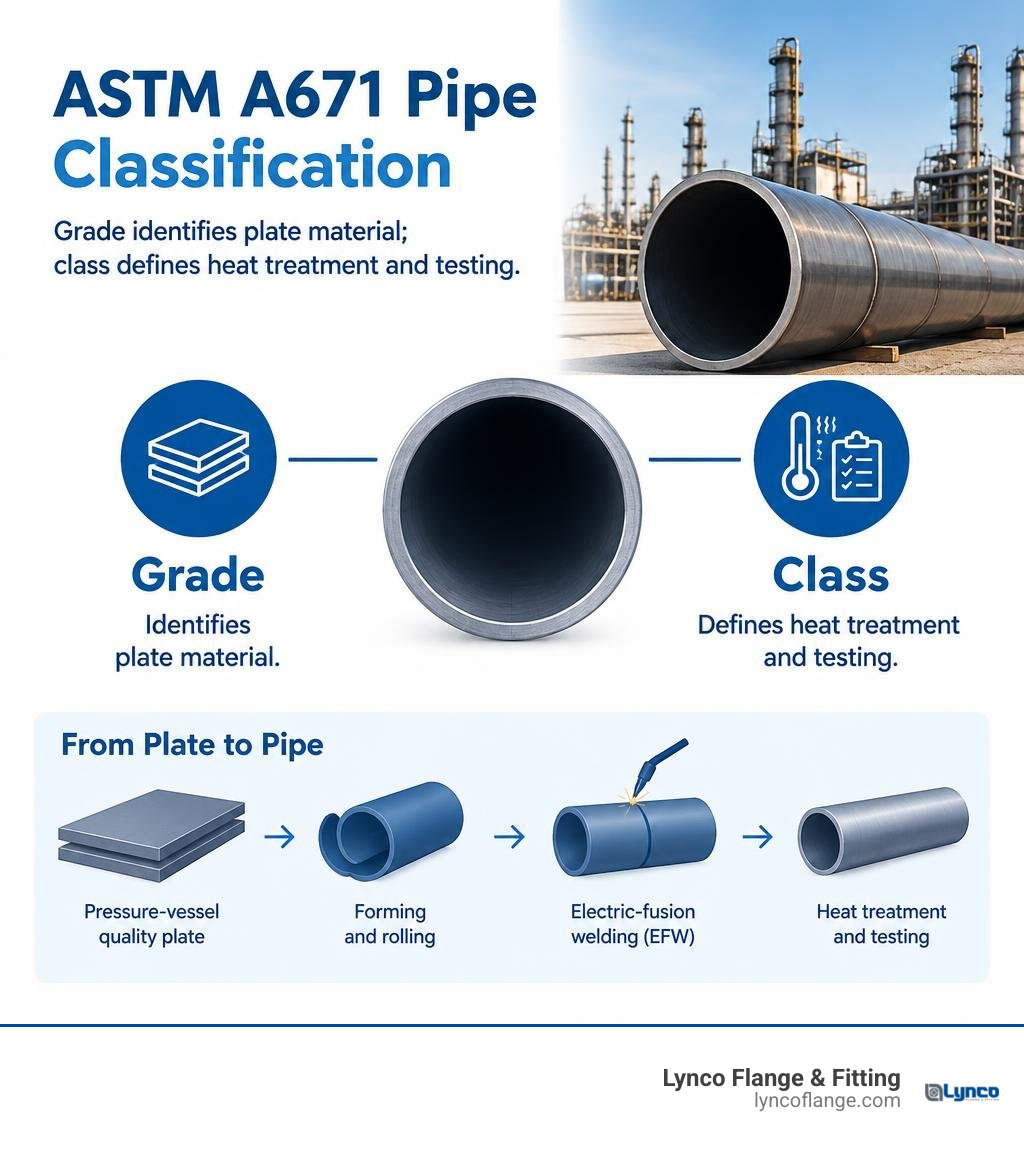
ASTM A671 pipe is electric-fusion-welded steel pipe made from pressure-vessel-quality plate for high-pressure service at atmospheric and lower temperatures. For refinery buyers, the key is to specify both a grade, which identifies the plate material, and a class, which sets the heat treatment and inspection requirements. The specification nominally covers pipe at least 16 inches in outside diameter with walls at least 1/4 inch thick.
Those details matter when a line must handle pressure and low operating temperatures. This guide explains how to read the grade and class designations, check testing requirements, and place a clear order.
I’m Lance Vanover, CEO of Lynco Flange & Fitting. My 26 years in industrial piping operations shape how I explain ASTM A671 pipe specifications to procurement teams.
What Is ASTM A671 Pipe and How Is It Manufactured?
ASTM A671 covers electric-fusion-welded (EFW) steel pipe fabricated with the addition of filler metal. It is designed specifically for high-pressure process lines operating at atmospheric and lower (sub-ambient or cryogenic) temperatures.

Unlike standard continuous-weld or seamless pipe, ASTM A671 starts with flat rolled, pressure-vessel-quality steel plate. This raw material must conform to strict chemical and mechanical specifications before forming begins.
- Plate Preparation: Pressure-vessel-quality steel plate is cut, edge-planed, and beveled to create a precise joint geometry.
- Forming: Heavy-duty roll-bending machines or brake presses cold-form or hot-form the plate into a cylindrical shell.
- Electric-Fusion Welding (EFW): The longitudinal seam is welded using automated submerged arc welding (SAW) or shielded arc processes. Welds are typically double-welded (from both inside and outside) to achieve complete penetration and uniform fusion across the joint.
- Post-Weld Heat Treatment (PWHT): Depending on the class specified, the welded cylinder undergoes stress relief, normalizing, quenching, or tempering.
- Sizing and Calibration: Mechanical expansion or roll calibration brings the pipe to its finished roundness and diameter.
- Testing and Finishing: The completed cylinder undergoes non-destructive examination (NDE), hydrostatic testing, and end preparation (beveling or squaring).
ASTM A671 relies on the A530/A530M general requirements standard for testing protocols, inspection methods, and standard definitions. When you source specialized industrial pipe products, understanding these manufacturing checkpoints ensures the finished material withstands high internal pressures and severe operating cycles.
Dimensional Tolerances and Specifications for ASTM A671 Pipe
The standard nominally addresses heavy-wall pipe with an outside diameter (OD) of 16 inches (400 mm) or larger and a nominal wall thickness of 1/4 inch (6 mm) or greater. Pipe having other dimensions may be furnished provided it complies with all other requirements of the specification.
ASTM A671 is maintained by ASTM Committee A01 on Steel, Stainless Steel, and Related Alloys, under the direct stewardship of Subcommittee A01.09 on Carbon Steel Tubular Products. The standard establishes clear dimensional allowances:
- Outside Diameter Variation: The permissible variation in outside diameter is plus or minus 0.5% of the specified OD, determined by circumferential measurement (tape reading).
- Out-of-Roundness: The difference between the major and minor outside diameters must not exceed 1% of the nominal OD.
- Wall Thickness Limits: The minimum wall thickness at any point across the cylinder must not be more than 0.01 inches (0.3 mm) under the specified nominal wall thickness.
Maintaining these tight tolerances is vital for downstream fabrication, bevel alignment, and field welding. For engineers balancing alloy performance and cost, exploring the whats, whys, and hows of carbon steel provides valuable context on how plate chemistry impacts structural integrity under pressure.
Understanding ASTM A671 Grades vs. Classes: The Complete Matrix
A common source of confusion in procurement is the distinction between an ASTM A671 grade and an ASTM A671 class.
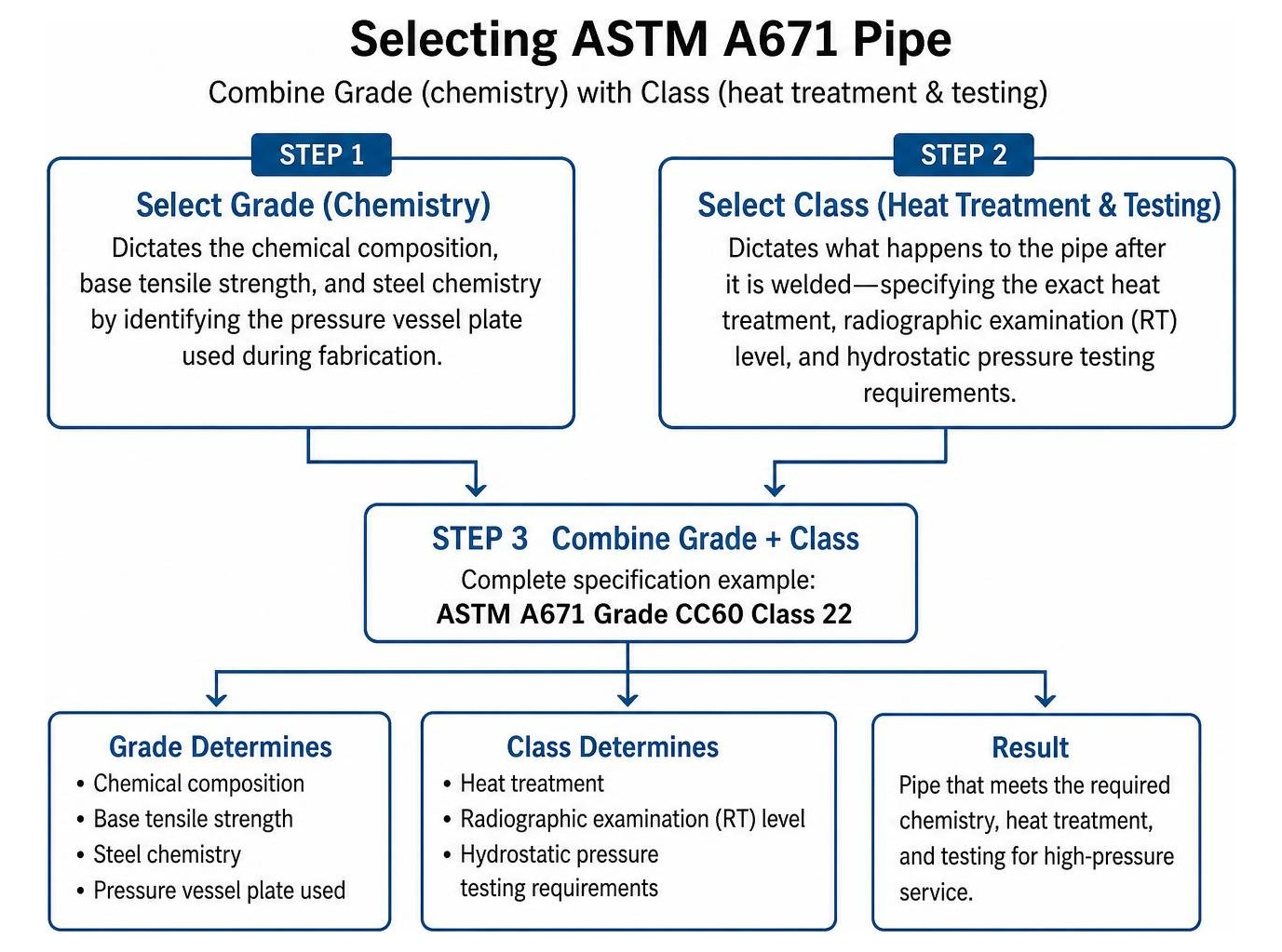
- Grade: Dictates the chemical composition, base tensile strength, and steel chemistry by identifying the pressure vessel plate used during fabrication.
- Class: Dictates what happens to the pipe after it is welded—specifying the exact heat treatment, radiographic examination (RT) level, and hydrostatic pressure testing requirements.
To specify a pipe completely, you must combine both callouts (such as ASTM A671 Grade CC60 Class 22).
Pressure Vessel Plate Grades: CC60, CC65, CC70, and Alloy Steels
The specification defines 23 distinct grades. These range from moderate-strength plain carbon steels to nickel-alloy plates designed for deep cryogenic service:
| Pipe Grade | Base Plate Specification | Material Type / Chemistry | Minimum Tensile Strength (ksi) | Minimum Yield Strength (ksi) |
|---|---|---|---|---|
| CA 55 | ASTM A285 Grade C | Plain Carbon Steel | 55 | 30 |
| CB 60 | ASTM A515 Grade 60 | Carbon-Silicon (Coarse Grain) | 60 | 32 |
| CB 65 | ASTM A515 Grade 65 | Carbon-Silicon (Coarse Grain) | 65 | 35 |
| CB 70 | ASTM A515 Grade 70 | Carbon-Silicon (Coarse Grain) | 70 | 38 |
| CC 60 | ASTM A516 Grade 60 | Carbon Steel (Fine Grain, Killed) | 60 | 32 |
| CC 65 | ASTM A516 Grade 65 | Carbon Steel (Fine Grain, Killed) | 65 | 35 |
| CC 70 | ASTM A516 Grade 70 | Carbon Steel (Fine Grain, Killed) | 70 | 38 |
| CD 70 | ASTM A537 Class 1 | Carbon-Manganese-Silicon | 70 | 50 |
| CD 80 | ASTM A537 Class 2 | Carbon-Manganese-Silicon (Q&T) | 80 | 60 |
| CFA 65 | ASTM A203 Grade A | Low Alloy (Nickel Steel) | 65 | 37 |
| CG 100 | ASTM A353 / A553 | 9% Nickel Alloy Steel | 100 | 75 |
The CC grades (CC60, CC65, CC70), fabricated from ASTM A516 fine-grain killed carbon steel, are the most common in refinery processes. They offer an ideal balance of notch toughness, weldability, and yield strength at atmospheric and moderately cold operating temperatures.
Heat Treatment and Inspection Matrix Across ASTM A671 Pipe Classes
ASTM A671 establishes 24 distinct classes organized by a two-digit numbering scheme.
The first digit (tens place) specifies the heat treatment type, while the second digit (units place) dictates the radiographic examination and pressure testing requirements:
- Class 10–13: Pipe is furnished without post-weld heat treatment.
- Class 20–23: Pipe is stress-relieved (PWHT) after welding (held at 1100°F to 1250°F [590°C to 680°C] for a minimum of 1 hour per inch of thickness).
- Class 30–33: Pipe is normalized after welding (heated above transformation range up to 1700°F [925°C] and air-cooled).
- Class 40–43: Pipe is normalized and tempered.
- Class 50–53: Pipe is quenched and tempered (heated, liquid-quenched, and tempered).
- Class 70–73: Pipe is quenched and precipitation-heat-treated.
| Class | Post-Weld Heat Treatment Applied to Pipe | Radiographic Examination of Weld Seam | Hydrostatic Pressure Test Required |
|---|---|---|---|
| Class 10 | None | None | None |
| Class 11 | None | 100% Full Length (Section 9) | None |
| Class 12 | None | 100% Full Length (Section 9) | Yes (per ASTM A530) |
| Class 13 | None | None | Yes (per ASTM A530) |
| Class 20 | Stress Relieved | None | None |
| Class 21 | Stress Relieved | 100% Full Length (Section 9) | None |
| Class 22 | Stress Relieved | 100% Full Length (Section 9) | Yes (per ASTM A530) |
| Class 23 | Stress Relieved | None | Yes (per ASTM A530) |
| Class 30 | Normalized | None | None |
| Class 31 | Normalized | 100% Full Length (Section 9) | None |
| Class 32 | Normalized | 100% Full Length (Section 9) | Yes (per ASTM A530) |
| Class 33 | Normalized | None | Yes (per ASTM A530) |
| Class 40 | Normalized and Tempered | None | None |
| Class 41 | Normalized and Tempered | 100% Full Length (Section 9) | None |
| Class 42 | Normalized and Tempered | 100% Full Length (Section 9) | Yes (per ASTM A530) |
| Class 43 | Normalized and Tempered | None | Yes (per ASTM A530) |
| Class 50 | Quenched and Tempered | None | None |
| Class 51 | Quenched and Tempered | 100% Full Length (Section 9) | None |
| Class 52 | Quenched and Tempered | 100% Full Length (Section 9) | Yes (per ASTM A530) |
| Class 53 | Quenched and Tempered | None | Yes (per ASTM A530) |
| Class 72 | Quenched and Precipitation Treated | 100% Full Length (Section 9) | Yes (per ASTM A530) |
Note: Classes 12, 22, 32, 42, and 52 are the most frequently requested configurations because they include both 100% radiographic examination of the longitudinal weld seam and mandatory hydrostatic pressure testing.
Mechanical Testing, Quality Inspection, and Regulatory Standards
To confirm mechanical integrity under high hoop stresses and low operating temperatures, ASTM A671 enforces rigorous testing protocols on plate materials and finished weld seams.
- Transverse Tension Test: A test specimen is cut perpendicular to the longitudinal weld seam and pulled to destruction. The transverse tensile strength must meet or exceed the minimum specified tensile strength of the base plate material.
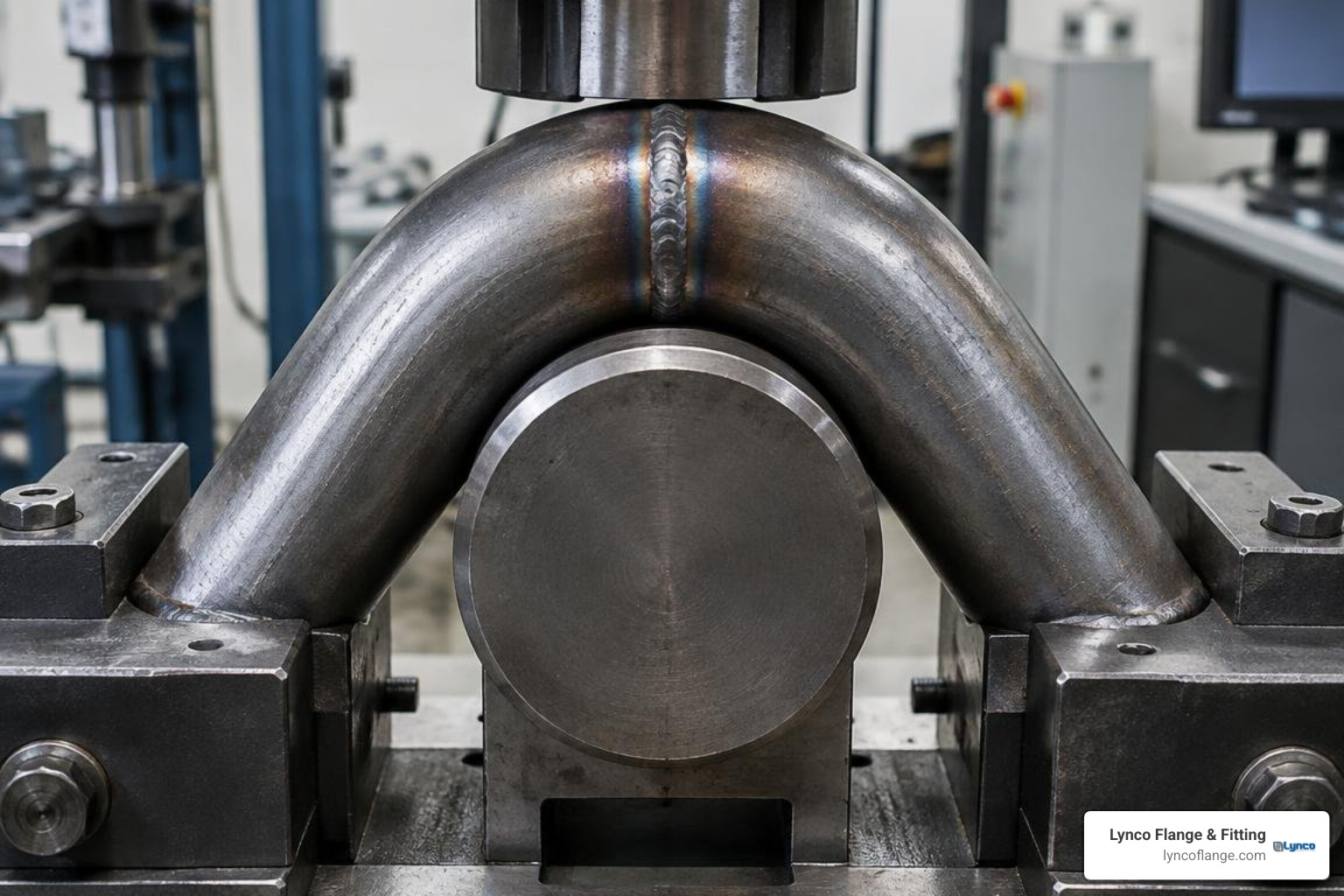
- Transverse Guided Weld Bend Test: Specimens are bent 180 degrees around a standardized die. The weld and heat-affected zone (HAZ) must show no cracks or flaws exceeding 1/8 inch (3.2 mm) along the bend contour.
- Charpy V-Notch Impact Testing: When specified via supplementary requirements, impact tests verify sub-zero notch toughness and resistance to brittle fracture.
- Hardness Testing: Ensures the weld seam and HAZ have not formed brittle martensitic microstructures during rapid cooling.
Reviewing verified material test reports and traceability ensures that chemistry heats, elongation values, and impact test results align with project requirements before material ships to the field.
ASTM A671 is an approved specification under federal pipeline safety regulations governed by the U.S. Department of Transportation. Specifically, DOT PHMSA 49 CFR Part 192 pipeline qualification lists ASTM A671 in Appendix B as a qualifying standard for natural gas transmission lines.
Supplementary Requirements and Non-Destructive Examination
Critical process units frequently mandate supplementary requirements (designated with an “S”) to provide additional quality verification:
- S1. Charpy V-Notch Impact Test: Verifies impact energy absorption at design-specific minimum operating temperatures.
- S2. Heat Treatment Parameters: Outlines custom hold times, cooling mediums, or specific tempering temperatures.
- S3. Magnetic Particle Examination (MT): Inspects external and internal weld surfaces for surface-breaking cracks and discontinuities.
- S4. Liquid Penetrant Examination (PT): Provides dye-penetrant checks on non-magnetic alloy grades or root passes.
- S5. Ultrasonic Testing (UT): Examines base plate edges and weld seams for laminations or volumetric sub-surface defects.
All welding procedures, welders, and welding operators must be qualified in accordance with Section IX of the ASME Boiler and Pressure Vessel Code. When building out complex process lines, pairing your pipe with matching weld fittings for high-pressure systems maintains pressure containment throughout your piping run.
Comparing ASTM A671 vs. ASTM A672 and ASTM A691
Engineers often evaluate three closely related ASTM standards for heavy-wall, electric-fusion-welded pipe:
| Standard | Primary Service Temperature Window | Typical Base Plate Specifications | Typical Applications |
|---|---|---|---|
| ASTM A671 | Atmospheric and Lower Temperatures (Down to Cryogenic) | ASTM A285, A515, A516, A537, A203, A353, A553 | LPG/NGL processing, cold flare headers, cryogenic storage, sub-ambient refinery lines. |
| ASTM A672 | Moderate Temperatures at High Pressures | ASTM A285, A515, A516, A537, A299, A204 | High-pressure boiler feedwater, general hydrocarbon transfer, utility steam. |
| ASTM A691 | High Temperatures at High Pressures (Creep Service) | ASTM A387 (Cr-Mo alloys), A204 (Mo alloy), A542 | Catalytic cracking units, hydrotreaters, high-pressure superheated steam headers. |
While ASTM A671 focuses on low-temperature fracture toughness, ASTM A672 serves moderate temperature needs, and ASTM A691 utilizes chrome-moly alloy steels designed for creep resistance at elevated temperatures (800°F to 1100°F+ [427°C to 593°C+]). Proper carbon steel pipe fitting engineering ensures that components maintain matching pressure-temperature ratings throughout the system.
Critical Industrial Applications and Refinery Use Cases
ASTM A671 pipe is widely used in refineries, petrochemical plants, and marine infrastructure where volatile fluids operate under elevated pressure at atmospheric or refrigerated temperatures.
- Liquefied Petroleum Gas (LPG) & NGL Recovery: Transporting propane, butane, and natural gas liquids where auto-refrigeration during depressurization creates sub-ambient temperatures.
- Cold Flare Headers and Relief Headers: Relief headers experience rapid gas expansion (Joule-Thomson cooling), dropping local metal temperatures below zero. Grades like CC65 or CC70 in Class 22 or 32 resist brittle failure.
- Cryogenic Storage & LNG Transfer: 9% nickel grades (CG 100) provide notch toughness down to -320°F (-196°C) for refrigerated liquefied gas storage and loading lines.
- Crude Distillation & Fractionation Overhead Lines: Heavy-wall A671 piping accommodates large volumetric flow rates and high pressures in overhead condenser loops.
- High-Pressure Gas Utility and Distribution: Gas intake and transmission headers qualified under DOT Part 192 require high mechanical strength combined with full weld radiography.
Frequently Asked Questions About ASTM A671 Pipe
What is the primary difference between ASTM A671 and ASTM A672 pipe?
The fundamental difference lies in their design temperature focus and base plate material testing. ASTM A671 is designed for high-pressure service at atmospheric and lower temperatures, requiring plate grades (such as ASTM A516) capable of passing low-temperature impact tests. ASTM A672 is intended for high-pressure service at moderate temperatures and commonly utilizes plate chemistries optimized for ambient-to-intermediate duty.
How do class numbers indicate heat treatment and testing in ASTM A671?
Class numbers use a structured two-digit system:
- The tens digit indicates the heat treatment applied to the pipe after welding (e.g., 1 = none, 2 = stress relieved, 3 = normalized, 4 = normalized and tempered, 5 = quenched and tempered).
- The units digit specifies the inspection level (e.g., 0 = no RT/hydro, 1 = 100% RT without hydro, 2 = 100% RT with mandatory hydro, 3 = hydro without RT).
What information is required when ordering ASTM A671 pipe?
A complete procurement order should include:
- Total quantity (feet, meters, or number of lengths)
- Material specification (ASTM A671 or ASTM A671M for metric units)
- Pipe Grade (e.g., CC60, CC65, CC70)
- Pipe Class (e.g., Class 12, Class 22, Class 32)
- Size (nominal outside diameter and nominal wall thickness)
- Length (specific cut lengths or random lengths)
- End finish (beveled for welding or square cut)
- Applicable Supplementary Requirements (e.g., S1 Charpy impact testing at a specified temperature)
Conclusion
Selecting the right pipe for high-pressure, sub-ambient refinery service requires balancing steel plate chemistry, thermal treatment, and non-destructive examination. Specifying ASTM A671 with the correct grade and class ensures your systems operate reliably without risk of brittle fracture or seam failure.
At Lynco Flange & Fitting, our Houston-based engineering sales team provides direct technical consultation, verified quality control, and full material test report traceability across large-diameter and heavy-wall carbon steel products. For more background on material selection across your facility, explore the differences between carbon steel piping and black steel piping or reach out to our team for sizing and specification support.