What ASTM A671 Gr CC60 Means for Your Pipe Order
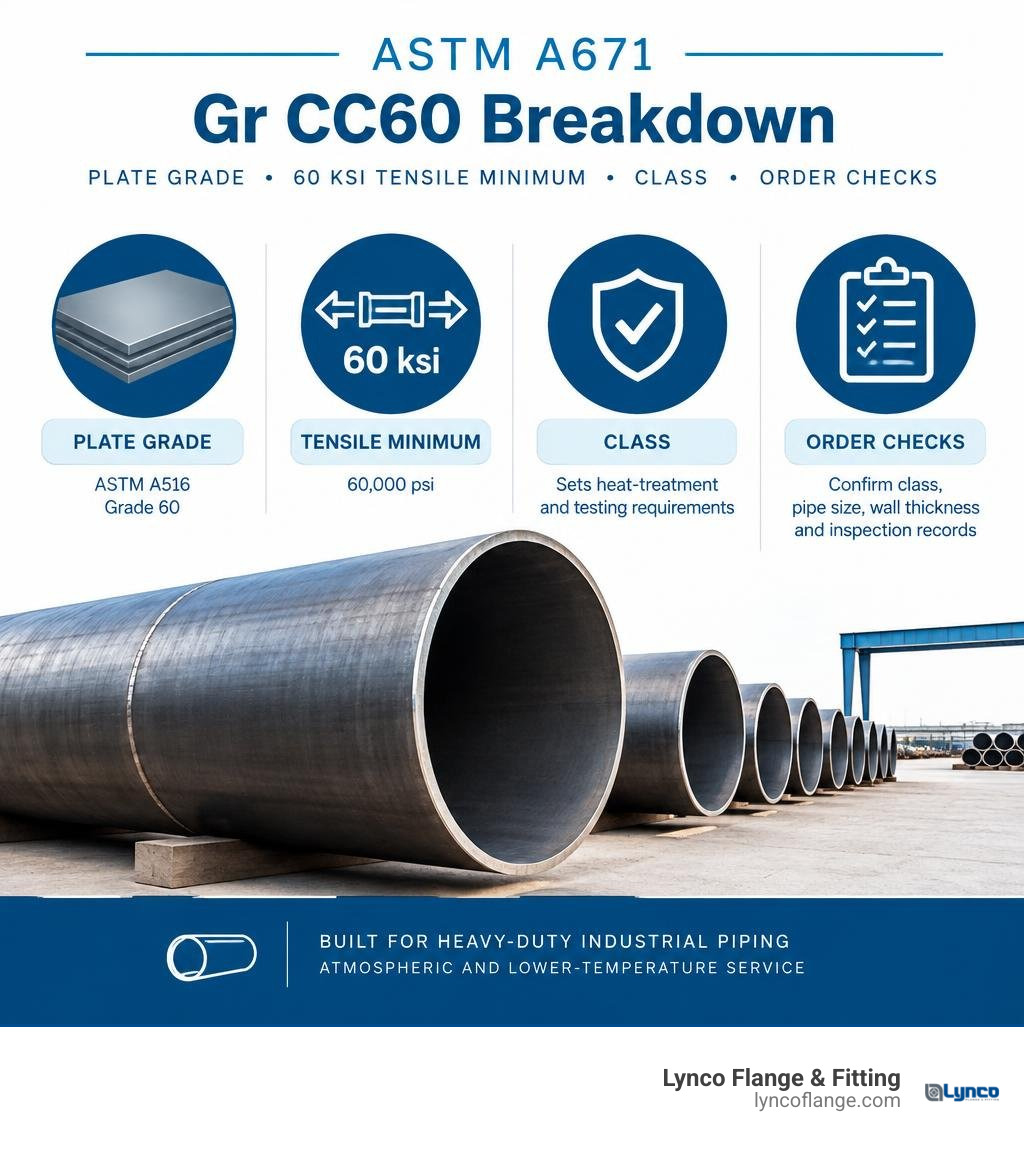
For procurement, astm a671 gr cc60 identifies electric-fusion-welded steel pipe made from ASTM A516 Grade 60 pressure-vessel plate. It is intended for atmospheric and lower-temperature service. The “60” means a minimum tensile strength of 60,000 psi; the pipe’s class separately sets its heat-treatment and testing requirements.
A grade alone is not enough to place an order. Confirm the class, pipe size, wall thickness, and required inspection records before accepting a quote.
I’m Lance Vanover, CEO of Lynco Flange & Fitting. My 26 years in industrial flange and fitting operations inform how I review astm a671 gr cc60 requirements alongside the components and records a piping project needs.
What Is ASTM A671 Gr CC60 EFW Pipe?
When designing heavy-duty industrial piping systems, standard seamless pipe options often max out in both diameter and heavy-wall availability. That is where electric-fusion-welded (EFW) pipe fabricated from pressure-vessel-quality plate comes into play. ASTM A671 covers heavy-wall electric-fusion-welded steel pipe meant specifically for atmospheric and lower-temperature service.
Unlike commodity line pipe produced in rapid, continuous mills, ASTM A671 pipe starts out as high-grade carbon steel plate rolled and welded with strict quality controls. If you are brushing up on the fundamentals of pressure piping design, reviewing a practical guide to piping system basics is a great way to contextualize how large-diameter welded pipe integrates with upstream and downstream equipment.
Understanding the ASTM A671 Gr CC60 Material Designation
The designation breaks down into very specific metallurgical requirements:
- ASTM A671: The overarching standard specification for EFW steel pipe for atmospheric and lower temperatures.
- Grade CC60: Indicates that the pipe is fabricated from ASTM A516/A516M Grade 60 plate. This is a fully killed carbon steel manufactured using fine-grain practice to ensure exceptional notch toughness at lower temperatures.
- “60”: Represents the minimum tensile strength of the base metal—60,000 psi (415 MPa).
Engineers frequently select Grade CC60 over lower-grade carbon steels because its fine-grain structure provides superior resistance against brittle fracture, making it well suited for lower-temperature operations across refineries, chemical facilities, and power plants.
EFW Plate-to-Pipe Manufacturing Process
The manufacturing route of ASTM A671 pipe differs fundamentally from seamless extrusion or continuous electric resistance welding (ERW). ASTM A671 uses plate forming combined with automated fusion welding processes, most commonly double submerged arc welding (DSAW).
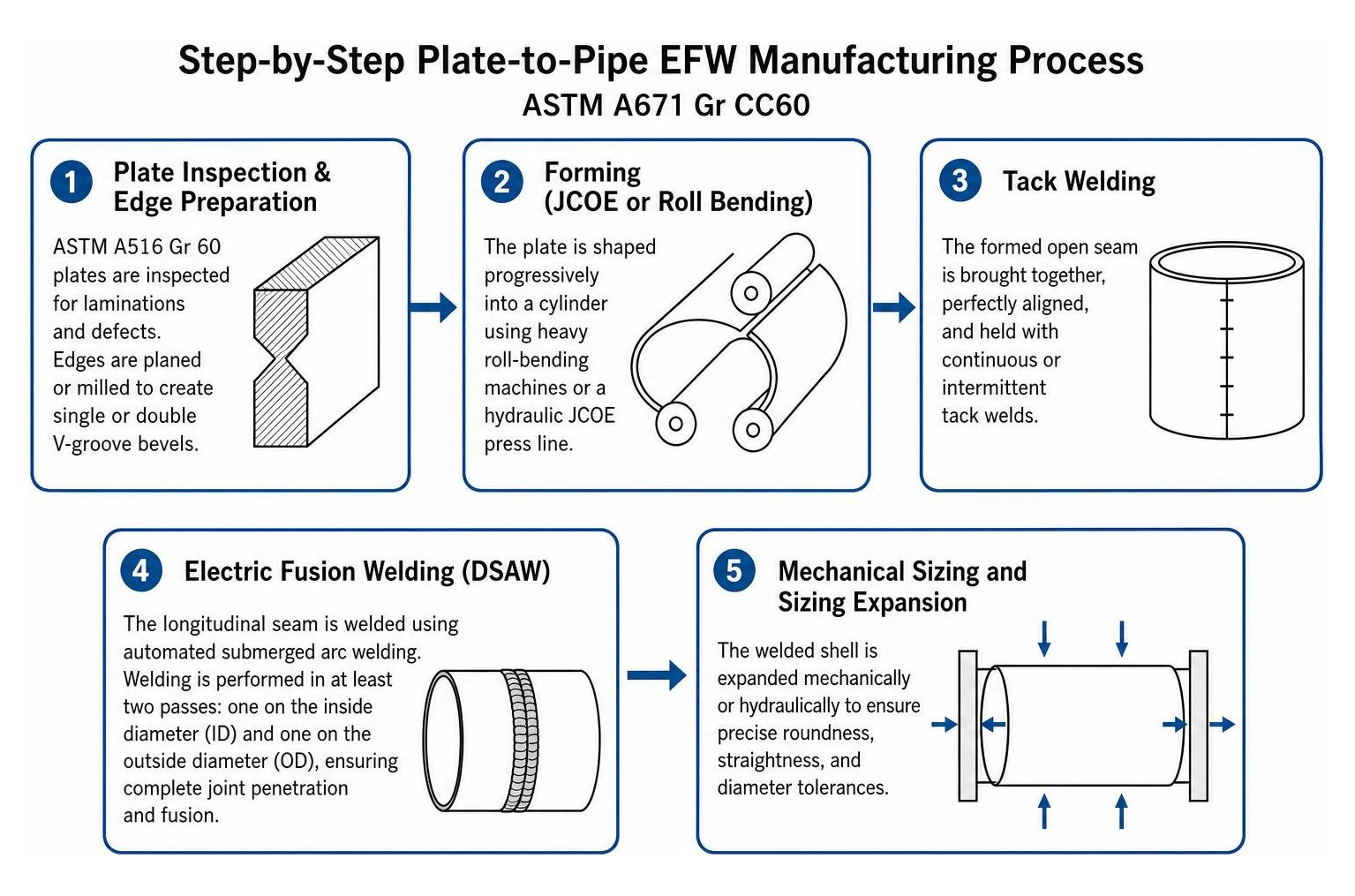
- Plate Inspection & Edge Preparation: Pressure vessel plates meeting ASTM A516 Gr 60 are inspected for laminations and defects. The plate edges are planed or milled to create single or double V-groove bevels.
- Forming (JCOE or Roll Bending): The plate is shaped progressively into a cylinder using heavy roll-bending machines or a hydraulic JCOE (J-ing, C-ing, O-ing, Expanding) press line.
- Tack Welding: The formed open seam is brought together, perfectly aligned, and held with continuous or intermittent tack welds.
- Electric Fusion Welding (DSAW): The longitudinal seam is welded using automated submerged arc welding. Welding is performed in at least two passes: one on the inside diameter (ID) and one on the outside diameter (OD), ensuring complete joint penetration and fusion.
- Mechanical Sizing and Sizing Expansion: The welded shell is expanded mechanically or hydraulically to ensure precise roundness, straightness, and diameter tolerances.
Understanding these forming steps helps explain why matching the right fittings is so critical. For more on how welded geometries influence fitting fabrication, explore a guide to carbon steel pipe fitting design and engineering.
Chemical Composition and Mechanical Properties
The base metal of ASTM A671 Grade CC60 must strictly comply with the chemical and mechanical limits of ASTM A516 Grade 60 plate.

Chemical Composition Limits by Thickness
Carbon content is controlled based on the thickness of the plate to balance strength with weldability. As plate thickness increases, carbon allowances rise slightly to achieve core strength, while manganese adjustments maintain toughness.
| Element | Thickness 1/2 in. [12.5 mm] and under | Thickness over 1/2 in. to 2 in. [12.5 to 50 mm] | Thickness over 2 in. to 4 in. [50 to 100 mm] | Thickness over 4 in. [100 mm] |
|---|---|---|---|---|
| Carbon (C), max % | 0.21 | 0.23 | 0.25 | 0.27 |
| Manganese (Mn) % | 0.55 – 0.98 | 0.79 – 1.30 | 0.79 – 1.30 | 0.79 – 1.30 |
| Phosphorus (P), max % | 0.025 | 0.025 | 0.025 | 0.025 |
| Sulfur (S), max % | 0.025 | 0.025 | 0.025 | 0.025 |
| Silicon (Si) % | 0.13 – 0.45 | 0.13 – 0.45 | 0.13 – 0.45 | 0.13 – 0.45 |
(Note: For thicknesses 1/2 in. and under, the manganese maximum can be increased up to 1.30% to compensate for reductions in carbon content).
Keeping sulfur and phosphorus below 0.025% prevents hot cracking during welding and avoids low-temperature embrittlement. To see how these elements influence performance across industrial grades, take a look at the whats whys and hows of carbon steel.
Mechanical Strength and Testing Standards
Grade CC60 provides dependable ductility alongside moderate tensile strength. For full compliance with the ASTM A671 EFW welded steel pipe specification, base metal and weld seam specimens undergo standardized physical testing:
- Tensile Strength: 60,000 to 80,000 psi [415 to 550 MPa]
- Yield Strength (minimum): 32,000 psi [220 MPa]
- Elongation in 8 in. [200 mm] (minimum): 21%
- Elongation in 2 in. [50 mm] (minimum): 25%
Testing requirements include transverse guided weld bend tests to verify seam ductility, Charpy V-Notch impact testing to confirm low-temperature fracture resistance, and hardness surveys across the weld metal, heat-affected zone (HAZ), and parent plate.
ASTM A671 Heat Treatment Classes and Quality Assurance
A major point of confusion for buyers is the difference between Grade and Class. In ASTM A671, the Grade defines the plate chemistry and mechanical strength, while the Class defines the thermal processing (heat treatment), non-destructive testing (NDT), and pressure testing applied to the pipe.
ASTM A671 Gr CC60 Class 12, 22, and 32 Requirements
ASTM A671 encompasses numerous class designations (Classes 10 through 73). For Grade CC60, Classes 12, 22, and 32 are the most commonly specified:
| Pipe Class | Heat Treatment Requirement | Radiographic Examination | Hydrostatic Test |
|---|---|---|---|
| Class 12 | None (Pipe supplied in as-welded condition from as-rolled plate) | 100% Radiography of weld seam | Mandatory per ASTM A530/A530M |
| Class 22 | Post-Weld Heat Treatment (Stress relief at 1100–1200 °F [590–650 °C]) | 100% Radiography of weld seam | Mandatory per ASTM A530/A530M |
| Class 32 | Normalized (Heated to max 1700 °F [925 °C] followed by still air cooling) | 100% Radiography of weld seam | Mandatory per ASTM A530/A530M |
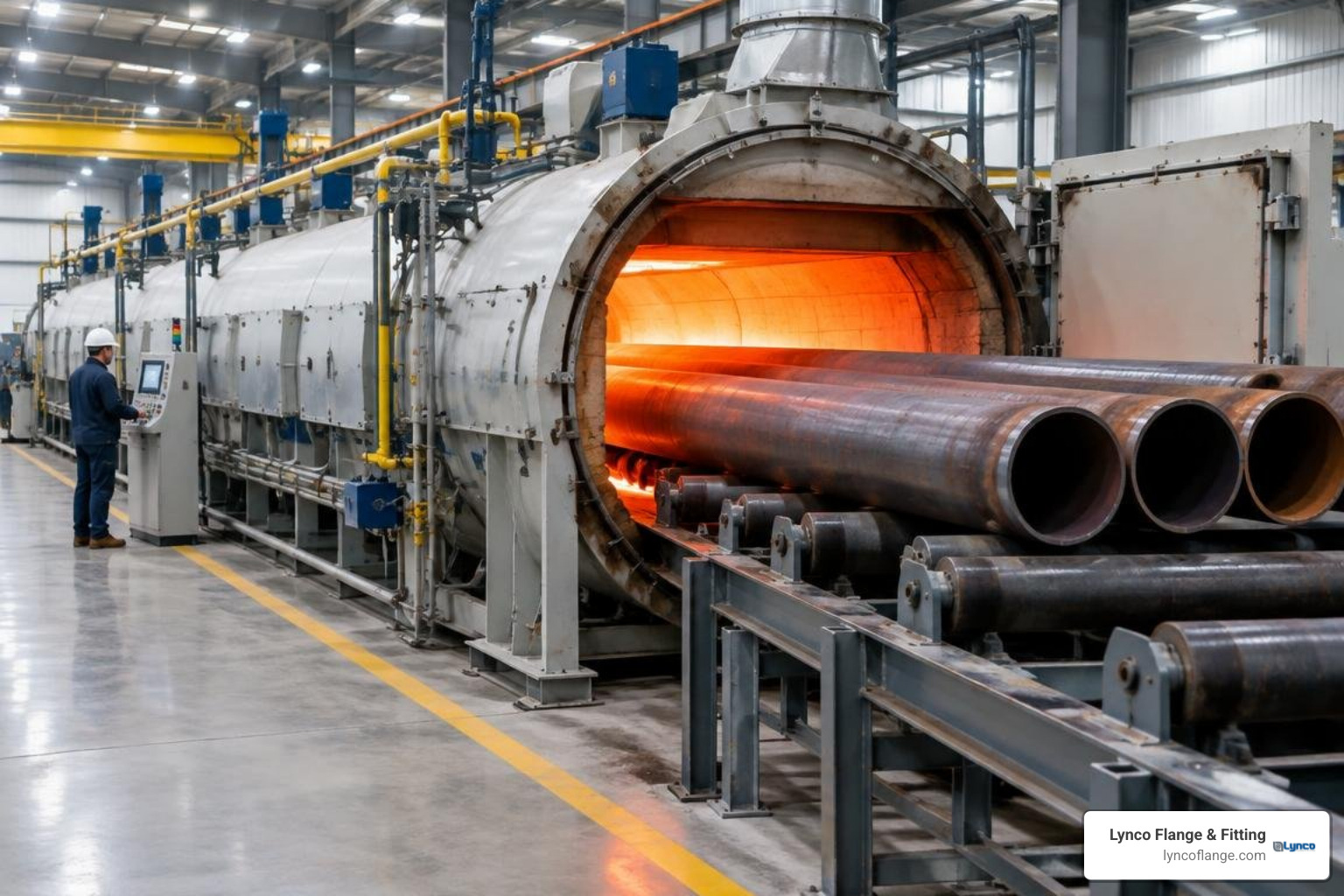
- Stress Relief (Class 22): The welded pipe is heated to 1100–1200 °F [590–650 °C], held for a minimum of 1 hour per inch of thickness, and cooled slowly. This eliminates residual stresses created during forming and welding.
- Normalizing (Class 32): The entire pipe is brought above its upper critical temperature (up to 1700 °F [925 °C]) to refine the grain structure throughout both the parent plate and weld seam.
- Quench and Temper (Classes 42/52): Heated to a minimum of 1700 °F [925 °C], water-quenched, and tempered at a minimum of 1100 °F [590 °C].
Selecting the right heat treatment class helps prevent stress-corrosion cracking and ensures consistent hardness across welded joints. When assembling these systems, you can discover more about what are the advantages of carbon steel pipe fittings when paired with properly stress-relieved pipe spools.
Radiographic, Hydrostatic, and Non-Destructive Testing
Quality assurance under ASTM A671 ensures that welded seams match the structural integrity of the surrounding plate:
- Radiographic Examination (RT): For classes requiring radiography (such as Class 12, 22, 32), the entire length of 100% of the longitudinal weld seam undergoes X-ray or gamma-ray inspection per ASME Boiler and Pressure Vessel Code, Section VIII, Paragraph UW-51.
- Hydrostatic Testing: Pipes are hydrostatically pressure tested according to ASTM A530/A530M to verify leak-tightness and structural hoop strength under pressure.
- Ultrasonic Testing (UT): Often requested as a supplementary requirement (S3 or S4) to check plate laminations near beveled weld preps.
Comparison: ASTM A671 vs. ASTM A672, ASTM A333, and CC65/CC70
Engineers often evaluate multiple piping standards for energy and petrochemical facilities. Knowing when to specify ASTM A671 over alternatives prevents costly material substitutions and code non-compliance.
ASTM A671 vs ASTM A672 vs ASTM A333
| Parameter | ASTM A671 | ASTM A672 | ASTM A333 |
|---|---|---|---|
| Primary Service | Atmospheric & Lower Temperatures | Moderate Temperatures & High Pressures | Low-Temperature Refrigeration & Cryogenics |
| Manufacturing | EFW Welded from Plate | EFW Welded from Plate | Seamless or Welded Pipe |
| Size Range | NPS 16 to NPS 150 (DN 400 to 3800) | NPS 16 to NPS 150 (DN 400 to 3800) | NPS 1/8 to NPS 36 (DN 6 to 900) |
| Typical Base Plate | ASTM A516 (Fine-grain killed) | ASTM A515 (Coarse-grain) or A516 | Standardized bar/billet formulations |
| Impact Testing | Standard at lower temperatures | Typically optional | Mandatory Charpy V-notch down to -50 °F (-45 °C) or lower |
- ASTM A671 vs. ASTM A672: Both use EFW plate fabrication. However, A671 is engineered for lower-temperature duty using fine-grain killed plates (A516), whereas A672 is intended for moderate-temperature high-pressure steam and process lines, often utilizing coarse-grain plates (like A515).
- ASTM A671 vs. ASTM A333: ASTM A333 (such as Grade 6) is predominantly supplied as seamless pipe for smaller to mid-range sizes (NPS 1/2 to 24). When your process piping demands diameters above NPS 16 or NPS 24 with heavy walls at lower temperatures, ASTM A671 becomes the standard choice.
When connecting these distinct pipe grades to valves and vessels, understanding flange standards explained ANSI ASME and more ensures your flanges, gaskets, and bolting match the pressure-temperature ratings of the piping spec.
Comparing Grade CC60 with Grades CC65 and CC70
Within the ASTM A671 CC family, grades are derived from different plates under ASTM A516:
- Grade CC60 (A516 Gr 60): Min Tensile 60 ksi (415 MPa), Min Yield 32 ksi (220 MPa). Offers the lowest carbon equivalent, providing superior weldability and the highest relative toughness at sub-zero temperatures.
- Grade CC65 (A516 Gr 65): Min Tensile 65 ksi (450 MPa), Min Yield 35 ksi (240 MPa). An intermediate balance of tensile capability and impact toughness.
- Grade CC70 (A516 Gr 70): Min Tensile 70 ksi (485 MPa), Min Yield 38 ksi (260 MPa). Offers higher pressure containment with thinner wall requirements, but requires tighter pre-heat control during field welding due to higher carbon content.
For specific design projects where maximum low-temperature ductility outweighs absolute yield strength, CC60 remains the conservative engineering standard.
Dimensional Tolerances, Applications, and Procurement Specifications
ASTM A671 covers large-diameter, heavy-wall pipe with dimensions beginning at NPS 16 (DN 400) and extending past NPS 150 (DN 3800), with wall thicknesses from 1/4 in. [6 mm] up to 3 in. [75 mm] and beyond.
Standard Dimensional and Out-of-Roundness Tolerances
- Outside Diameter (OD): Shall not vary more than ±0.5% of the nominal outside diameter, based on circumferential measurement.
- Out-of-Roundness (Ovality): The difference between major and minor outside diameters must not exceed 1% of the nominal OD.
- Wall Thickness: The minimum wall thickness at any point must not be more than 0.01 in. [0.3 mm] under the specified nominal wall thickness.
- Seam Alignment: Radial offset of plate edges along the weld seam must not exceed 1/8 in. [3.2 mm] for thick-wall sections.
Accurate pipe sizing and roundness are essential when fitting up custom flanges in the field. To see how dimensional tolerances affect joint fit-up, see our guide on understanding the crucial purpose of pipe flanges.
Primary Industrial Applications and Ordering Requirements
ASTM A671 Grade CC60 pipe is widely used in:
- Oil & Gas Refining: Low-temperature gas separation units, atmospheric headers, and flare lines.
- Petrochemical Plants: Olefins and polymer processing units operating under moderate cyclic pressures.
- Power Generation: Cooling water intake, low-pressure steam extraction, and balance-of-plant piping.
- Offshore & Marine: Large-diameter structural headers and utility water transport.
Procurement Checklist
To prevent project delays and ensure quality compliance, always include the following parameters when issuing a Material Take-Off (MTO):
- Standard and Grade: e.g., ASTM A671 Grade CC60.
- Class Designation: e.g., Class 22 (identifying PWHT, 100% RT, and hydrotesting).
- Dimensions: Exact Outside Diameter (OD) and Nominal Wall Thickness (WT) or Schedule.
- Length Requirements: Single random, double random, or custom cut-lengths (e.g., 40 ft / 12 m).
- Supplementary Testing Requirements: Charpy V-Notch test temperatures, transverse weld hardness limits (e.g., NACE MR0175/ISO 15156 compliance if sour service applies).
- Certification: EN 10204 Type 3.1 Material Test Report (MTR) with plate heat numbers, chemical analysis, heat treatment charts, and NDT reports.
For a full reference on pairing your pipe orders with matching butt weld or forged fittings, consult your complete guide to steel fittings.
Frequently Asked Questions About ASTM A671
What is the primary difference between ASTM A671 and ASTM A672?
ASTM A671 is designed for atmospheric and lower-temperature service and uses fine-grain killed carbon steel plate (such as ASTM A516). ASTM A672 is designed for moderate-temperature, high-pressure service and frequently uses coarse-grain steel plates (such as ASTM A515).
Why is Class 22 commonly specified for Grade CC60 piping?
Class 22 requires both post-weld heat treatment (stress relief at 1100–1200 °F) and 100% radiographic examination of the longitudinal weld seam. This combination relaxes residual welding stresses and proves joint integrity, making it well suited for high-integrity pressure service.
Can ASTM A671 CC60 pipe be used in low-temperature service?
Yes. Because Grade CC60 is manufactured from ASTM A516 Grade 60 fine-grain killed plate, it possesses high notch toughness. When specified with supplementary Charpy impact testing (such as Supplementary Requirement S2), it performs reliably down to sub-zero temperatures.
Conclusion
ASTM A671 Grade CC60 is a reliable solution when your piping specifications call for large-diameter, heavy-wall pressure piping in atmospheric or lower-temperature environments. By specifying the correct class—such as Class 22 for full stress relief and 100% X-ray inspection—you ensure the structural and pressure integrity of your system’s most critical headers.
At Lynco Flange & Fitting, based in Houston, Texas, our engineering-focused sales team helps project managers and piping engineers select, specify, and source compliant industrial flanges, fittings, and piping products. Whether you are reviewing an MTO for an oil and gas refinery or verifying material compatibility, we provide direct technical guidance and ISO-compliant quality control.
If you are expanding your knowledge on material selection across different carbon grades, be sure to read our breakdown on the differences between carbon steel and black steel piping. Contact our team today for dedicated assistance with your next major capital project.