Why Choose a Copper Nickel Blind Flange for Seawater Piping?
A copper nickel blind flange is a solid, bolted plate that seals the end of a pipe or closes an opening for maintenance and testing. It is worth considering for seawater systems because copper-nickel alloys resist corrosion and marine fouling. To choose one, match the alloy grade, flange dimensions, pressure class, and gasket face to your piping specification. Common grades are 90/10 (UNS C70600) and 70/30 (UNS C71500).
Those details matter most when a closed line must stay sealed in a marine or offshore setting. I’m Lance Vanover, CEO of Lynco Flange & Fitting. I’ve spent more than 26 years in industrial flange and fitting operations, where choices such as a copper nickel blind flange depend on getting the specification right before ordering.
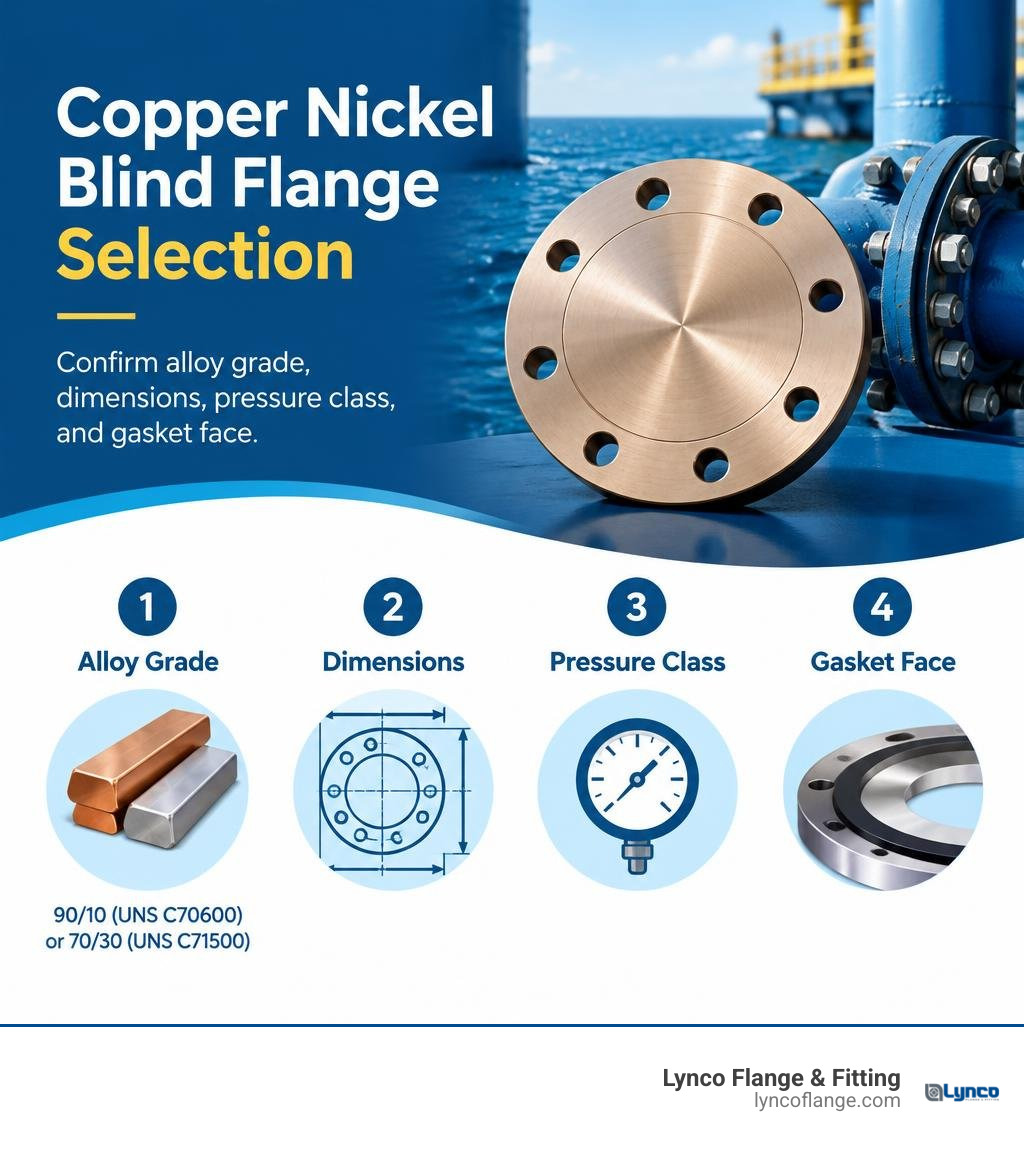
1. What Sets the Copper Nickel Blind Flange Apart from Other Pipe Closures?
Sealing high-pressure marine lines requires closures capable of withstanding constant hydraulic forces and saltwater exposure. Unlike line blanks or welded end caps, a cupro-nickel blind flange provides a heavy-duty, reusable pressure barrier. It contains fluid forces while allowing direct access to the piping interior whenever crews need to flush, inspect, or modify the system.

Understanding the Copper Nickel Blind Flange Function and Design
A blind flange has no center opening or inner bore. Instead, it is machined from a solid forged disk or plate, featuring a perimeter bolt pattern designed to mate with standard flanged connections. Because it lacks a center bore to relieve fluid pressure, it experiences significant mechanical stress, particularly bending and shear loads across its center face.
Engineers frequently use these solid components to blank off pipe ends with blind flanges during system expansions, pressure testing campaigns, or routine maintenance shutdowns. Beyond acting as an end cap, blind flanges can be drilled and tapped with small NPT or SAE threaded ports. These ports allow technicians to install pressure gauges, drain residual seawater before line disassembly, or inject cleaning solutions without unbolting the entire assembly.
Cu-Ni Blind Flanges vs. Standard Flange Configurations
While open-bore flanges facilitate fluid transport across pipeline networks, blind flanges serve as deliberate, heavy-duty dead-ends. Comparing their structural differences highlights how each style handles stress within a piping network.
| Flange Style | Core Function | Internal Bore Geometry | Pressure Handling Location | Typical Application |
|---|---|---|---|---|
| Blind Flange | Terminal isolation & dead-end sealing | None (Solid forged disc) | Entire solid plate center face | Pipe dead-ends, manways, test ports |
| Weld Neck | High-stress fluid conveyance | Full bore matching mating pipe schedule | Stress distributed along tapered hub | Main process lines, high-temperature headers |
| Slip-On | Moderate-stress fluid conveyance | Slightly larger than pipe outer diameter | Fillet welds at hub top and pipe bottom | Low-pressure cooling loops, utility lines |
| Socket Weld | Small-diameter fluid flow | Counter-bored socket for pipe insertion | Fillet weld at external socket shoulder | Instrumentation lines, high-pressure runouts |
To learn more about how different configurations support industrial networks, review our comprehensive catalog of pipe flanges.
2. Key Material Grades and International Engineering Standards
Copper-nickel alloys (often called cupronickel) achieve their mechanical strength and seawater protection through balanced metallurgy. The addition of nickel strengthens the copper matrix, while controlled amounts of iron and manganese form a protective surface film in moving brine.
Cu-Ni 90/10 (UNS C70600) vs. Cu-Ni 70/30 (UNS C71500)
Two primary alloy grades dominate industrial and marine piping systems:
- Cu-Ni 90/10 (UNS C70600 / Werkstoff 2.0872): Composed of roughly 90% copper, 10% nickel, 1.4% iron, and 1.0% manganese. This formulation offers excellent resistance to biofouling and general seawater corrosion at flow velocities up to 10 feet per second (3 meters per second). Its ductility and cost-efficiency make it the standard choice for offshore seawater cooling lines, fire mains, and ballast systems.
- Cu-Ni 70/30 (UNS C71500 / Werkstoff 2.0882): Formulated with 70% copper, 30% nickel, 0.7% iron, and 1.0% manganese. The higher nickel content provides greater yield strength and superior resistance to impingement attack and erosion corrosion at higher velocities (up to 15 feet per second). It is widely used in submarine piping, naval combatant vessels, and high-temperature chemical environments.
For deeper insights into matching metallurgy with severe operating conditions, check our guide on corrosion-resistant alloy options.
ASME, DIN, and EN Manufacturing Specifications
To ensure interchangeability across global systems, cupro-nickel blind flanges are manufactured in strict compliance with international dimensional and metallurgical standards:
- ASTM / ASME SB 151 & SB 152: Dictates the chemical and mechanical standards for copper-nickel alloy rod, bar, plate, and forged blanks.
- ASME B16.5 & ASME B16.47: Standardizes dimensions, bolt hole patterns, tolerances, and pressure-temperature ratings for sizes from 1/2 inch to 24 inch NPS (B16.5) and 26 inch to 48 inch NPS (B16.47).
- EN 1092-1 / DIN 2.0872 / DIN 2.0882: Covers European metric pressure ratings (PN6 through PN64) with standard metric bolt patterns.
- ISO 7005-1 & BS Specifications: Governs international maritime and British standard flange configurations, ensuring worldwide field compatibility.
3. Marine, Offshore, and Industrial Performance Advantages
Saltwater creates an aggressive environment for industrial piping. Marine equipment faces continuous electrochemical attack and organic fouling from marine organisms such as barnacles, mussels, and tube worms.
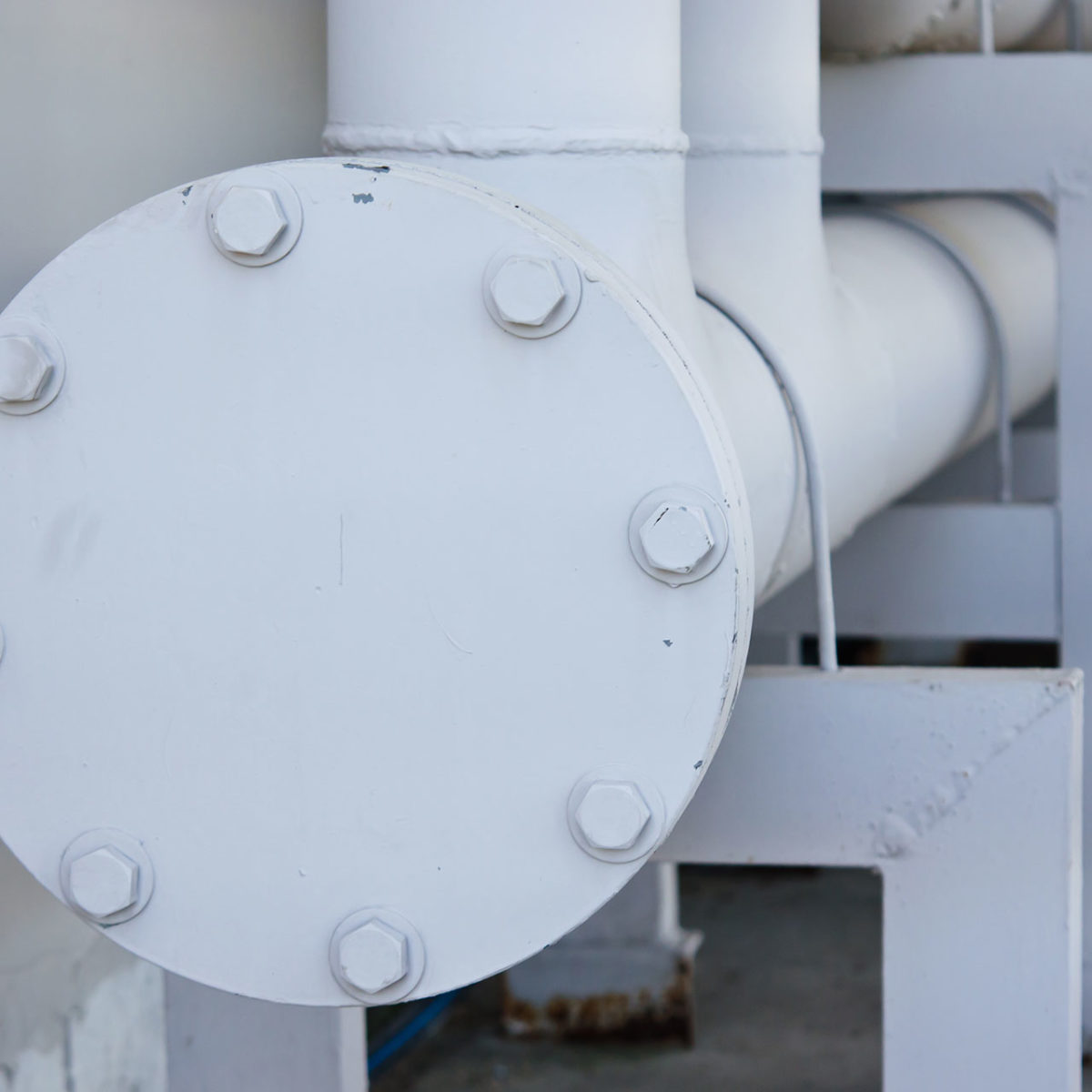
Evaluating Copper Nickel Blind Flange Durability in Harsh Seawater
Copper-nickel blind flanges resist these environmental challenges through a natural electrochemical process. When exposed to clean, aerated seawater, the alloy forms a thin, protective surface film composed primarily of cuprous oxide. This oxide layer slows general corrosion rates down to less than 0.001 inches (0.025 mm) per year.
At the same time, the surface releases a controlled level of copper ions. This natural biofouling resistance prevents macro-algae and shell growth from anchoring to the flange face and gasket seating surface. Consequently, pipe technicians avoid having to scrape calcified organisms off sealing faces during system maintenance.
For critical seawater terminations and maintenance dead-ends, installing an engineered blind flange ensures consistent joint tightness without unexpected degradation.
Material Comparison: Cu-Ni vs. Stainless Steel and Carbon Steel
Choosing the wrong alloy for saltwater applications can lead to rapid component failure. Here is how copper-nickel compares to other common industrial alloys:
| Material Grade | Crevice Corrosion in Stagnant Seawater | Natural Macrofouling Resistance | Risk of Chloride SCC | Typical Marine Service Life |
|---|---|---|---|---|
| Cu-Ni 90/10 | Exceptional (Immune to chloride crevice attack) | High (Continuous natural ion release) | None (Immune to chloride SCC) | 20 to 30+ Years |
| Cu-Ni 70/30 | Exceptional (Resists high-velocity erosion) | High (Prevents calcified marine growth) | None (Immune to chloride SCC) | 25 to 35+ Years |
| 316L Stainless | Poor (High susceptibility under stagnant gaskets) | None (Requires biocides or mechanical scraping) | Moderate at temperatures above 140°F (60°C) | 3 to 7 Years (Uncoated) |
| Carbon Steel | Rapid general wall loss (Requires thick coatings) | None (Fouls rapidly in open seawater) | None (Fails via uniform corrosion first) | 1 to 4 Years (In raw seawater) |
| Duplex 2205 | Very Good (High PREN rating) | Low (Subject to organic biofouling) | Low | 15 to 25 Years |
For an in-depth breakdown of alternative alloys and their structural trade-offs, explore our article on alloy options for harsh environments.
4. Dimensional Ranges, Pressure Ratings, and Testing Protocols
Cupro-nickel blind flanges must handle severe pressure spikes and thermal cycling across diverse operational environments.
Pressure Classes and Size Availability (1/2″ to 48″)
Standard sizing ranges from 1/2 inch to 48 inch nominal bore (15 NB to 1200 NB), accommodating small instrumentation ports up to massive municipal intake headers. Pressure ratings follow ASME and European standards:
- ASME Ratings: Class 150, Class 300, Class 600, Class 900, Class 1500, and Class 2500 LBS.
- European Metric Ratings: PN6, PN10, PN16, PN25, PN40, and PN64.
Solid blind flanges are significantly thicker than standard pipe wall schedules to manage hydrostatic thrust forces acting against the solid disk.
Quality Verification and Material Testing
To confirm structural integrity before delivery, forgings undergo rigorous non-destructive evaluation (NDE) and material testing protocols:
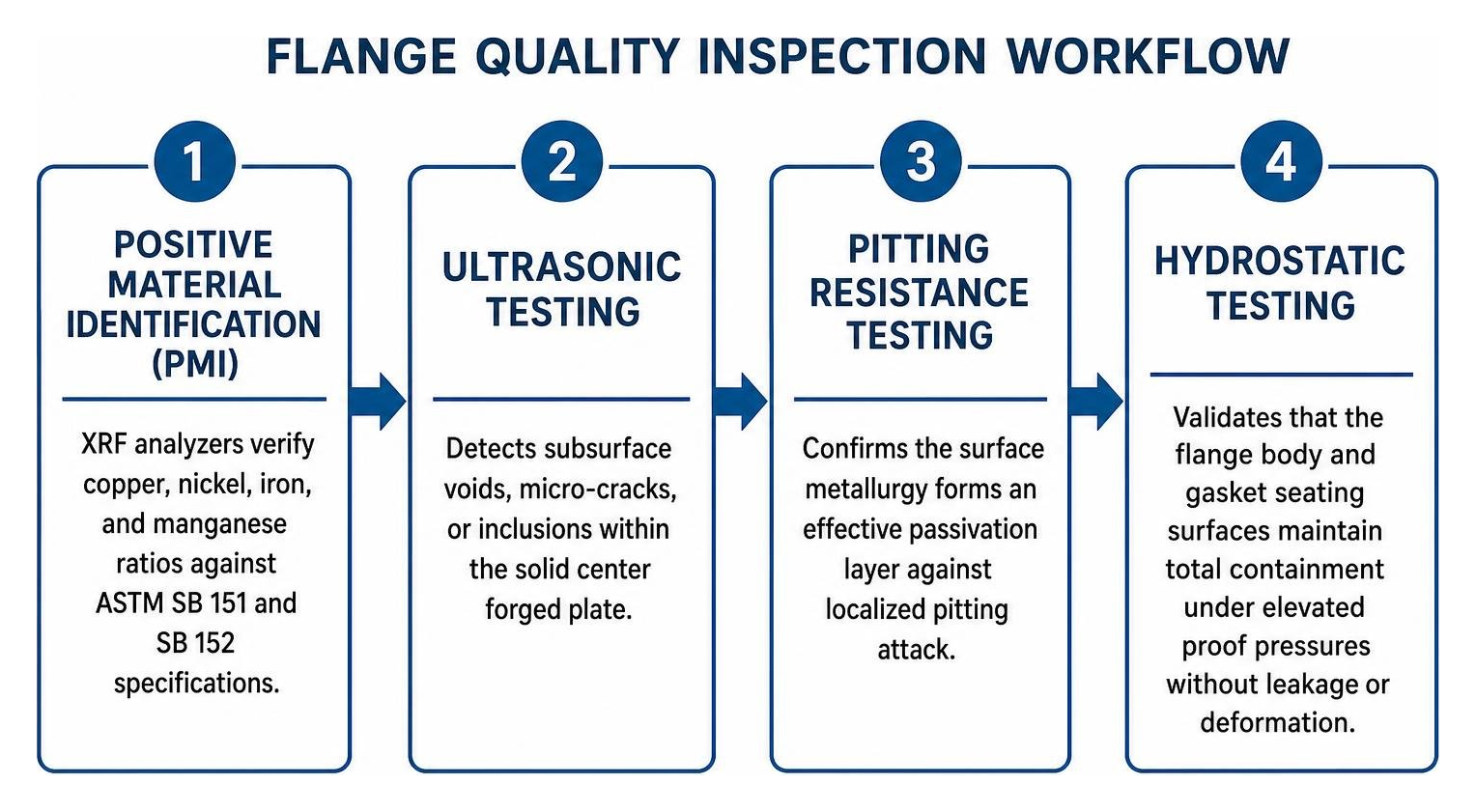
- Positive Material Identification (PMI): High-resolution X-ray fluorescence (XRF) analyzers verify the precise copper, nickel, iron, and manganese ratios against ASTM SB 151 and SB 152 specifications.
- Ultrasonic & Eddy Current Testing: Detects subsurface voids, micro-cracks, or inclusions within the solid center forged plate.
- Pitting Resistance Testing: Confirms the surface metallurgy forms an effective passivation layer against localized pitting attack.
- Hydrostatic Testing: Validates that the flange body and gasket seating surfaces maintain total containment under elevated proof pressures without leakage or deformation.
5. Selection, Installation, and Maintenance Best Practices
Reliable long-term performance requires proper field assembly and joint make-up protocols.
Gasket Selection and Bolt Torque Protocol
Sealing a copper-nickel blind flange requires selecting compatible gaskets and fasteners to avoid joint failure:
- Gasket Selection: Use full-face or ring gaskets made from EPDM, Neoprene, or PTFE (Teflon). For higher-pressure Class 600+ assemblies, use spiral wound gaskets with PTFE fillers and alloy inner/outer retaining rings.
- Fasteners: Standardize on Monel (Alloy 400), silicon bronze, or high-tensile stainless steel fasteners paired with non-conductive insulating sleeve and washer kits. This prevents galvanic corrosion between dissimilar metals.
- Torque Sequences: Tighten bolts in an alternating cross-pattern (star sequence) across multiple passes (30%, 60%, and 100% of final torque) to compress the gasket evenly and prevent flange face distortion.
Cost Factors and Long-Term Lifecycle Economics
While copper-nickel blind flanges carry higher initial raw material costs than standard carbon steel or 304/316 stainless steel alternatives, their lifecycle economics are highly favorable in seawater systems.
Unprotected carbon steel or 316L stainless steel lines in stagnant seawater often suffer from crevice corrosion, pitting, or biofouling within a few years, requiring emergency shutdowns and line replacements. Investing in high-grade 90/10 or 70/30 cupronickel eliminates premature gasket-face pitting and frequent maintenance cycles, delivering a lower total cost of ownership over decades of marine service.
Frequently Asked Questions About Copper-Nickel Flanges
What is the pressure rating range for a cupro-nickel blind flange?
Cu-Ni blind flanges are manufactured across the full pressure spectrum, from ASME Class 150 up to Class 2500 LBS, as well as European metric ratings from PN6 through PN64. Actual allowable working pressure depends on the operating temperature and the selected alloy grade (with 70/30 offering higher mechanical strength ratings at elevated temperatures).
Why is 90/10 copper nickel preferred over 70/30 for seawater piping?
Grade 90/10 (UNS C70600) offers an ideal balance of corrosion resistance, natural biofouling defense, cold workability, and cost efficiency for low-to-medium velocity seawater systems (under 10 ft/s). Grade 70/30 is generally reserved for higher-velocity flows, severe thermal conditions, or high-pressure submarine systems where added mechanical yield strength is mandatory.
Can copper nickel blind flanges be reused after pipeline maintenance?
Yes, provided the flange face shows no deep gouges, mechanical scoring, or dimensional warping across the sealing serrations. Whenever a blind flange is unbolted for line access, the old gasket must be discarded, the sealing face cleaned with a soft brass wire brush, and a new gasket installed before re-torquing the assembly.
Conclusion
Copper-nickel blind flanges deliver dependable sealing performance for marine, offshore, and industrial processing systems. Their resistance to biofouling, crevice corrosion, and mechanical stress makes them the benchmark choice for long-term saltwater piping containment.
At Lynco Flange & Fitting, our experienced, engineering-focused team provides technical guidance and large-inventory supply for industrial projects worldwide. Whether you need standard ASME B16.5 sizes or custom-machined dimensions, our ISO-compliant quality control ensures your pipeline components perform reliably in the harshest environments. For more operational insights, read our comprehensive guide to blind pipe flanges.