Flange gasket material types: the three main families
Matching the right types of flange gasket materials to the flange facing is the fastest way to avoid a leaking joint. For flat-face flanges operating at low-to-medium pressure, choose a non-metallic full-face gasket such as compressed fiber, PTFE, or flexible graphite. For raised-face flanges in high-temperature or pressure-cycling service, a semi-metallic spiral-wound or kammprofile gasket provides the resilience and blowout resistance needed. For grooved RTJ flanges in extreme-pressure oil and gas service, a solid metallic ring joint is the standard choice. When selecting gaskets for industrial piping, engineers categorize materials into three primary families: non-metallic (soft), semi-metallic (composite), and metallic. Each family utilizes a distinct mechanical sealing mechanism designed for specific operational envelopes.
| Gasket Family | Construction Style | Typical Seating Stress | Primary Service Conditions | Common Standards |
|---|---|---|---|---|
| Non-Metallic | Homogeneous elastomer, compressed fiber sheets, PTFE, flexible graphite | Low (< 5 MPa to 30 MPa) | Low-to-medium pressure, utility water, mild chemicals, flat-face flanges | ASME B16.21, EN 1514-1 |
| Semi-Metallic | Alternating metal windings with soft filler (spiral wound), serrated core with facing (kammprofile), jacketed | Moderate (30 MPa to 70 MPa) | High temperature, fluctuating pressures, steam, hydrocarbons, Class 150–2500 | ASME B16.20, EN 1514-2 |
| Metallic | Solid forged/machined alloy rings (octagonal, oval, BX, RX), lens rings | High (> 70 MPa to 100+ MPa) | Extreme pressure, critical oil & gas upstream, API 6A, Class 900–2500+ | ASME B16.20, API 6A |
How flange gasket material types compare by construction
The physical construction of a gasket governs its compressibility, elastic recovery, and sealing mechanics.
Non-metallic gaskets rely entirely on the deformation of compliant materials (elastomers, compressed synthetic fibers, or expanded fluoropolymers) under relatively light compressive stress. They readily flow into the micro-imperfections of standard flange facings to block leak paths. However, soft sheets offer limited elastic recovery under cyclic loads.
Semi-metallic gaskets combine the structural integrity and resilience of metals with the conformability of soft sealing elements. In spiral-wound designs, a V-shaped metal strip acts like a heavy-duty spring, while flexible graphite or PTFE filler handles sealing. This composite construction provides recovery when piping systems undergo pressure or thermal cycling.
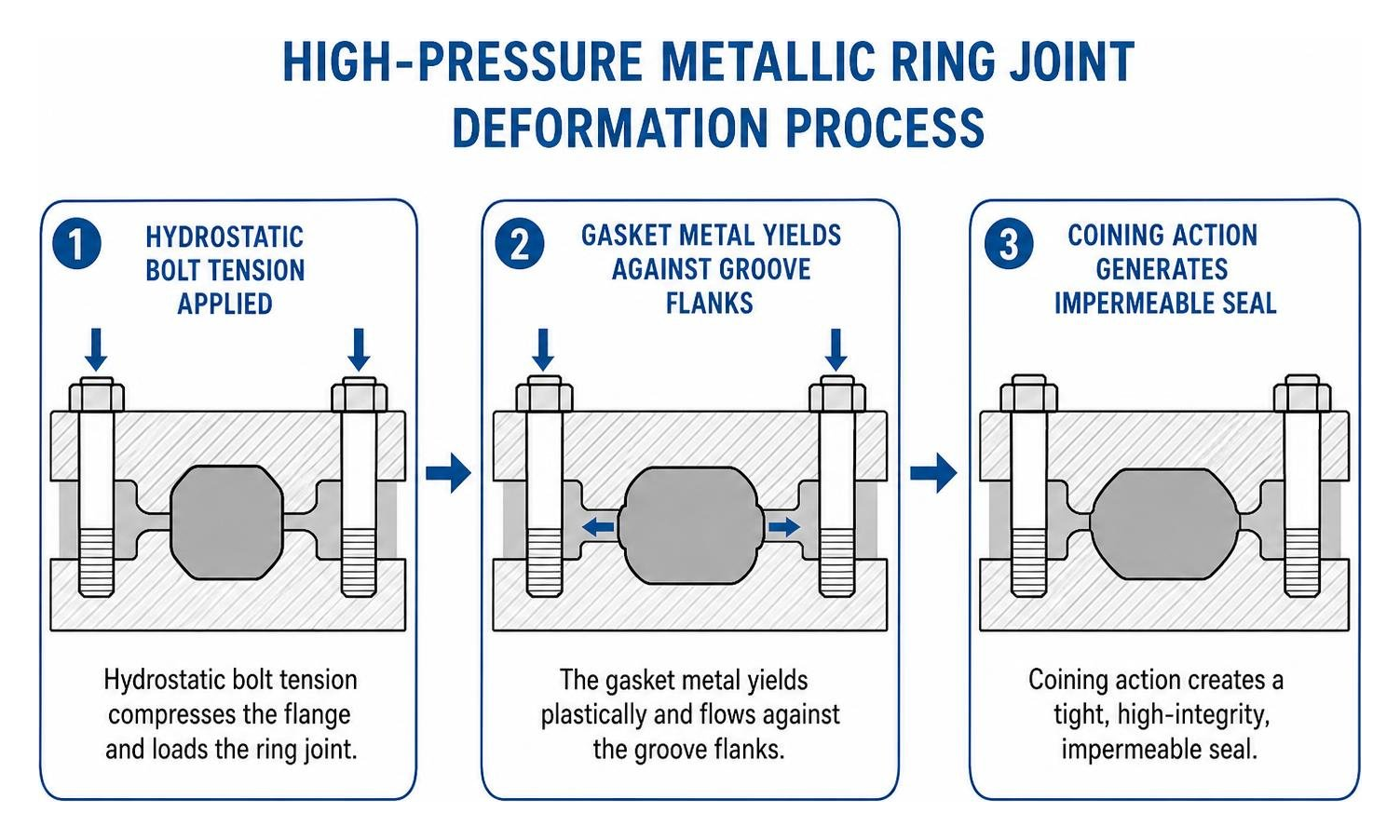
Metallic gaskets feature solid cross-sections of machined alloy. Rather than filling microscopic surface voids through bulk compression, they rely on high-load mechanical line contact or wedging action to deform the gasket material against a precision-machined flange groove.
Non-metallic, semi-metallic, and metallic gasket characteristics
Choosing among these families requires balancing available bolt load against the system’s operating severity.
Non-metallic gaskets are the standard for low seating stress connections, such as fragile cast-iron valves, bronze fittings, or flat-face equipment flanges where heavy bolt tension would crack the casting.
Semi-metallic styles are the workhorses of midstream processing and refining. They withstand pressure cycling and thermal shock up to ASME Class 2500.
Metallic gaskets require high bolt loads to achieve plastic deformation along their sealing edges. As detailed in the Gasket Handbook, treating the bolted flange connection as an integrated system—fasteners, flanges, and gasket working together—is essential to maintain sufficient residual stress across varying process cycles.
Non-metallic flange gasket materials and typical applications
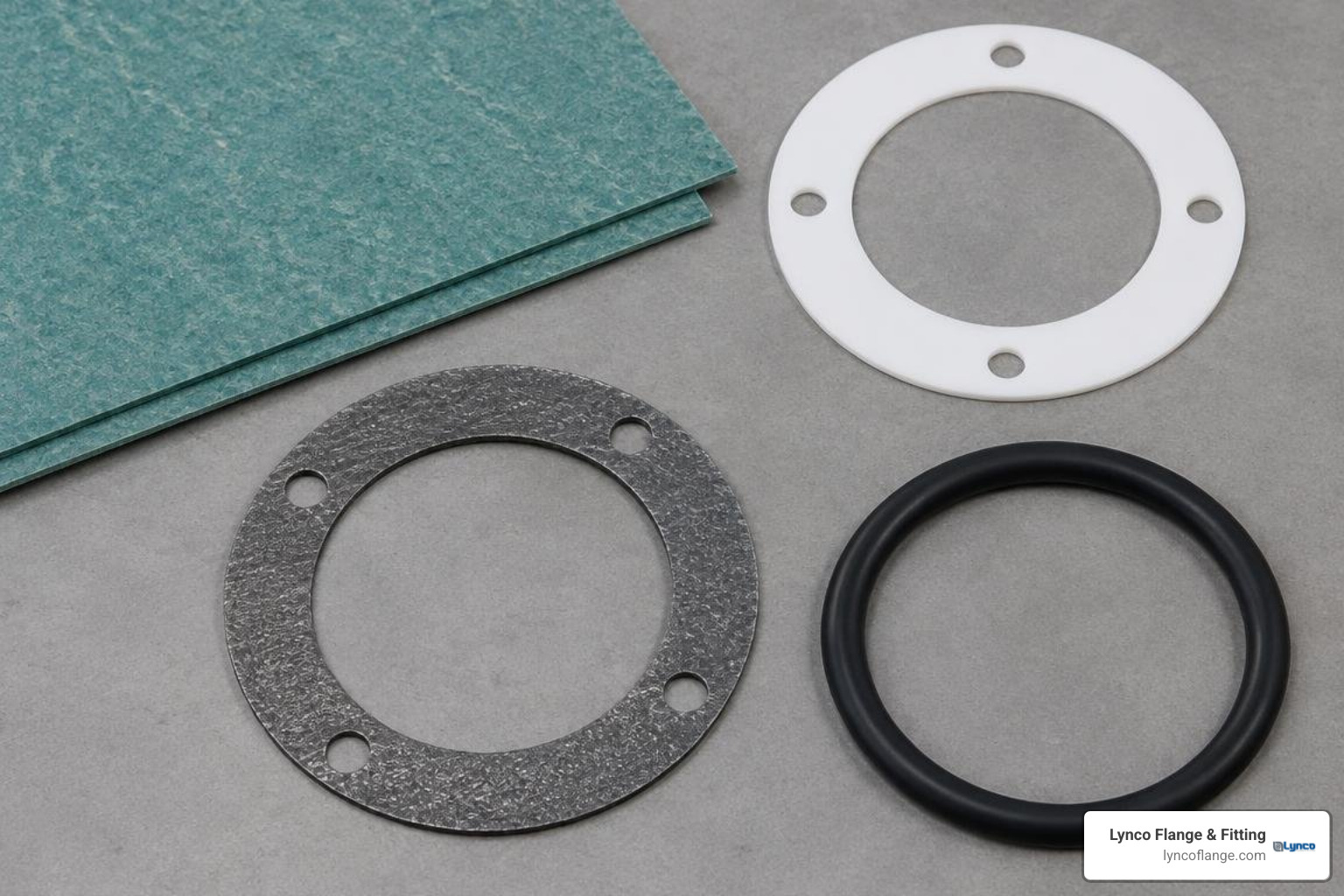
Soft gaskets provide economical sealing across broad temperature and chemical spectra where operating pressures remain low to moderate.
Compressed fiber, PTFE, graphite, and rubber
- Compressed Non-Asbestos Fiber (CNAF): Formulated from aramid, glass, or carbon fibers locked in elastomeric binders such as Nitrile (NBR), EPDM, or SBR. NBR-bound aramid sheets handle aliphatic hydrocarbons, fuels, and standard water service up to approximately 40 bar and 150°C to 200°C. Inorganic fibers bound with high-grade polymers resist creep relaxation at continuous temperatures up to 250°C.
- Polytetrafluoroethylene (PTFE & ePTFE): Virgin PTFE offers near-universal chemical inertness across the full pH scale (0–14), excepting molten alkali metals and elemental fluorine, with temperature capabilities from cryogenic levels up to 260°C (500°F). Because standard virgin PTFE is prone to cold flow and creep relaxation under compressive load, expanded PTFE (ePTFE) and filled PTFE formulations are preferred for rigid industrial piping.
- Flexible Graphite: Manufactured from exfoliated natural flake graphite, flexible graphite contains no elastomeric binders to degrade. It operates from cryogenic temperatures up to 454°C (850°F) in oxidizing atmospheres, and up to 460°C or higher in non-oxidizing or steam environments. It is frequently supplied with a tanged or flat stainless steel foil core to boost handling strength and blowout resistance.
- Elastomers (Rubber): Solid elastomers (durometer 35 to 95 Shore A) such as EPDM, Neoprene, Nitrile (Buna-N), and Fluoroelastomers (FKM/Viton) compress under minimal bolt tension. EPDM serves municipal water and mild chemical systems; NBR seals fuel oils; and FKM resists aggressive fuels and acids up to 200°C. Pure elastomers must not be used on high-pressure hydrocarbon pipeline joints.
- Cork and Mineral Compositions: Cork-elastomer composites seal low internal pressures up to 345 kPa (50 psi) at temperatures under 120°C (250°F), primarily in light lubrication systems. High-purity vermiculite and mica sheet composites provide thermal stability in extreme dry exhaust applications reaching 900°C.
Choosing flange gasket material types for soft-gasket service
When deploying soft gaskets, match material properties to the specific service parameters:
- Verify Pressure and Temperature Limits: Never evaluate temperature and pressure in isolation. A material that withstands 200°C at atmospheric pressure may rupture if subjected to 25 bar at that same temperature.
- Review Potable Water and Food Requirements: For municipal drinking water pipelines, select materials certified to NSF/ANSI 61.
- Assess Chemical Concentration: Concentrated oxidizing acids (such as 98% sulfuric acid) attack flexible graphite, making modified PTFE the appropriate selection.
- Eliminate Legacy Materials: Asbestos-containing formulations have been replaced by modern CNAF, ePTFE, and high-purity graphite alternatives.
Semi-metallic gasket types for demanding flange service
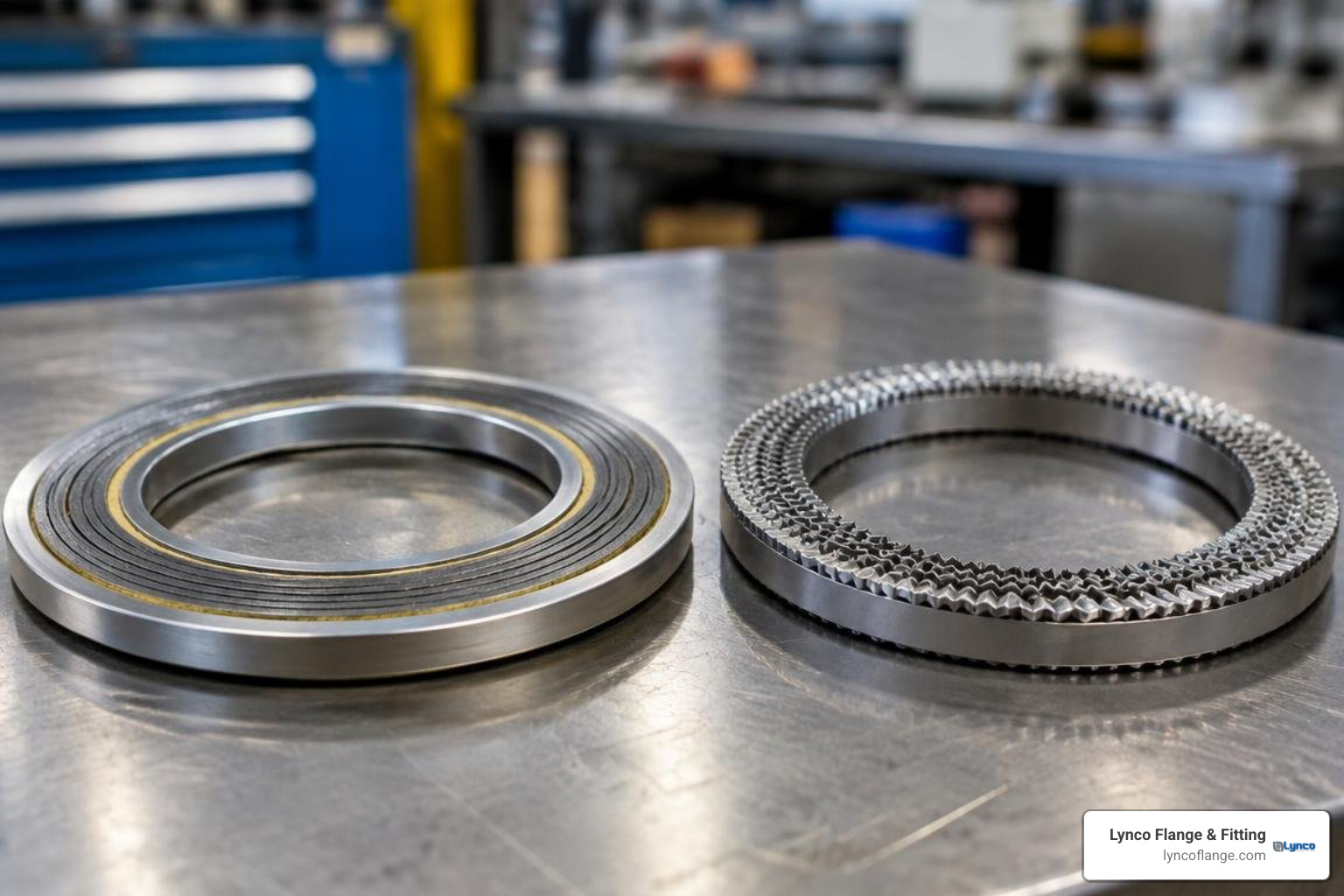
When joint conditions exceed the pressure or temperature thresholds of soft sheets, semi-metallic composite designs bridge the gap.
Spiral-wound, kammprofile, and jacketed designs
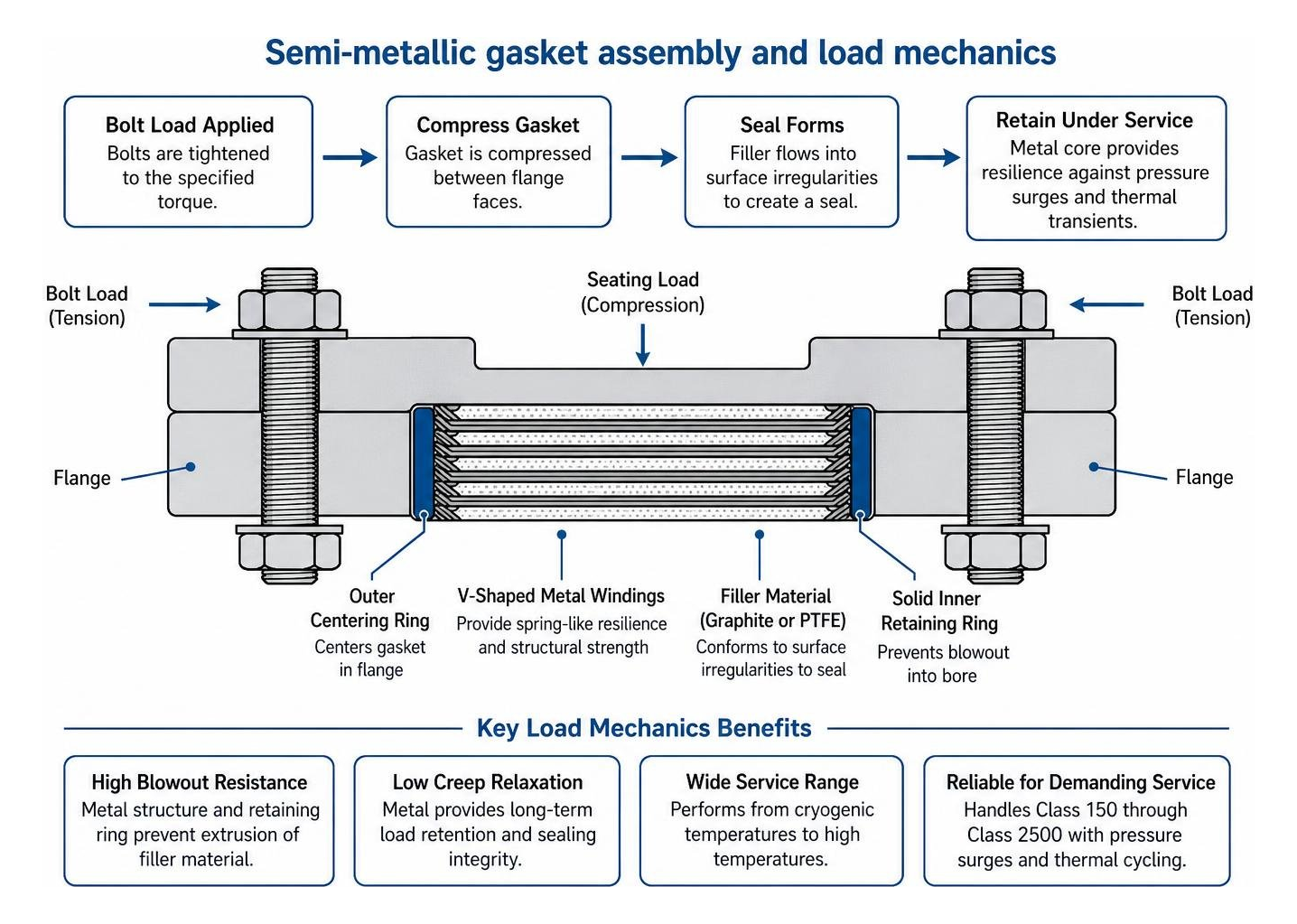
- Spiral-Wound Gaskets (SWG): Composed of alternating V-profile metal strip windings (typically 304, 316L, or Inconel) and compliant filler material (graphite or PTFE). The metal spring profile provides mechanical resilience against rapid thermal transients and pressure surges from Class 150 through Class 2500.
- Kammprofile (Grooved Metal Core) Gaskets: Built around a solid metal core machined with concentric serrations on both faces, layered with soft graphite or PTFE facings. Kammprofile gaskets deliver high blowout resistance and reliable sealing at lower seating stress than spiral-wound units, making them well-suited for worn or lightly pitted raised faces.
- Metal-Jacketed Gaskets: Consist of a soft filler material (flexible graphite or ceramic fiber) encased inside a metallic outer shell (such as carbon steel, stainless, or Monel). Primarily used in shell-and-tube heat exchanger partitions, jacketed styles require high, uniform seating loads and are increasingly superseded by custom kammprofile designs.
- Corrugated Metal Gaskets: Feature thin corrugated metal cores faced with high-purity (98%+) graphite. They offer low seating stress capability in standard pipeline flanges and heat exchanger applications with limited available bolt load.
Selecting semi-metallic gaskets by flange and service
Semi-metallic gaskets must be properly matched to flange geometry to avoid joint failure:
- Outer Centering Ring: Positions the sealing element concentrically within the bolt circle on ASME B16.5 raised-face flanges and acts as a compression stop.
- Mandatory Inner Rings: For graphite-filled spiral-wound gaskets in ASME Class 400 and higher (as well as all Class 150/300 vacuum or PTFE-filled applications), an inner metal ring is required by ASME B16.20. The inner ring prevents radial inward buckling of the windings into the pipe bore, protecting downstream equipment from debris.
- Flange Compatibility: Never install an outer-ring spiral-wound gasket on a flat-face (FF) flange paired with cast iron or bronze; the metallic ring will bottom out against the flange face before the soft element achieves sufficient seating stress, leading to a loose joint or a cracked casting.
- For specific engineering parameters across severe operational classes, review our High-Pressure Flange Gasket Selection Guide.
Metallic flange gasket types for high-pressure and high-temperature joints
Solid metal gaskets represent the standard for severe containment applications in upstream oil and gas production, high-pressure steam, and chemical synthesis.
RTJ, flat-metal, and corrugated-metal gaskets
- Ring Type Joint (RTJ) Gaskets (Style R, RX, BX): Precision-machined solid metal rings designed for matching grooved flange facings per ASME B16.20 and API 6A.
- Style R (Oval and Octagonal): Standard interchange rings for ASME B16.5 Class 900+ flanges. The octagonal cross-section provides higher sealing efficiency than the traditional oval geometry.
- Style RX: A pressure-energized variation of Style R designed for pressures up to 5,000 psi. As internal pressure rises, the ring expands outward against the groove walls, tightening the seal.
- Style BX: Pressure-energized octagonal rings engineered specifically for API 6A 6BX flanges, capable of containing working pressures up to 20,000 psi.
- Solid Flat and Grooved Metal Gaskets: Heavy metal discs used where extreme compressive loads can be maintained and chemical compatibility requires solid exotic alloys (such as Hastelloy, Monel, or Inconel).
- Lens Rings and Double-Cone Seals: Spherical-faced solid metal rings used in hyperbaric synthesis units and high-pressure gas headers operating above 400 bar.
When metallic gaskets are appropriate
Solid metallic gaskets require strict adherence to mechanical tolerances:
- Hardness Differential: The gasket material must always be softer than the mating flange groove material (typically by at least 15–20 HB). This ensures the gasket deforms plastically into the groove during makeup rather than coin-marking or damaging the flange groove itself.
- Surface Inspection: Inspect flange grooves for pitting, corrosion scale, tool marks, and wall distortion before makeup. Solid metal rings cannot bridge uneven groove defects.
- Severe Upstream Service: Whenever processing hydrogen at high pressure, wet sour crude subject to NACE MR0175/ISO 15156, or wellhead fluids exceeding 427°C (800°F), solid metallic RTJ assemblies provide the required structural containment.
How to select a flange gasket and prevent joint failure
Selecting the correct gasket requires evaluating the whole assembly—piping, flanges, fasteners, and fluid—as a unified pressure-containment system. Understanding the impact of temperature and pressure on flange and fitting selection ensures the entire connection operates safely within its design envelope.
Match material to pressure, temperature, and process fluid
Process chemistry, baseline operating temperature, and working pressure dictate the base material selection:
- Chemical Attack: Verify that process media, cleaning solvents, and steam purges will not degrade, dissolve, or harden the gasket binder or core.
- Thermal Aging: Elastomers harden and lose elasticity over time at elevated temperatures, leading to bolt load relaxation.
- Thermal and Pressure Cycling: Operations subject to frequent start-ups, shutdowns, or thermal expansion require resilient semi-metallic styles rather than rigid sheets.
- Loss of Primary Containment: Follow structured integrity protocols such as the SAPIA Flange Management Guideline to eliminate fugitive emissions and protect personnel during operational upsets.
Match gasket style to flange facing, surface finish, and bolt load
A gasket must match the mechanical surface finish and geometry of the flange facing:
- Flat-Face (FF) Flanges: Require full-face elastomeric or soft CNAF gaskets with matching bolt holes to distribute clamping loads evenly and prevent flange bending moments.
- Raised-Face (RF) Flanges: Typically utilize Ring (IBC – Inside Bolt Circle) soft gaskets, spiral-wound gaskets, or kammprofiles. For spiral-wound gaskets, ASME standards recommend a flange surface roughness between 125 and 250 microinches AARH (3.2 to 6.3 micrometers Ra). A surface that is too smooth can allow the soft filler to slip, while one that is too rough can cut the sealing element.
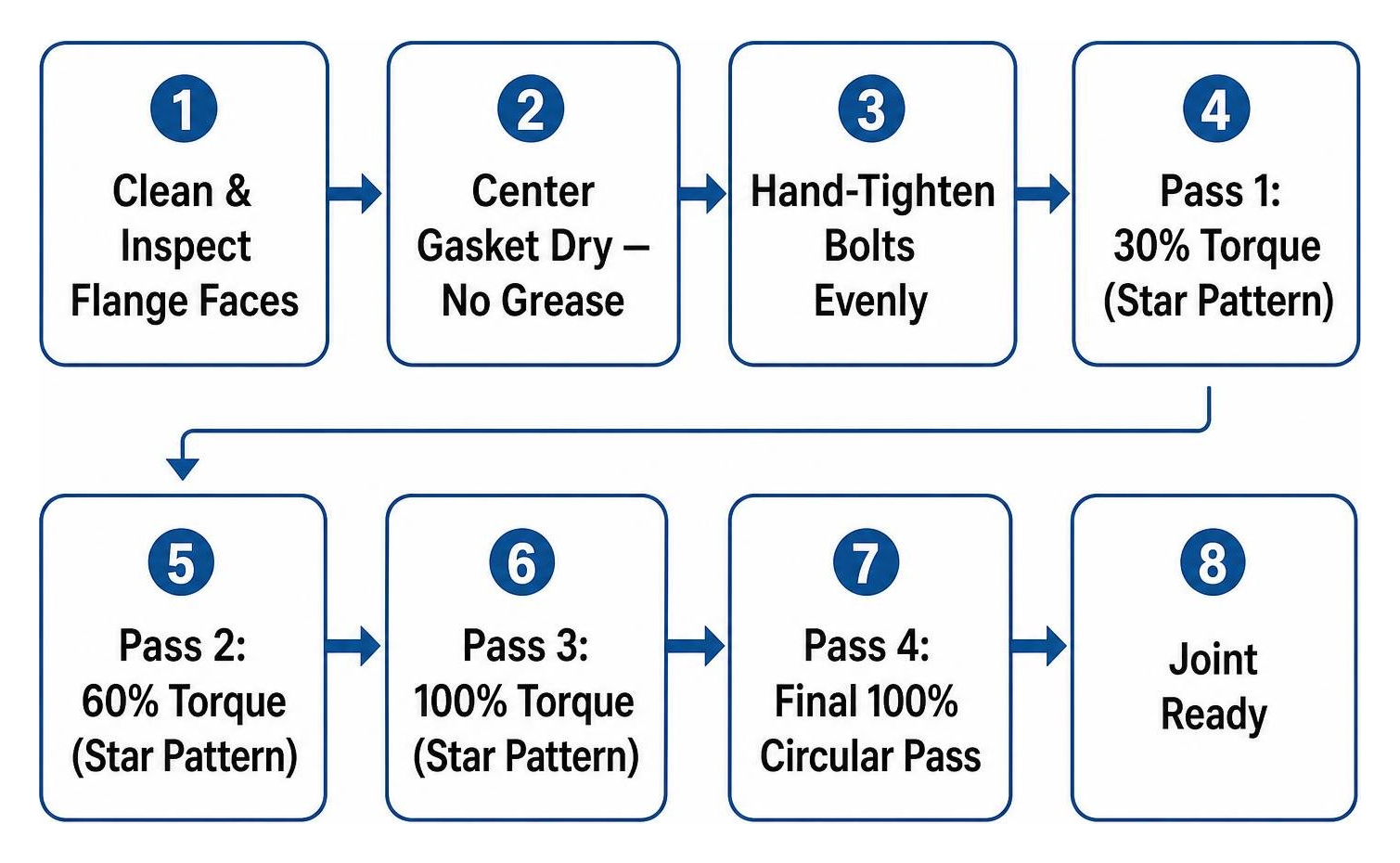
- Bolt Yield Target: Fasteners act as elastic springs that maintain pressure on the gasket face. Minimum initial bolt load should reach 50% of bolt yield strength; typical controlled tensioning targets 80% to 100% of yield using torque verification or hydraulic tensioning. Applying proper bolt tension using our guide on how to properly torque flanges prevents loose joints and uneven compression.
Full-face gaskets versus ring-type gaskets
- Full-Face Gaskets (Type FF): Cover the entire mating face of the flange and include pre-punched bolt holes. Used primarily on flat-face flanges (cast iron, ductile iron, bronze, FRP) where tightening forces must be distributed across the full surface to prevent cracking the flange neck.
- Ring Gaskets (Type IBC – Inside Bolt Circle): Seat entirely within the circle formed by the flange bolts on raised-face flanges. Because the bolt force acts over a smaller sealing area, ring gaskets achieve higher compressive surface pressure (MPa) for a given bolt load, improving seal tightness on steel flanges.
- Standard dimensional envelopes and designations for non-metallic flat variants are governed internationally by EN 1514-1:2024 gasket types and dimensions and ASME B16.21.
Standards, emissions, and compliance checks
Industrial piping joints must comply with design codes and fugitive emission mandates:
- ASME B16.20: Dimensions and tolerances for metallic and semi-metallic gaskets (spiral-wound, jacketed, grooved, and RTJ).
- ASME B16.21: Non-metallic flat gaskets for bolted flanges.
- ASME B16.5 & B16.47: Steel pipe flanges and flanged fittings (NPS 1/2 through NPS 60).
- API 6A: Wellhead and Christmas tree equipment sealing specifications.
- Fugitive Emissions Standards: Regulations such as EPA Method 21, Clean Air Act provisions, and TA-Luft / VDI 2290 mandate verified technical tightness (leak rates below established parts-per-million thresholds) for volatile hazardous air pollutants (VHAPs).
Common gasket failures and prevention
Most flange joint leaks stem from assembly errors rather than inherent material defects. Reviewing the top 4 piping flange issues that may cause leakages helps prevent common joint failures in the field:
- Uneven Bolt Load and Misalignment: Tightening bolts without a star pattern or pulling misaligned flanges together with fasteners creates localized crushing on one side of the gasket while leaving the other side under-compressed.
- Flange Face Damage: Scratches, gouges, or corrosion pits crossing the radial width of the sealing face create direct leak paths that soft materials cannot bridge under pressure.
- Gasket Reuse: Never reuse a gasket. Compressive loading permanently deforms gasket materials, crushing pores and destroying elastic recovery. A reused gasket cannot conform to flange faces a second time.
- Use of Joint Compounds and Grease: Applying grease or anti-seize paste to a flat gasket softens the elastomeric binder, lowers friction, and promotes gasket extrusion and blowout. Always install gaskets dry unless specifically formulated otherwise by the manufacturer.
Frequently Asked Questions about flange gasket material types
Which flange gasket material is best for corrosive chemicals?
Expanded PTFE (ePTFE) and filled PTFE provide the broadest chemical resistance across the entire 0 to 14 pH scale. They handle concentrated acids, caustics, and aggressive solvents from cryogenic temperatures up to 260°C (500°F). For high-pressure chemical applications, a spiral-wound gasket featuring alloy windings (such as Hastelloy C-276 or Alloy 20) with a PTFE filler is recommended.
Can non-metallic gaskets be used for high-pressure service?
Generally, non-metallic gaskets are restricted to low- and medium-pressure applications (ASME Class 150 to Class 300). At higher pressures, soft sheets risk creep extrusion and mechanical blowout. However, reinforced flexible graphite with a tanged stainless steel core can operate up to Class 300/600 under steady conditions, provided sufficient bolt load is maintained. For Class 600 and above, semi-metallic or metallic gaskets are standard.
Should a flange gasket be reused after disassembly?
No. Flange gaskets should always be discarded and replaced with new components whenever a joint is broken. Compressive bolting loads cause permanent plastic deformation of the sealing elements (fibers, graphite cells, PTFE, and metal windings). Re-tightening a spent gasket risks immediate joint failure and fugitive emissions during startup.
Conclusion
Achieving a durable, leak-tight bolted joint requires selecting the right gasket material and matching it to the overall flange assembly:
- Confirm Service Parameters: Define operating and upset pressures, continuous temperatures, and chemical exposure.
- Match Flange Facing: Use full-face soft gaskets for flat-face flanges, spiral-wound or kammprofile gaskets for raised faces, and precision-machined solid metal rings for RTJ grooves.
- Size and Center Correctly: Ensure the gasket inner diameter matches the pipe bore without obstructing the flow path.
- Control Bolt Load: Use hardened washers, lubricated fasteners, and calibrated, multi-pass torque sequences to achieve target seating stress.
At Lynco Flange & Fitting, our Houston-based engineering sales team provides technical support, ISO-compliant quality management, and an extensive inventory of flanges, fittings, and sealing components. Contact us today for engineering guidance and flange solutions tailored to your critical piping systems.