Black Mild Steel Pipe: What Fabricators Need to Know
Black mild steel pipe is low-carbon steel pipe without a galvanized coating. Its dark surface comes from oxide formed during manufacturing, not a rust-proof finish. Fabricators use it for gas and mechanical lines and structural work because it is strong and easy to weld. To source the right pipe, specify the material standard, nominal size, wall schedule or class, manufacturing method, and end finish. Check corrosion exposure and the project’s code requirements before ordering.
I’m Lance Vanover, CEO of Lynco Flange & Fitting. Over 26 years in industrial flange and fitting distribution, I’ve helped teams match components to black mild steel pipe specifications and fabrication needs.
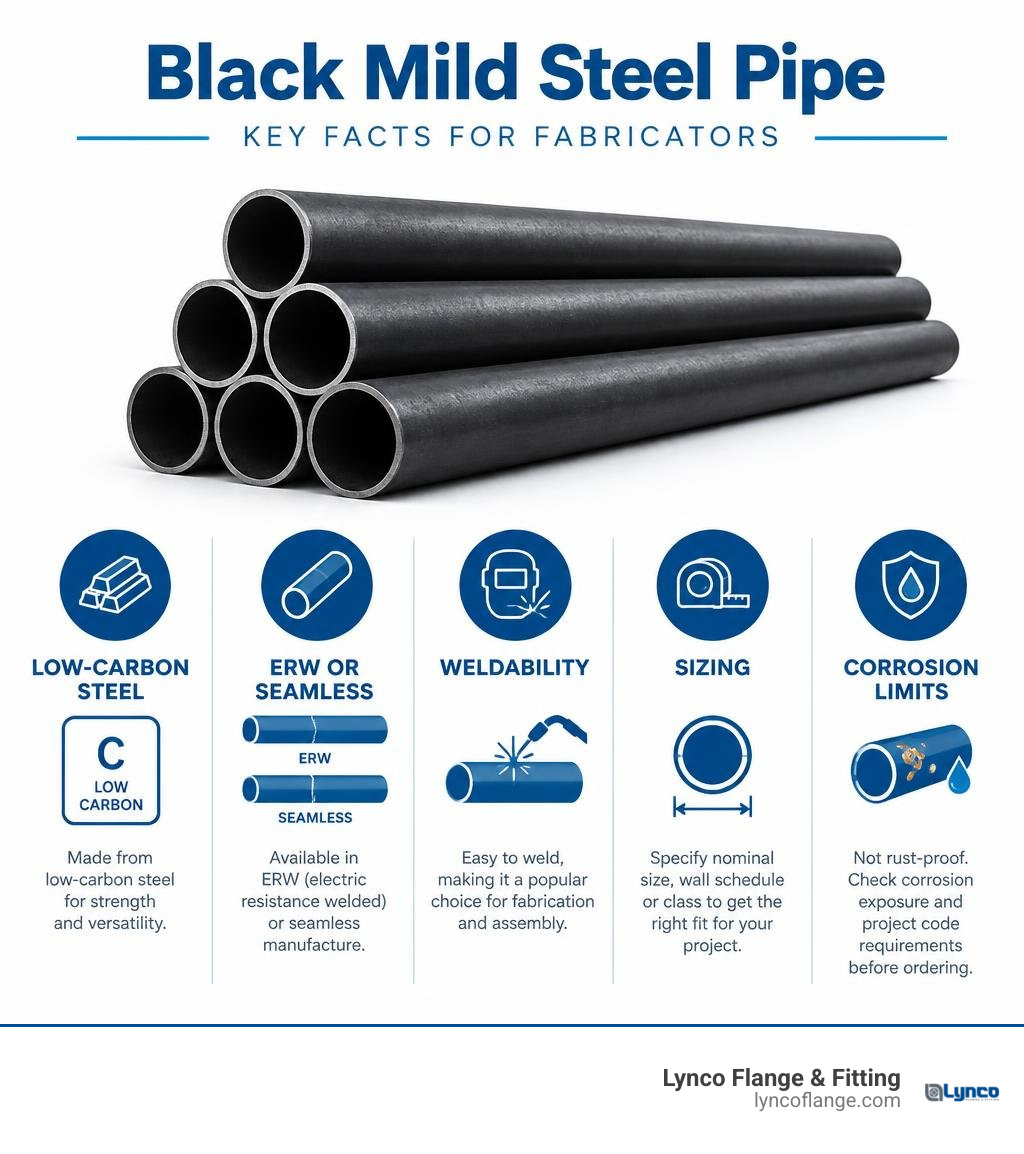
Black mild steel pipe terms to remember:
What Is Black Mild Steel Pipe and How Is It Made?
Black mild steel pipe is an ungalvanized, low-carbon steel tubular product engineered primarily for structural fabrication, non-potable fluid transport, steam systems, and gas conveyance. Understanding the whats, whys and hows of carbon steel helps explain why this material is a foundational element across trade workshops.
Chemically, mild steel contains between 0.05% and 0.25% carbon by weight. This modest carbon composition prevents the material from becoming excessively brittle when cooled and ensures superior ductility, malleability, and workability. Most black steel pipe is hot-rolled at temperatures exceeding 1700°F (925°C), which is well above the recrystallization point of steel. During this high-temperature rolling and forming process, the surface of the hot iron reacts with ambient atmospheric oxygen. This chemical reaction generates a natural, tightly adhering iron oxide film known across fabrication shops as mill scale.
This mill scale imparts the characteristic dark gray or “self-colour” slate-black appearance. It is crucial to remember that this natural oxide scale is not a permanent rust preventative; bare mild steel will oxidise further when exposed to ambient moisture or wet outdoor environments. However, the absence of complex alloying elements means everyday fabricators can cut, bend, and weld black mild steel without the complex preheating cycles or post-weld heat treatments often demanded by high-alloy steels.
Key Material Properties of Black Mild Steel Pipe
The mechanical profile of black mild steel provides a dependable balance between tensile strength and ductility. For example, common structural and piping grades like ASTM A53 Grade B or ASTM A106 Grade B exhibit a minimum yield strength of 35,000 psi (pounds per square inch) and a minimum tensile strength of 60,000 psi.
Because the carbon ceiling remains strictly below 0.25%, the steel absorbs mechanical shocks and accommodates severe bending or flanging operations without forming microscopic stress fractures. Its thermal tolerance makes it well suited for hot fluid and steam service where plastics or soft metals would fail.
The primary operational constraint of black mild steel is corrosion susceptibility. Unlike galvanized iron (GI) pipe, black steel carries no protective zinc barrier. In humid or wet operating environments, uncoated black pipe will develop surface rust rapidly.
| Feature | Black Mild Steel Pipe | Galvanized Steel (GI) Pipe |
|---|---|---|
| Protective Coating | Bare iron oxide mill scale | Hot-dip bonded zinc layer |
| Corrosion Resistance | Low to moderate (requires painting/dry environment) | High (zinc acts as a sacrificial anode) |
| Typical Working Lifespan | 5 to 10 years unpainted outdoors | 20 to 30+ years in outdoor environments |
| Potable Water Suitability | Unsuitable (rusts and contaminates water) | Suitable for municipal and potable water lines |
| High-Heat & Steam Service | Excellent (resists flaking and breakdown) | Poor (zinc flakes off at high temperatures) |
| Welding Preparation | Standard joint cleaning and beveling | Requires chemical or mechanical zinc removal |
| Cost Premium | Base benchmark price | ~20% to 30% more expensive than black pipe |
Manufacturing Methods: Seamless vs. ERW Pipes
Black mild steel pipes are produced using two primary industrial methodologies: Electric Resistance Welded (ERW) and Seamless extrusion.
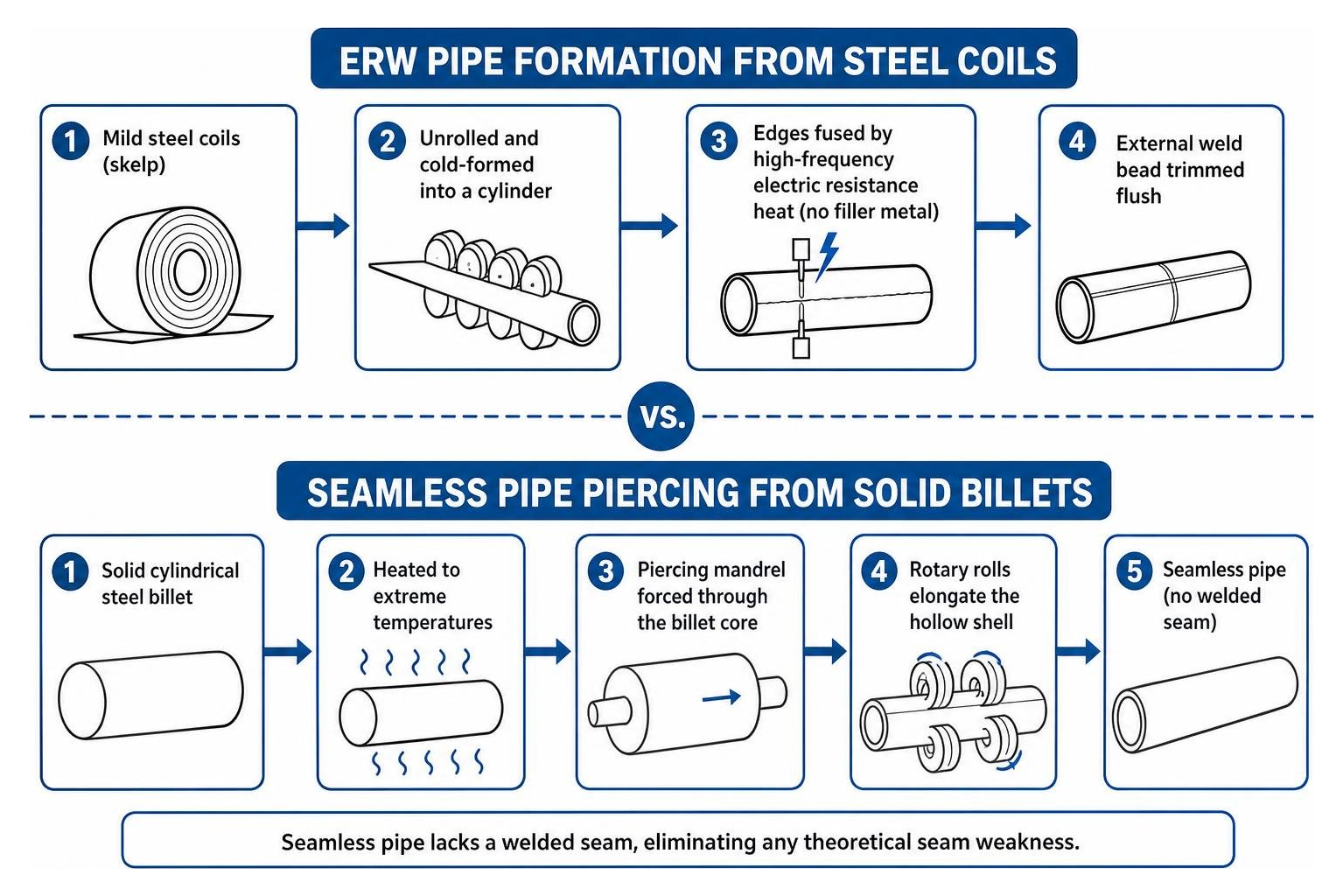
Electric Resistance Welded (ERW) Pipe: ERW pipe begins its life as flat mild steel coils (skelp). The coil is continuously unrolled, cold-formed through a series of progressive shaping rollers into a cylindrical profile, and its longitudinal edges are fused together using high-frequency electrical resistance heat without adding filler metal. The external weld bead is trimmed flush. ERW pipe provides consistent wall thickness tolerances and lower production costs.
Seamless Pipe: Seamless pipe is manufactured by heating a solid cylindrical steel billet to extreme temperatures and forcing a piercing mandrel through its core while rotary rolls elongate the hollow shell. Because it lacks a welded seam, seamless pipe eliminates any theoretical seam weakness. It is specified for severe high-pressure or elevated-temperature services, such as ASTM A106 Grade B lines in power plants and refineries.
| Parameter | ERW Mild Steel Pipe | Seamless Mild Steel Pipe |
|---|---|---|
| Base Raw Material | Flat-rolled mild steel strip or coil | Solid round steel billet |
| Weld Seam Presence | Continuous longitudinal weld seam | 100% seamless (monolithic wall) |
| Wall Thickness Uniformity | Highly uniform across entire length | Minor wall variance possible from piercing |
| Pressure Integrity | Rated up to ~80%–85% of seamless equivalent | Highest rating (no weld seam efficiency penalty) |
| Standard Specifications | ASTM A53 Type E, BS EN 10217-1, IS 1239 | ASTM A106 Grade B, ASTM A53 Type S |
| Relative Cost | Lower production cost | 20% to 50%+ higher cost than ERW |
| Common Use Cases | Structural frames, HVAC, low-pressure gas | High-temperature boilers, refining, heavy steam |
Sizing, Schedules, and International Manufacturing Standards
Specifying steel pipe requires a clear understanding of sizing conventions. Unlike tubing, which is specified by its exact outside diameter (OD) and measured wall thickness, pipe is governed by Nominal Pipe Size (NPS) in North America or Nominal Bore (NB) internationally.
For nominal sizes ranging from 1/8 inch to 12 inches (6 NB to 300 NB), the nominal number does not match either the exact inside diameter or the outside diameter. For example, a 1-inch nominal pipe has a fixed outside diameter of 1.315 inches (33.40 mm). The internal bore fluctuates based on the selected wall thickness schedule. Once you reach 14 inches and above, the nominal size matches the exact outside diameter.
Wall thickness is designated by schedule ratings (such as Schedule 40 or Schedule 80 under ASME B36.10M) or structural classes (such as Light, Medium, and Heavy under standards like BS EN 10255 and IS 1239). As fabricators work through pressure containment and mechanical connections, exploring a guide to carbon steel pipe fitting design and engineering ensures your scheduled pipe connects accurately to matched flanges and forged components.
Sizing and Specifying Black Mild Steel Pipe by Schedule and Standard
Industrial pipe manufacturing is governed by regional and global specifications. In North America, A53/A53M Standard Specification for Pipe, Steel, Black and Hot-Dipped, Zinc-Coated, Welded dictates standard-weight carbon steel pipe for mechanical and pressure uses. In the United Kingdom and Europe, BS EN 10255 governs non-alloy steel tubes suitable for welding and threading. In India and Asia, IS 1239 (Part 1) classifies mild steel tubes into three distinct wall categories:
- Class A (Light): Thinner wall profile; often identified by yellow mill markings, utilized for low-pressure fluid transport and lightweight structures.
- Class B (Medium): Standard wall profile; marked blue, utilized for utility plumbing, fire lines, and structural framing.
- Class C (Heavy): Thick wall profile; marked red, engineered for high-pressure gas mains, hydraulic feeds, and steam runs.
The following chart outlines key dimensional standards for Schedule 40 (Standard Weight) and Schedule 80 (Extra Strong) black mild steel pipes alongside international metric conversions:
| Nominal Size (NPS / NB) | Outside Diameter (Inches) | Outside Diameter (mm) | SCH 40 Wall Thickness (mm) | SCH 40 Weight (lbs/ft) | SCH 40 Weight (kg/m) | SCH 80 Wall Thickness (mm) | SCH 80 Weight (lbs/ft) |
|---|---|---|---|---|---|---|---|
| 1/2″ (15 NB) | 0.840 in | 21.34 mm | 2.77 mm | 0.85 lbs/ft | 1.27 kg/m | 3.73 mm | 1.09 lbs/ft |
| 3/4″ (20 NB) | 1.050 in | 26.67 mm | 2.87 mm | 1.13 lbs/ft | 1.69 kg/m | 3.91 mm | 1.48 lbs/ft |
| 1″ (25 NB) | 1.315 in | 33.40 mm | 3.38 mm | 1.68 lbs/ft | 2.50 kg/m | 4.55 mm | 2.17 lbs/ft |
| 1-1/4″ (32 NB) | 1.660 in | 42.16 mm | 3.56 mm | 2.27 lbs/ft | 3.39 kg/m | 4.85 mm | 3.00 lbs/ft |
| 1-1/2″ (40 NB) | 1.900 in | 48.26 mm | 3.68 mm | 2.72 lbs/ft | 4.05 kg/m | 5.08 mm | 3.63 lbs/ft |
| 2″ (50 NB) | 2.375 in | 60.33 mm | 3.91 mm | 3.66 lbs/ft | 5.44 kg/m | 5.54 mm | 5.03 lbs/ft |
| 3″ (80 NB) | 3.500 in | 88.90 mm | 5.49 mm | 7.58 lbs/ft | 11.29 kg/m | 7.62 mm | 10.25 lbs/ft |
| 4″ (100 NB) | 4.500 in | 114.30 mm | 6.02 mm | 10.80 lbs/ft | 16.07 kg/m | 8.56 mm | 14.98 lbs/ft |
| 8″ (200 NB) | 8.625 in | 219.08 mm | 8.18 mm | 28.58 lbs/ft | 42.53 kg/m | 12.70 mm | 43.39 lbs/ft |
Primary Applications and Industrial Use Cases
Black mild steel pipe serves as the mechanical backbone for industrial systems where water-induced internal oxidation is not a governing risk factor. Its high thermal stability and rugged pressure handling make it the industry standard for:
- Natural Gas and Propane Distribution: Black iron and mild steel pipes are the primary piping materials used to feed natural gas into industrial boilers, furnaces, and commercial buildings. Natural gas contains low moisture levels, preventing internal corrosion while the rugged steel resists external mechanical impacts.
- Fire Sprinkler and Hydrant Systems: Fire suppression systems rely on heavy-wall black steel pipe (such as Schedule 40 or Class C) for wet and dry standpipe risers. Steel lines survive extreme heat during structural fires without melting, maintaining system pressure.
- HVAC and Chilled/Hydronic Water Loops: Closed-loop hydronic heating and chilled water lines recycle treated, deoxygenated water. Because free oxygen is eliminated from the loop, internal rusting ceases, allowing black mild steel pipe to operate reliably for decades.
- Industrial Steam Distribution: High-pressure steam lines require reliable mechanical strength under rapid thermal expansion. Seamless ASTM A106 Grade B black pipe handles these cyclical thermal loads without degradation.
- Energy and Hydrocarbon Processing: Understanding what metals are used for pipe fittings in the oil and gas industry provides perspective on how carbon and mild steel pipe assemblies integrate with forged flanges across refinery infrastructure.
Structural and Mechanical Fabrication Uses
Beyond moving fluids and gases, fabricators rely on black mild steel pipe for structural projects. Because round pipe has a uniform polar moment of inertia, it offers excellent torsional resistance and multi-directional column load-bearing capabilities.
Structural uses include:
- Construction Scaffolding: Standard 48.3 mm OD (1-1/2″ nominal) mild steel pipe with a 2.9 mm to 3.2 mm wall thickness serves as the worldwide benchmark for modular staging and scaffolding tubes.
- Protective Bollards and Barrier Posts: Schedule 40 and Schedule 80 4-inch to 8-inch pipes, often core-filled with concrete, form crash-rated safety bollards around utilities, fuel pumps, and loading docks.
- Handrails, Guardrails, and Industrial Platforms: The clean weldability of mild steel allows fabricators to build complex handrail systems and support frameworks quickly. Fabricators know that carbon steel pipe fittings deliver durable strength across these heavy-load structural fabrications.
Fabricator’s Guide: Cutting, Welding, and Joining Black Pipe
Working with black mild steel pipe in the shop requires straightforward fabrication practices:
- Cutting Operations: Cold-cut mechanical circular saws or horizontal bandsaws yield square cuts free of heat-affected zones. When using oxy-fuel or plasma cutting torches on thick-wall pipe (such as Schedule 80 or large-diameter sections), grind away all residual slag, oxidized dross, and mill scale back at least 1/2 inch from the cut edge.
- Edge Preparation: For pipes slated for butt-welding (typically sizes 2 inches and above), bevel the pipe ends to an angle of 37.5 degrees (plus or minus 2.5 degrees) with a 1/16-inch (1.6 mm) root face.
- Welding Procedures: Black mild steel is readily welded using Shielded Metal Arc Welding (SMAW with E6010 root and E7018 fill/cap electrodes), Gas Metal Arc Welding (GMAW / MIG using ER70S-6 wire), or Gas Tungsten Arc Welding (GTAW / TIG) for sanitary or root passes. Because the carbon balance is under 0.25%, standard ambient temperatures (above 50°F / 10°C) do not require preheating unless wall thicknesses exceed 1 inch.
Threaded, Grooved, and Flanged Connections
Fabricators employ three main mechanical methods to join black steel pipe without open butt-welding:
- Threaded Connections: Smaller lines (1/2 inch to 2 inches) are commonly threaded using National Pipe Taper (NPT) or British Standard Pipe Taper (BSPT) dies. Tapered threads seal on the flanks through thread deformation, supplemented by PTFE paste or thread sealant tape, and mate with threaded black malleable iron or forged steel fittings.
- Grooved Mechanical Joints: Common in fire suppression and commercial mechanical loops, pipe ends are roll-grooved or cut-grooved to accept mechanical bolted couplings with elastomeric gasket seals. This eliminates open flame permits on job sites.
- Flanged Connections: For high-pressure piping assemblies and process connections to valves, pumps, or vessels, fabricators weld Slip-On, Weld Neck, or Socket Weld flanges directly onto plain-end pipe. When outfitting these systems, fabricators must understand the top qualities of carbon steel fittings for piping to match pressure classes, ANSI bolt patterns, and material chemistry.
Sourcing, Pricing Trends, and Sizing Economics
Procuring black mild steel pipe requires balancing standard mill stick lengths against transport and cutting logistics.
- Standard Available Lengths: In North America, domestic black steel pipe is standardly distributed in random 21-foot (6.4-meter) or double-random 42-foot sticks with plain end (PE), beveled end (BE), or threaded and coupled (T&C) finishes. Globally, 6-meter (approx. 20-foot) standard sticks are universal.
- Pricing Dynamics: Black mild steel is priced globally either per linear foot, per meter, or by weight (hundredweight / CWT in the US; per kilogram or metric ton internationally).
Pricing fluctuates with global scrap steel and raw coil indices. For example, benchmark 1-inch Schedule 40 ERW domestic black pipe trades around $4.92 per foot in North America (at approximately 1.68 lbs per foot), while standard 6-meter lengths in the UK average roughly £44.95 (excl. VAT). In India, IS 1239 Medium Class black ERW pipe trades between ₹60 and ₹76 per kg (around ₹163.88 per meter for 1-inch 25 NB).
By comparison, seamless heavy-wall pipes carry a premium: a 3-inch Schedule 80 ASTM A106 Grade B pipe (weighing 10.25 lbs per foot) costs roughly $636.73 per 20-foot stick, whereas an 8-inch Schedule 80 A106 pipe (weighing 43.39 lbs per foot) sits near $2,189.42 per 20-foot stick.
- Purchasing Tips: Always request a certified Mill Test Certificate (MTC) verifying the steel’s heat number, chemical composition, tensile/yield test results, and hydrostatic pressure testing. When ordering structural or fluid tubing internationally, look for compliance references from recognized distributors and verify that the supplier’s material certifications align with your project’s governing code requirements.
Frequently Asked Questions About Black Mild Steel Pipe
Can black mild steel pipe be used for drinking water systems?
No. Black mild steel pipe should never be used for potable drinking water supply lines. The lack of a protective internal coating allows dissolved oxygen in untreated tap water to oxidize the bare iron wall. This reaction causes heavy internal corrosion, produces brown discolored water, generates tuberculation deposits that restrict flow, and leaches oxidized particulate into the drinking supply. Potable water distribution requires hot-dip galvanized (GI) steel pipe, copper, stainless steel, or approved thermoplastic piping.
How does black mild steel differ from standard carbon steel pipe?
The terms are often used interchangeably, but mild steel is a specific subcategory of carbon steel. Mild steel strictly contains low carbon levels (between 0.05% and 0.25%), optimizing weldability and formability. Medium- and high-carbon steel pipes contain up to 2.0% carbon, offering far greater hardness and wear resistance at the expense of ductility and weldability. Furthermore, black steel pipe specifically refers to ungalvanized pipe carrying an iron oxide mill scale finish. For a deeper breakdown of structural and alloy nuances, review the 4 differences between carbon steel piping and black steel piping.
What is the typical service life of uncoated black mild steel pipe?
In dry indoor environments or sealed, closed-loop mechanical systems (like hydronic heating and non-corrosive natural gas lines), uncoated black mild steel pipe routinely lasts 50 to 100 years. However, when left uncoated in humid, wet, or outdoor atmospheric environments, bare black pipe can suffer noticeable surface degradation within 1 to 2 years and structural failure within 5 to 10 years. Applying zinc-rich primers, direct-to-metal industrial epoxy paint, or bituminous external coatings extends outdoor service life considerably.
Conclusion
Black mild steel pipe remains an indispensable workhorse for modern fabricators, mechanical contractors, and industrial plants. Its low-carbon chemistry delivers superior weldability, rugged mechanical strength, and structural predictability at a cost-effective price point. By pairing the appropriate sizing schedule, manufacturing type (ERW vs. seamless), and end connections to your operating conditions, you can build piping and structural assemblies that perform safely for decades.
At Lynco Flange & Fitting, our Houston-based technical sales team brings decades of engineering-focused distribution experience to your projects. We maintain an extensive inventory of weld flanges, forged steel fittings, and custom components certified to rigorous ISO-compliant quality standards.
When specifying piping systems for your next build, make sure to explore the key differences between carbon steel piping and black steel piping to choose the right components for your build. Reach out to our team today for direct technical guidance, precision component matching, and rapid industrial delivery.