Types of Pipe Fittings: What They Do and How to Choose
The main types of pipe fittings are elbows, tees, and wyes for changing direction or branching; couplings, unions, and reducers for joining or resizing pipe; and caps and plugs for closing a line. Flanges make bolted connections that can be taken apart for service. Choose among them by checking the fluid, operating pressure and temperature, pipe size, material, connection method, and applicable standards. Pressure fittings and drain-waste-vent (DWV) fittings are not interchangeable: one must contain pressure, while the other is shaped for gravity drainage and venting.
I’m Lance Vanover, CEO of Lynco Flange & Fitting. After more than 26 years in the business, I’ve helped teams navigate the types of pipe fittings used in industrial projects, including weld, forged steel, and custom fittings.
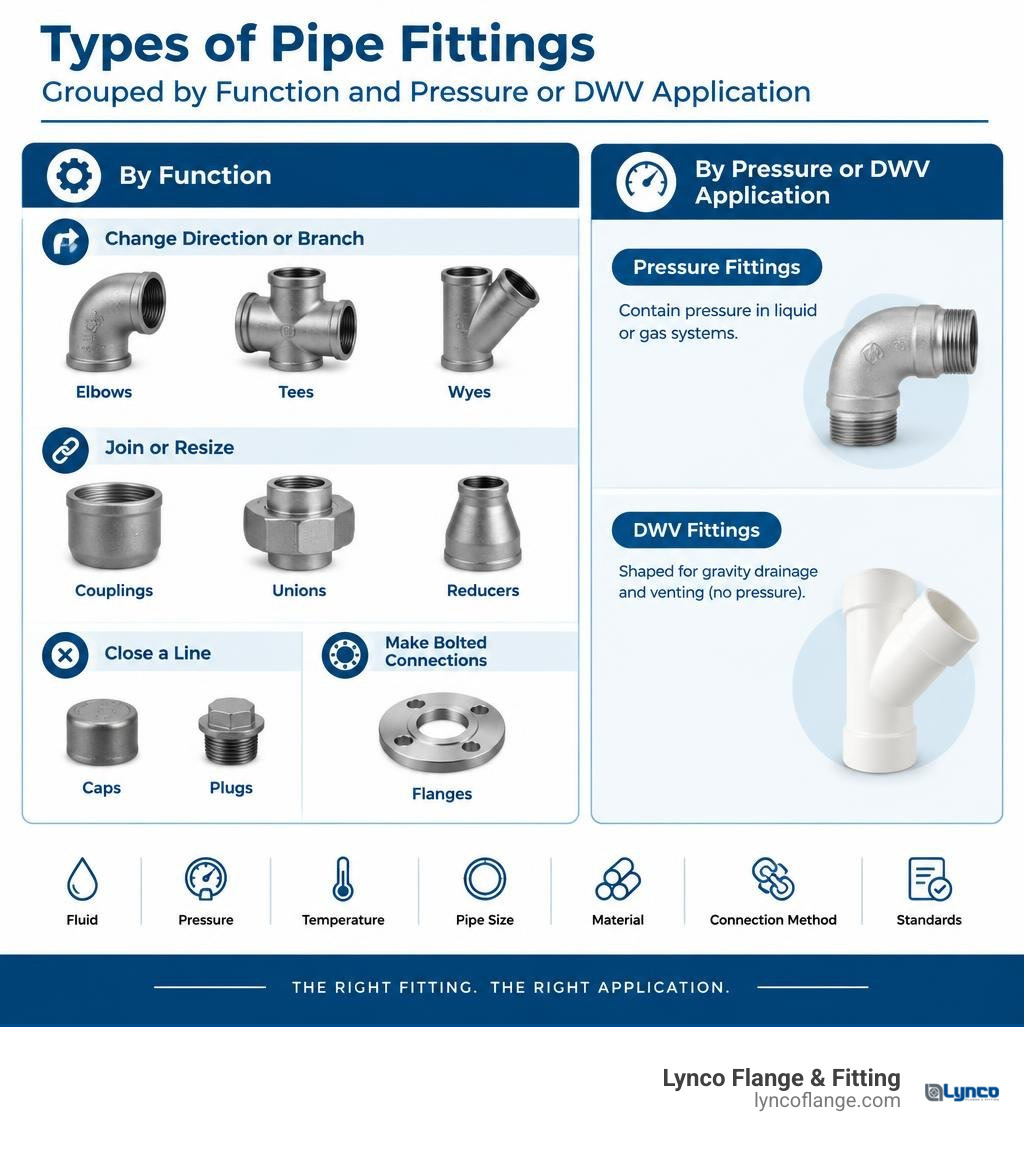
Types of pipe fittings vocab explained:
Core Types of Pipe Fittings and Their Functions
Piping systems rely on specialized fittings to control direction, split flow, transition between diameters, and seal line terminations. Understanding the 5 different types of pipeline fittings is the first step in designing any fluid conveyance network. Every component is engineered to handle specific structural loads and fluid dynamics according to standard piping and plumbing fitting conventions.
Directional and Branching Types of Pipe Fittings
Directional fittings route media around physical obstacles and across complex industrial layouts.
- 90-Degree and 45-Degree Elbows: These are the most common fittings for changing flow direction. In plumbing and process piping, elbow angles designate the degree of bend from the original straight line. A standard 90-degree elbow creates a right-angle turn, while a 45-degree elbow offers a gentler directional shift that reduces friction loss.
- Long-Radius (LR) vs. Short-Radius (SR) Elbows: The radius of curvature of a long-radius elbow is 1.5 times the nominal pipe diameter (1.5D), providing lower flow resistance and minimal fluid turbulence. A short-radius elbow has a curvature radius equal to the nominal pipe diameter (1.0D). While SR elbows save space in compact equipment skids, they generate higher pressure drops.
- Equal and Reducing Tees: A standard tee features a 90-degree side branch off a continuous straight run. An equal tee maintains the same nominal diameter across all three ports, whereas a reducing tee has a smaller branch outlet to feed secondary lines without needing extra reducers.
- Wye (Y) Fittings: Wyes branch off the main line at a 45-degree angle. This sweeping entry minimizes internal turbulence in pressure lines and prevents clogging in gravity-flow drainage stacks.
- Cross Fittings: Crosses feature four perpendicular ports (one inlet and three outlets, or three inlets and one outlet). Because four connection points overdetermine a geometric plane, thermal expansion can place immense physical stress on cross joints. Consequently, process piping designers often prefer engineered branch connection methods or popular industrial branch connections over rigid mechanical crosses.
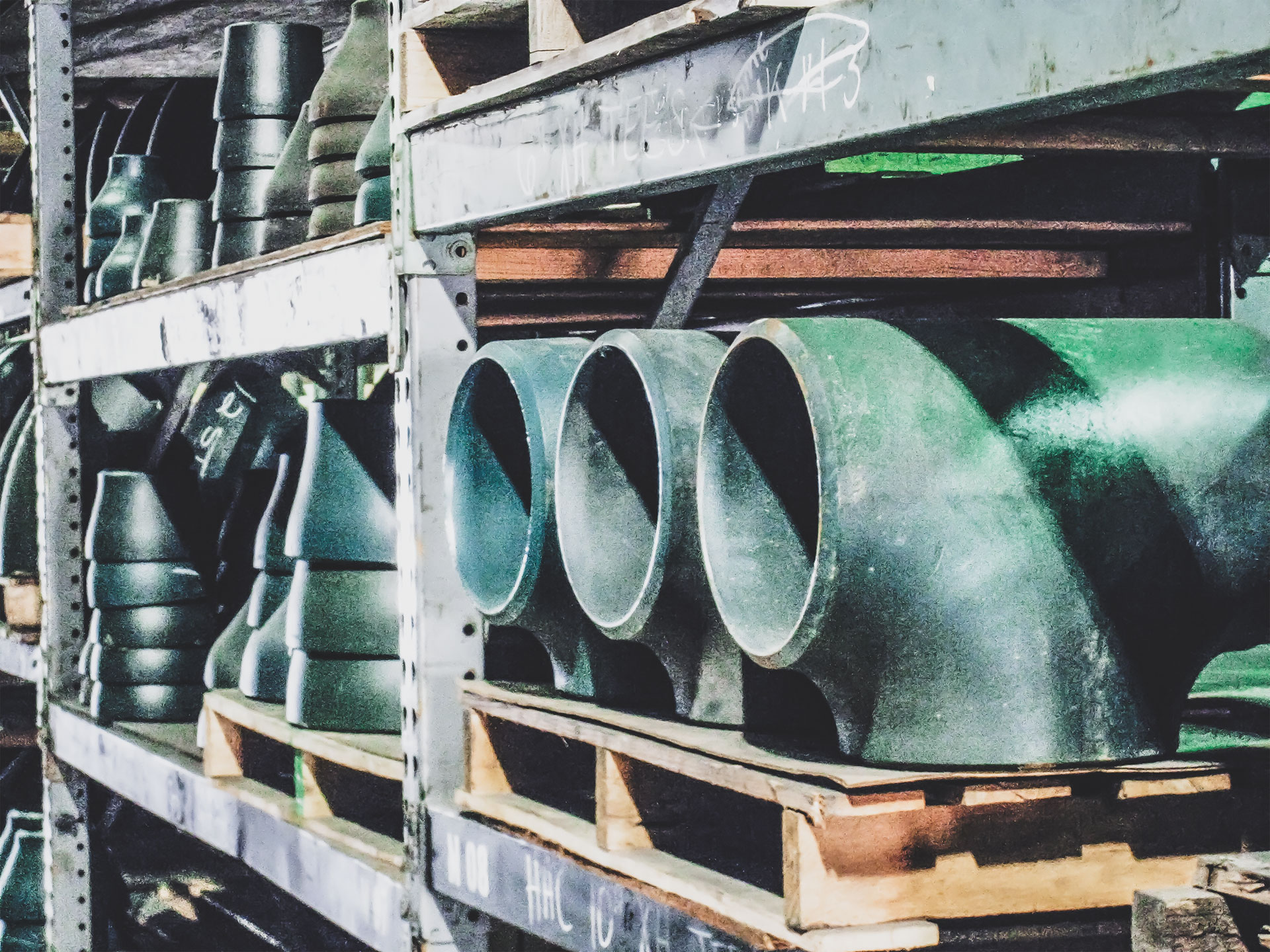
Extension, Reduction, and Termination Components
Piping networks require inline hardware to link straight lengths, adjust pipe diameters, and seal dead ends.
- Full and Half Couplings: Couplings join two straight sections of pipe. A full coupling features internal threading or socket pockets on both ends. A half coupling has a single joining end and a beveled or plain opposite end, allowing it to be welded onto a vessel or header pipe as a branch tapping.
- Pipe Unions and Dielectric Unions: Unlike permanent couplings, unions incorporate a central threaded collar that uncouples without cutting into the line. For systems linking dissimilar metals (such as copper water lines to galvanized steel tanks), dielectric unions introduce an electrically insulating thermoplastic sleeve that halts galvanic corrosion.
- Concentric and Eccentric Reducers: Reducers bridge two pipes of differing nominal sizes. Concentric reducers taper evenly along a shared centerline, making them ideal for vertical lines. Eccentric reducers feature an offset taper with one flat side. Installing an eccentric reducer with the flat side facing up prevents gas pockets from forming upstream of pump inlets, while a flat-bottom orientation ensures complete gravity drainage.
- Bushings and Nipples: Hex bushings thread into a female port to reduce its opening to a smaller pipe size within a compact footprint. Pipe nipples are short lengths of straight pipe with external male threads on both ends, available in close (fully threaded), barrel (unthreaded center section), and hex-body profiles.
- Caps and Plugs: A cap fits over the external perimeter of a male-threaded or plain pipe end to isolate the line. A plug screws directly into a female-threaded fitting or manifold port to seal the passage.
High-Pressure and Industrial Types of Pipe Fittings
When tapping into thick-walled headers subject to high mechanical stress, integrally reinforced branch connection fittings—commonly known as olets—provide superior structural integrity.
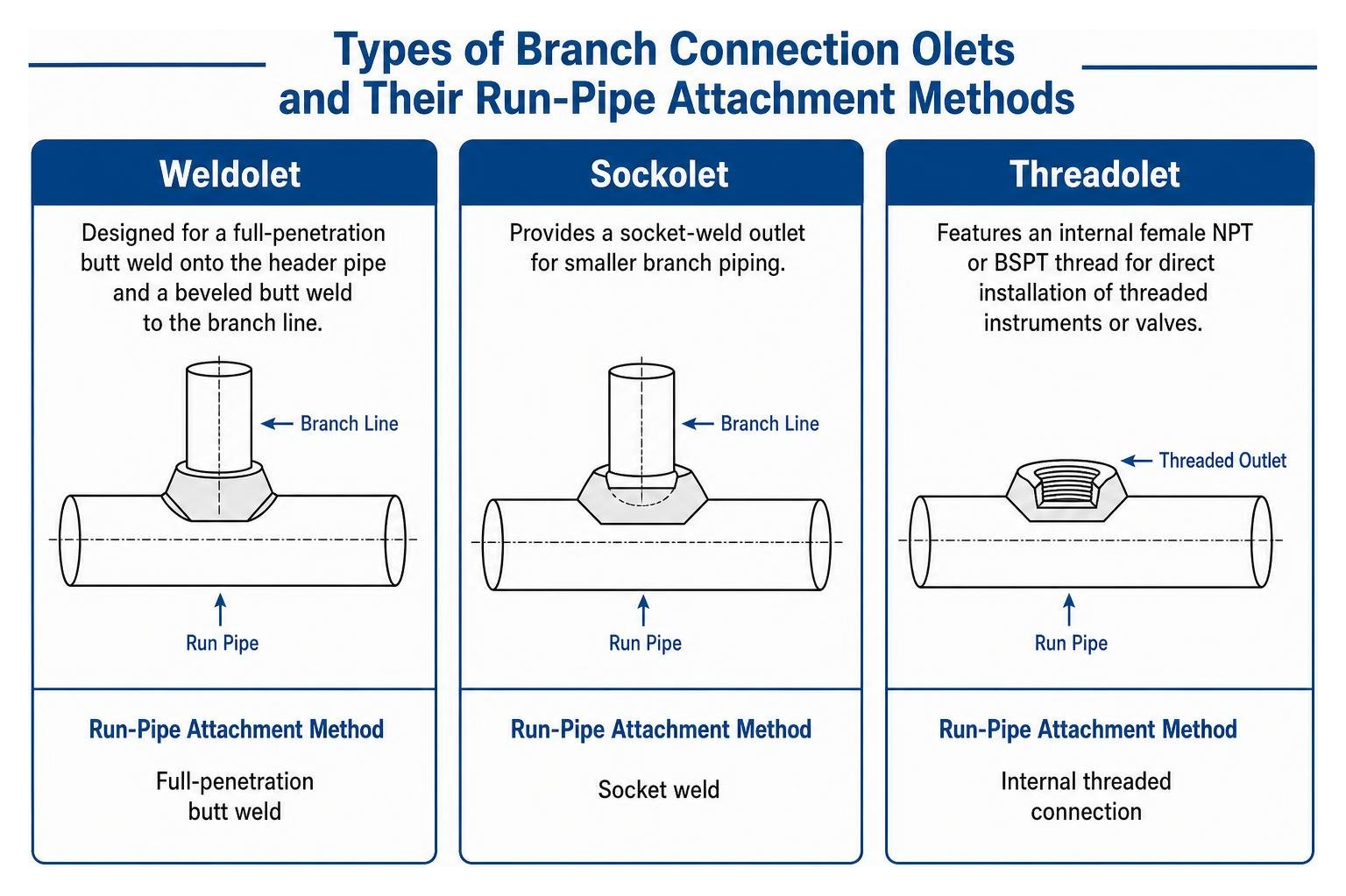
Using 3 different types of olets ensures full reinforcement at the run pipe without needing wraparound saddle plates:
- Weldolets: An olet designed for a full-penetration butt weld onto the header pipe and a beveled butt weld to the branch line. They represent the strongest branch design for severe operating conditions.
- Sockolets: These components provide a socket-weld outlet for smaller branch piping. Exploring weldolets vs sockolets highlights that sockolets streamline installation on small-bore piping, while weldolets deliver higher cyclic fatigue resistance.
- Threadolets: Featuring an internal female NPT or BSPT thread, threadolets allow direct installation of threaded instrumentation, thermowells, or drain valves onto pressurized headers without welding the branch pipe.
Selecting between these types of branch connection fittings depends on line size, pressure classification, and whether the installation calls for a welded or mechanical joint.
Industrial Flanges: Classification, Facings, and Pressure Ratings
Flanges provide non-permanent, bolted transitions between pipe sections, valves, pumps, and pressure vessels. Standardized under ASME B16.5 (for sizes from NPS 1/2 to NPS 24) and ASME B16.47 (for large-diameter lines from NPS 26 to NPS 60), flanges are categorized by pressure-temperature ratings. Flanges are rated at 150, 300, 400, 600, 900, 1500, and 2500 psi (or 10, 15, 25, 40, 64, 100, and 150 bars of pressure).
Selecting the right types of flanges for piping requires pairing the body design with the correct sealing surface:
- Raised Face (RF): Features a 1/16-inch (for Class 150 and 300) or 1/4-inch (for Class 400 and higher) raised platform machined with concentric or spiral serrations. This concentrates bolt torque onto a compact gasket area to ensure a tight seal.
- Flat Face (FF): The gasket surface sits in the same plane as the bolting circle. Understanding raised vs flat faced flanges is vital when bolting steel pipe to cast iron or bronze pumps, as flat face configurations distribute bolt loads evenly and protect brittle equipment housings from cracking.
- Ring-Type Joint (RTJ): Features a precision-machined annular groove that accommodates a solid metallic ring gasket (per ASME B16.20). Under bolt loading, the ring undergoes plastic deformation to create a dependable seal in high-pressure oil and gas services exceeding Class 900.
These components fulfill several structural purposes of industrial flanges, including maintaining joint rigidity under bending moments and allowing rapid line disassembly during plant turnarounds.
Flange Styles: Weld Neck, Slip-On, Blind, and Specialty Hubs
Different flange geometries distribute stress across the pipe joint in distinct ways:
- Weld Neck Flanges: Characterized by a long, tapered hub that matches the bore diameter of the pipe. As detailed in our guide to weld neck flanges, this smooth transition transfers mechanical stress directly to the pipe wall, mitigating stress concentrations in extreme-temperature lines.
- Slip-On Flanges: Slipped over the pipe end and secured with an internal and external fillet weld. They reduce upfront fabrication and alignment costs, though their calculated fatigue life is roughly one-third that of a weld neck.
- Blind Flanges: Manufactured without a central bore, blind pipe flanges bolt directly onto open flange faces to isolate piping systems, block pressure during hydrostatic testing, or cap cleanout manways.
- Long Weld Neck (LWN) Nozzles: Featuring an extended, heavy-wall cylindrical neck that replaces standard pipe spools, long weld neck flanges are standard for vessel nozzles and column connections in chemical plants.
These designs represent the most common flange types in the oil and gas industry, where structural integrity and pressure containment are paramount.
Pipe Fitting Materials and Selection Criteria
Choosing the right material prevents premature corrosion, stress cracking, and pressure containment failures. Operating temperature, system pressure, flow velocity, and fluid chemistry dictate whether a project requires metallic alloys or thermoplastics.
| Material Classification | Common Specifications | Temperature Range | Primary Advantages | Common Applications |
|---|---|---|---|---|
| Carbon Steel | ASTM A105, ASTM A234 WPB | -20°F to 800°F (-29°C to 427°C) | High tensile strength, cost-effective, thermal endurance | High-pressure steam, oil, natural gas, structural piping |
| Stainless Steel | ASTM A182 / A403 (304L, 316L) | -320°F to 1000°F (-196°C to 538°C) | Superior pitting and general corrosion resistance | Cryogenics, food processing, pharmaceuticals, marine |
| Titanium Alloys | ASTM B363 (Grades 2, 5, 7) | -40°F to 600°F (-40°C to 316°C) | High strength-to-weight ratio, immune to seawater corrosion | Offshore oil & gas, aerospace, chemical refining |
| Thermoplastics (PVC/CPVC) | ASTM D2466 (PVC), ASTM F439 (CPVC) | 32°F to 140°F (PVC) / 200°F (CPVC) | Corrosion-proof, smooth interior, lightweight | Potable water, DWV systems, light industrial acids |
| Non-Ferrous (Copper/Brass) | ASTM B88 (Types K, L, M), C36000 | -20°F to 400°F (-29°C to 204°C) | Biostatic properties, ductile, thermal conductivity | Domestic water lines, HVAC hydronics, instrument air |
Metallic Alloys: Carbon Steel, Stainless Steel, and Exotic Metals
Metallic fittings handle high-temperature, high-pressure, and abrasive industrial environments:
- Carbon Steel: Forged carbon steel (ASTM A105) and wrought butt-weld carbon steel (ASTM A234 WPB) are the industry standard for industrial energy transportation. The advantages of carbon steel fittings center on their high yield strength, thermal stability, and shock resistance.
- Stainless Steel: Containing chromium and nickel, grades 304L and 316L resist oxidizing acids and chloride pitting. When comparing stainless steel vs carbon steel pipe fittings, stainless grades are preferred for corrosive chemical lines and cryogenic applications, while carbon steel remains more cost-effective for dry steam and hydrocarbons.
- Titanium and Chrome-Moly Alloys: In offshore environments, the benefits of titanium pipe fittings include total immunity to wet chlorine and saltwater corrosion. Meanwhile, chrome-moly alloys (ASTM A182 F11/F22) deliver the creep resistance required in power plant steam superheaters. These grades are among the critical metals used for pipe fittings in the oil and gas industry.
Thermoplastics and Non-Ferrous Metals
For light commercial and residential applications, non-ferrous and plastic fittings provide cost-effective flow control:
- PVC and CPVC: Schedule 40 PVC pipe and fittings are rated for pressure systems where temperatures will not exceed 140°F. For both PVC and CPVC, manufacturers recommend a reduction in the pressure rating for operating temperatures above 73°F (23°C). CPVC resin modification extends thermal tolerance up to 200°F, making it suitable for domestic hot-water distribution. Notably, PVC Schedule 40 offers better sound deadening qualities than PVC Schedule 40 DWV Foam Core and ABS Foam Core, reducing water-flow noise inside walls.
- Copper and Lead-Free Brass: Copper tubing fittings rely on capillary soldering (sweating) or mechanical pressing. Heavier Type L copper is preferred for commercial plumbing and underground service lines, whereas thinner Type M copper is used for general interior domestic water lines. Lead-free brass fittings serve as durable adapters between dissimilar metals and threaded valves.
Connection Methods and Fabrication Standards
A piping system is only as dependable as its joints. Connection methods balance joint strength, leak integrity, and field assembly speed.
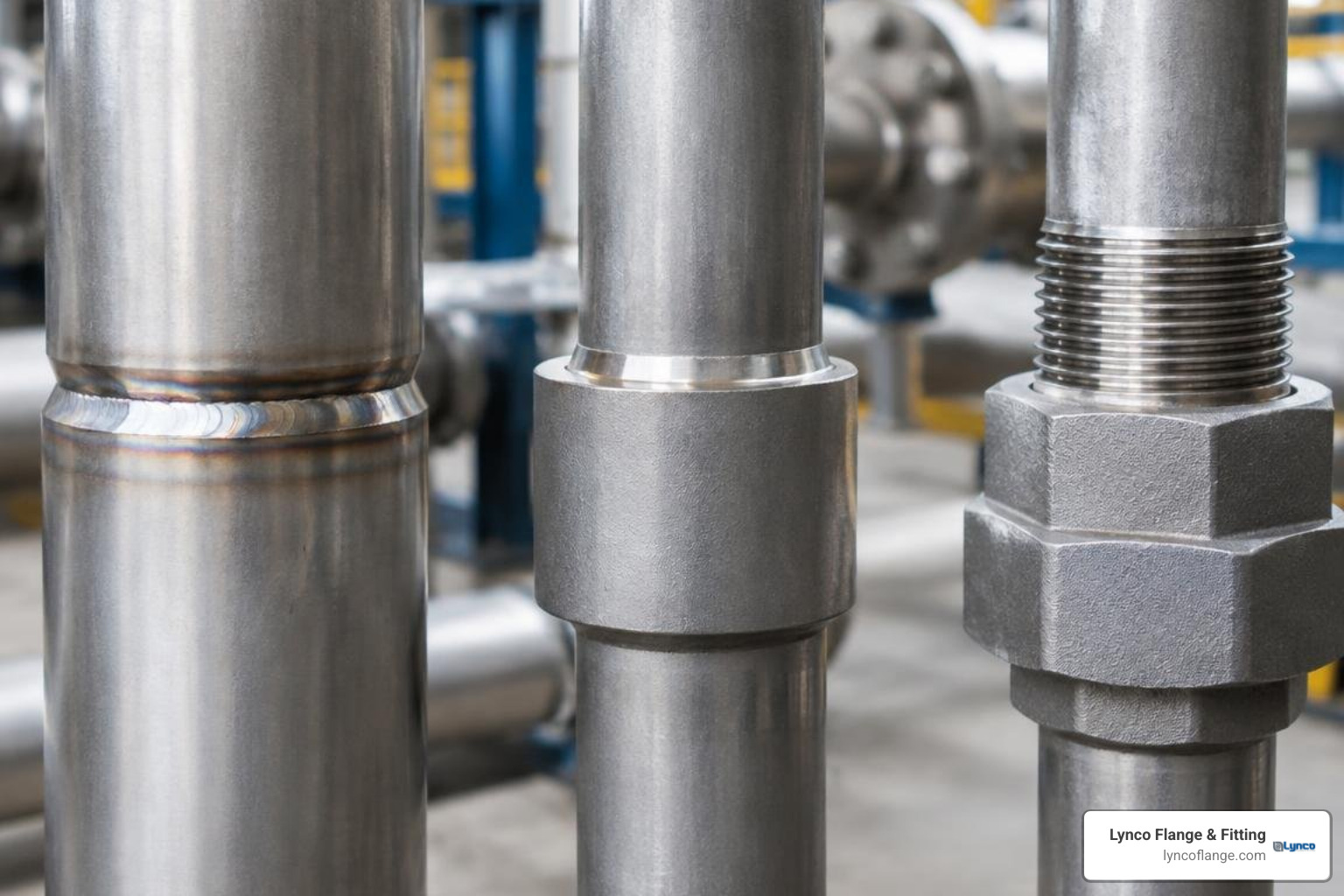
Welded and Forged Steel Connections
High-integrity industrial systems depend on welded joints to ensure pressure containment:
- Butt-Weld Fittings (ASME B16.9): Pipe ends are beveled to a 37.5-degree angle (creating a 75-degree included V-groove) and welded directly to the matching beveled end of the fitting. This achieves a smooth internal transition that minimizes pressure drop and matches the full structural yield strength of the parent pipe. The structural integrity of weld fittings makes them the primary choice for critical refining and high-pressure steam headers.
- Socket-Weld Fittings (ASME B16.11): The pipe slips into an internal counterbore before a fillet weld is applied around the outer hub. An axial expansion gap of roughly 1/16 inch must be left between the pipe end and the bottom of the socket pocket prior to welding. This gap accommodates thermal expansion during the welding pass and prevents weld-root cracking.
- Forged vs. Cast Components: In high-stress piping, forged steel fittings outperform cast options because the forging process aligns the metal grain structure, eliminating internal voids, gas pockets, and porosity that can compromise cast metals under cyclic pressure.
Threaded, Mechanical, and Push-Fit Joining Methods
Non-welded joints allow faster installation and simpler field servicing:
- Tapered Pipe Threads (NPT vs. BSPT): National Pipe Taper (NPT) utilizes a 60-degree thread angle and a 1-in-16 taper ratio, while British Standard Pipe Taper (BSPT) features a 55-degree angle. Because their thread profiles and pitches differ, NPT and BSPT fittings cannot be interchanged. Thread sealant should always be applied to male threads only, keeping excess compound out of the fluid stream.
- Press Fittings: Press technology uses a calibrated electro-hydraulic tool to compress an internal O-ring seal onto the pipe. Pressing a stainless steel fitting can be completed within five seconds with the correct equipment, and stainless steel and carbon steel press fittings can withstand up to 16 bars of pressure.
- Compression and Flare Fittings: Compression joints seal by driving a brass or stainless steel ferrule into the tube wall as the nut tightens. Once tightened, the ferrule deforms permanently, which is why compression rings cannot be reused after disassembly. Flare fittings use a 45-degree or 37-degree flared tube mouth clamped against a matching cone, delivering high resistance to vibration pull-out in gas lines and hydraulic circuits.
- Grooved Mechanical Couplings: These fittings rely on ductile iron housing clamps engaging circumferential rolled or cut grooves on the pipe ends. Gasketed grooved joints accommodate slight axial expansion and angular deflection, making them popular in commercial fire protection lines and HVAC chillers.
Pressurized Systems vs. Drain-Waste-Vent (DWV) and Specialized Applications
Plumbing codes strictly separate pressurized supply piping from gravity-fed drain-waste-vent (DWV) systems. Pressure fittings feature compact, sharp geometric profiles designed to withstand internal hoop stress. In contrast, DWV fittings use broad, sweeping curves that rely on gravity to move solids and liquids without clogging.
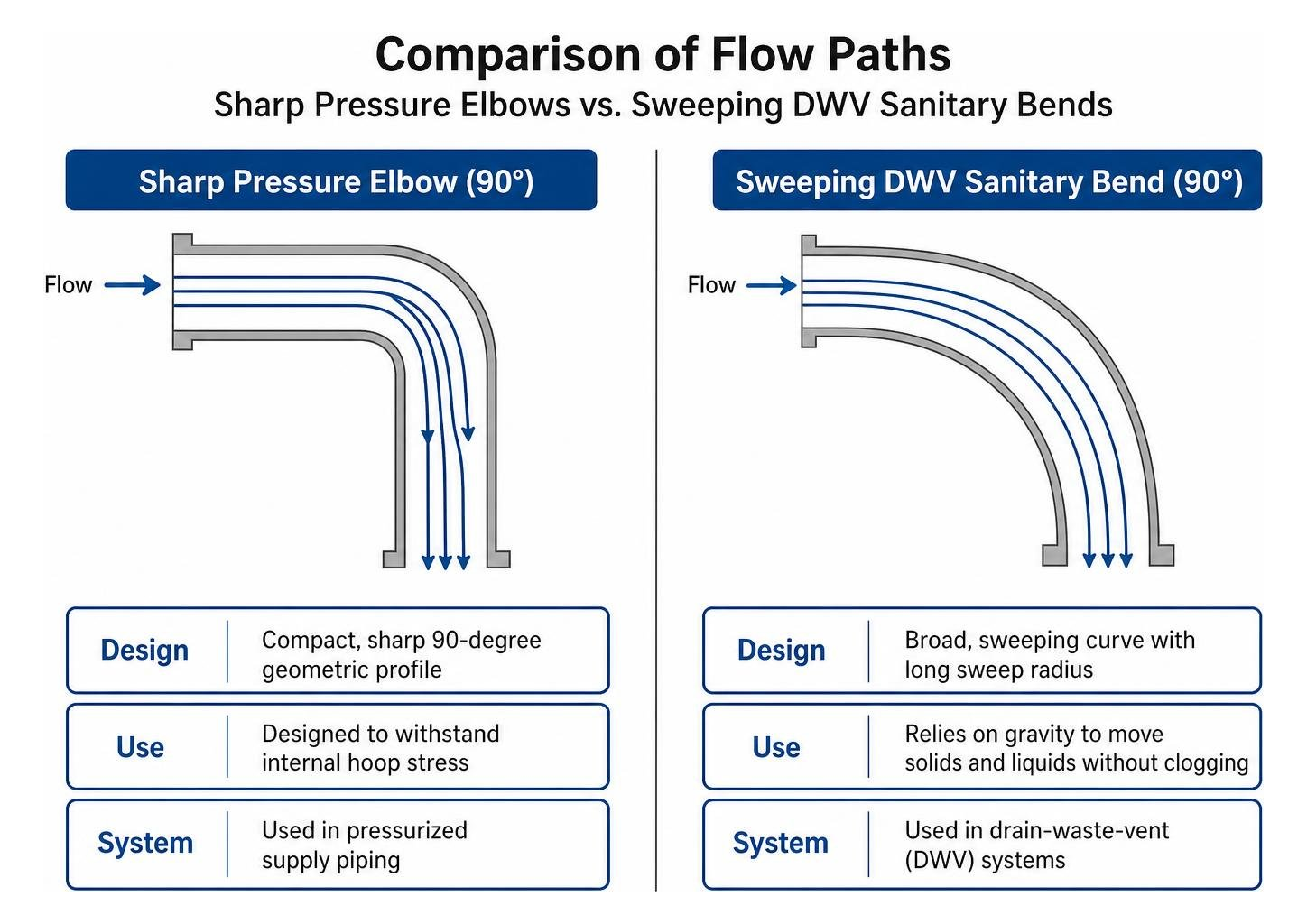
Key differences and specialized fittings include:
- Sweep Elbows and Sanitary Tees: Standard DWV 90-degree elbows incorporate a long sweep radius to guide waste smoothly down vertical stacks. Sanitary tees feature a curved baffle designed specifically to introduce horizontal fixture waste into a vertical stack while leaving the upper section open for air venting. Sanitary tees should never be installed horizontally, as their short turn radius can cause solids to settle and block the line; combination wyes with separate 45-degree bends must be used instead.
- Fixture Traps (P-Traps): Located directly below sink and floor drains, P-traps maintain a standing water seal that prevents hazardous, explosive sewer gases from entering occupied spaces.
- Clean-Out Fittings: Positioned at the base of vertical drainage stacks, ahead of building exits, and at long horizontal intervals, clean-outs feature a removable threaded plug that allows direct mechanical rodding access to clear clogs.
- Closet Flanges: Also known as toilet flanges, these specialized fittings anchor floor-mounted water closets to the structural subfloor while sealing the fixture outlet to the drainage system via a wax ring or elastomeric gasket.
Selecting properly rated components and following accurate sizing considerations for piping systems helps engineers and contractors avoid common pipe fitting selection mistakes that lead to premature joint failure.
Frequently Asked Questions about Pipe Fittings
What is the functional difference between a pipe coupling and a pipe union?
A pipe coupling creates a semi-permanent joint between two pipe lengths. Disassembling a coupled line generally requires cutting the pipe or unthreading multiple upstream joints. A pipe union is a three-piece fitting with two modular end pieces joined by a central threaded nut. Loosening this central nut allows you to disconnect and service pumps, valves, or filters without altering the adjacent pipe run.
When should you use a long-radius elbow instead of a short-radius elbow?
Use a long-radius (1.5D) elbow whenever space permits. Its sweeping centerline reduces friction loss, lowers turbulence, and minimizes pump power requirements. Short-radius (1.0D) elbows should be reserved for tight, space-constrained areas, such as compact equipment skids or vessel manifolds, where long-radius fittings will not fit.
Why do thermoplastic pipe fittings require pressure derating at elevated temperatures?
Thermoplastic polymers like PVC and CPVC lose tensile strength as temperatures increase. Their catalog pressure ratings are calculated at a standard baseline of 73°F (23°C). Operating above this temperature softens the plastic and lowers its allowable hoop stress. For example, operating PVC near its maximum allowable threshold of 140°F reduces its actual pressure capacity to less than one-third of its nominal rating.
Conclusion
Every industrial fluid and gas application requires matching the right fitting geometry, metallurgy, and joint configuration to the operating environment. Whether building a severe-service refinery header or a commercial distribution line, choosing high-integrity components is essential for long-term safety and performance.
At Lynco Flange & Fitting, our Houston, Texas team pairs extensive inventory with ISO-compliant quality control and deep technical expertise. Explore our forged steel pipe fittings and industrial flange solutions or contact our engineering sales staff for dependable, project-ready guidance.