Understanding the Blind Flange PVC Schedule 80: Design and Core Standards
When isolating flow or creating an accessible termination point in a piping run, mechanical engineers often turn to thermoplastic solutions. A Schedule 80 PVC blind flange is a solid, unbored circular disc molded without an inner bore. Instead of allowing fluid to pass through, its purpose is to seal off the line, terminating the piping network or blanking off an equipment nozzle.
Manufacturing rigid thermoplastic components requires strict adherence to standardized material and dimensional criteria. Schedule 80 PVC blind flanges are produced from unplasticized polyvinyl chloride compounds meeting ASTM D1784 Class 12454-B (Type I, Grade 1). This designation ensures the material exhibits high tensile strength, excellent modulus of elasticity, and chemical resistance.
The manufacturing and geometry of these fittings comply with ASTM D2467, which governs socket-type and flanged PVC fittings, while specialized molded components adhere to ASTM F1970. Furthermore, the bolt circle, hole count, and overall bolt spacing follow the widely recognized ANSI/ASME B16.5 Class 150 drilling standard. This dimensional consistency ensures that a Schedule 80 PVC blind flange can bolt seamlessly to matching companion flanges, metallic valves, pumps, or vessel nozzles without custom machining. For a deeper look at industry specs, review our guide on understanding flange standards and specifications.
What Distinguishes a Blind Flange PVC Schedule 80 from Standard and Companion Flanges?
In fluid handling systems, knowing which flange type to install prevents costly downtime and mechanical failure. Flanges fall broadly into two operational camps: open-bore flanges that facilitate fluid transport and solid-bore flanges that halt it.
A companion flange features a socket-weld or female threaded center hub designed to join directly onto a pipe end, allowing media to travel through unobstructed. In contrast, a blind flange possesses a completely flat, solid face with no center opening.
Unlike permanent solvent-welded end caps, a bolted blind flange serves as an accessible closure. It gives piping operators the ability to unbolt the assembly for cleanout access, visual interior inspections, hydro-testing, or system extensions. To dive deeper into these mechanical differences, check out what you need to know about blind pipe flanges and discover how technicians blank off pipe ends with blind flanges safely during planned maintenance.
Schedule 40 vs. Schedule 80: Pressure Ratings, Temperature Limits, and Wall Thickness
The primary mechanical difference between Schedule 40 and Schedule 80 PVC lies in wall thickness and total material volume. Schedule 80 components are molded with considerably thicker walls, giving them the structural rigidity necessary to handle heavier mechanical loads and higher internal hydraulic pressures.
The baseline working pressure for molded Schedule 80 PVC blind flanges is typically 150 PSI at 73°F (23°C). However, thermoplastic materials are sensitive to thermal changes. As operating temperatures climb, the tensile strength of the polymer diminishes, requiring engineers to apply a thermal derating factor:
- 73°F (23°C): 100% of rated capacity (150 PSI)
- 90°F (32°C): ~75% derated capacity (112 PSI)
- 110°F (43°C): ~50% derated capacity (75 PSI)
- 140°F (60°C): ~22% derated capacity (33 PSI)
Operating PVC components beyond 140°F (60°C) is not recommended; applications exceeding this threshold typically require switching to metallic alloys engineered for elevated temperatures.
| Specification | Schedule 40 PVC Blind Flange | Schedule 80 PVC Blind Flange |
|---|---|---|
| Primary Color | White | Dark Gray |
| Standard Baseline Pressure | Lower (variable by size) | 150 PSI @ 73°F (up to 8″ typically) |
| Relative Wall Thickness | Standard | Heavy-duty / Extra thick |
| Max Working Temperature | 140°F (60°C) | 140°F (60°C) |
| Material Standard | ASTM D1784 | ASTM D1784 Class 12454-B |
| Fitting Standard | ASTM D2466 | ASTM D2467 / ASTM F1970 |
| Bolt Pattern Standard | ANSI/ASME B16.5 Class 150 | ANSI/ASME B16.5 Class 150 |
| Common Environments | Residential, light irrigation, drainage | Industrial process, chemical, water treatment |
Key Applications and Industry Advantages of PVC Over Metal Flanges
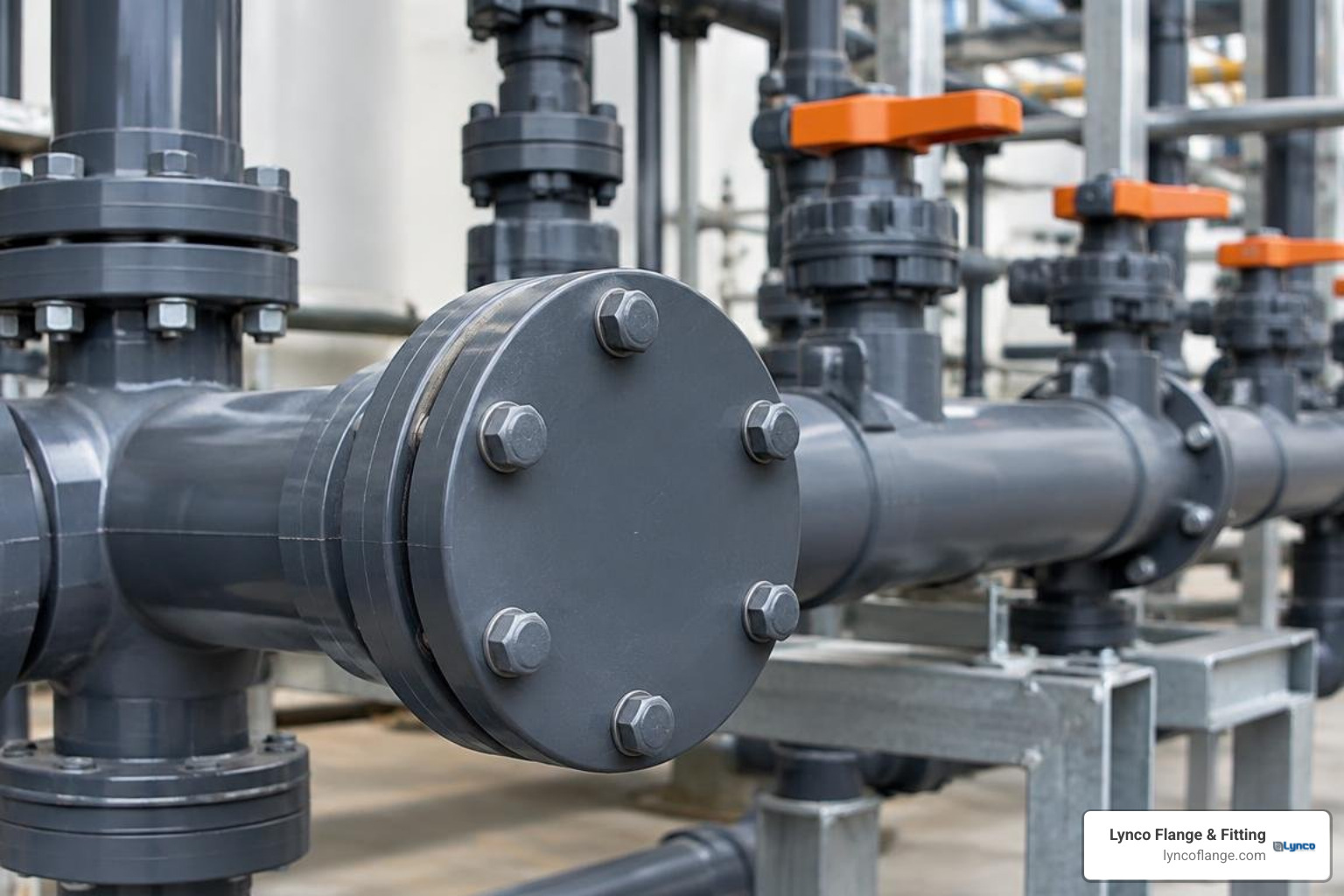
Industrial piping networks handling reactive chemicals, aggressive water chemistry, or saline fluids often require specialized material selection to avoid premature degradation. Schedule 80 PVC eliminates galvanic reactions, rusting, and pitting corrosion in moderate-temperature chemical environments.
PVC offers natural compatibility with mineral acids, bases, salts, and sodium hypochlorite solutions. Learning how to avoid corrosion on flanges often begins with selecting the right inert material for wet, chemically active environments.
Beyond chemical compatibility, Schedule 80 PVC delivers significant handling and installation advantages:
- Weight Reduction: Thermoplastic flanges weigh a fraction of heavy metallic alternatives, reducing structural support requirements and minimizing technician fatigue during installation.
- Smooth Non-Conductive Surface: PVC does not support electrolytic conduction, making it ideal for buried utilities or electrolytic chemical environments.
- Total Installed Cost: Between lower component purchasing costs and reduced labor hours during assembly, plastic flanging systems present a budget-conscious fluid containment solution.
Comprehensive Size Ranges for Blind Flange PVC Schedule 80 Installations
Schedule 80 PVC blind flanges are manufactured in a wide array of diameters to match industrial systems. From compact instrumentation tie-ins to massive municipal intake headers, these fittings mirror standardized pipe sizes:
- Compact Sizes (1/2″ to 1-1/2″): Utilize a standard 4-bolt pattern, common on chemical dosing skids, bypass loops, and test ports.
- Mid-Range Diameters (2″ to 4″): Utilize 4-bolt and 8-bolt configurations, serving commercial swimming facilities, municipal wastewater lines, and pump stations.
- Large Industrial Headers (6″ to 12″+): Utilize 8-bolt, 12-bolt, and larger Class 150 patterns to cap large manifold runs.
To evaluate dimensions across varying piping footprints, explore our breakdown of the most common pipe flange sizes and uses.
Primary Industrial Use Cases: From Chemical Processing to Water Treatment
Because Schedule 80 blind flanges provide a pressure-rated seal that can be unbolted on demand, they serve multiple operational roles across industrial facilities:
- Hydrostatic & Pressure Testing: During construction and commissioning, engineers use blind flanges to seal pipeline sections for hydrostatic pressure integrity verification before connecting downstream components.
- Future Expansion Ports: Installing a flanged tee with a blind flange creates a plug-and-play tie-in point for future branch connections, avoiding the need to cut and re-glue pipe in an active plant.
- Municipal & Wastewater Treatment: Heavy-duty PVC blanks isolate sludge lines, filter beds, and disinfection chemical feed systems during cleaning cycles.
- Agricultural & Commercial Irrigation: Large filtration manifolds utilize blind flanges on cleanout ports to simplify debris removal and seasonal drainage.
For more layout ideas and operational strategies, check out 5 ways to use blind pipe in your project.
Installation Best Practices: Gasket Selection, Bolting Sequence, and Reuse
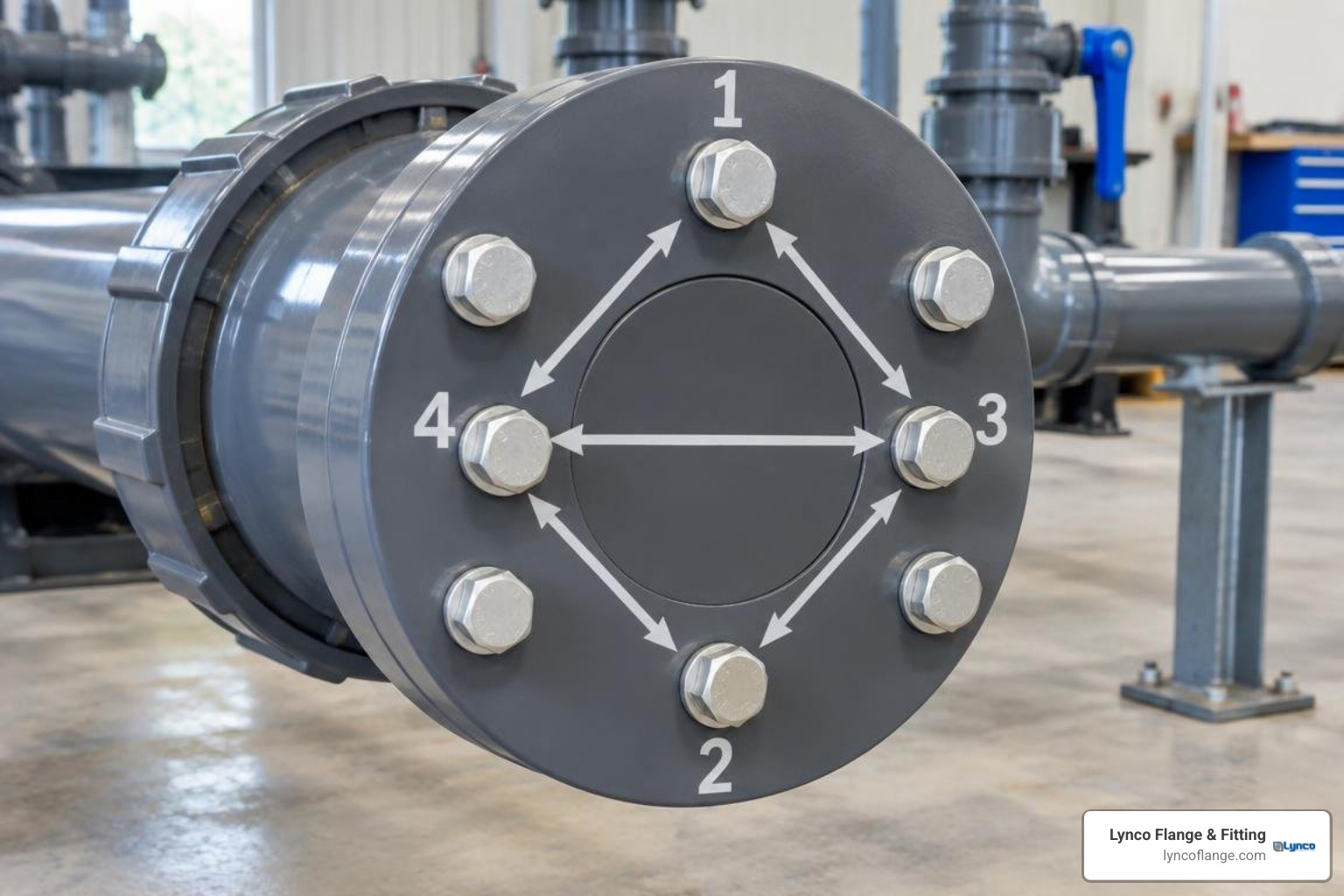
Installing a Schedule 80 PVC blind flange requires a different approach than mounting heavy forged steel flanges. Thermoplastics are rigid yet ductile; applying excessive torque or uneven bolting pressure can crack the bolt holes or warp the sealing face.
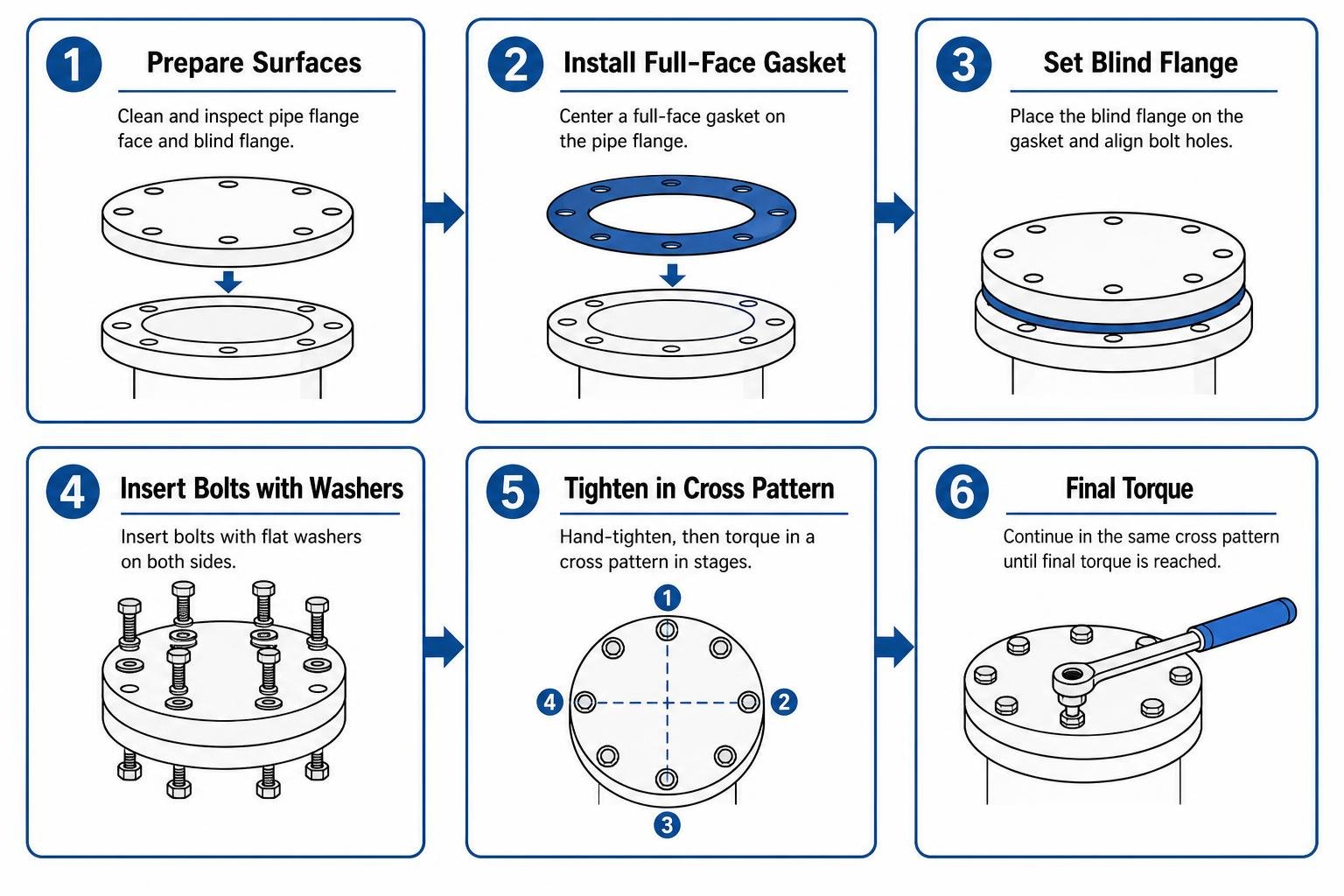
Follow these installation rules for a dependable, leak-free joint:
- Use Full-Face Elastomeric Gaskets: Never use ring-style gaskets with flat-faced thermoplastic flanges. Doing so introduces bending moments across the flange face as bolts are tightened, causing the plastic to snap. Always select a full-face gasket (1/8″ thickness recommended) made from chemically compatible elastomers—such as EPDM for general water and mild chemicals, or FKM (Viton) for aggressive acids and hydrocarbons. Hardness should ideally fall between 55 to 70 Durometer Shore A.
- Employ Flat Washers on Both Sides: Place heavy-duty, zinc-plated or stainless steel flat washers under both the bolt head and the nut. Washers distribute clamping loads evenly over the PVC surface and prevent the fastener heads from gouging the plastic.
- Lubricate Fastener Threads: Apply an approved light lubricant or PTFE paste to bolt threads and nut faces to reduce frictional drag, ensuring torque translates accurately into gasket compression.
- Follow a Star/Cross-Pattern Sequence: Tighten all bolts hand-tight first. Then, using a calibrated torque wrench, tighten the bolts in a crisscross sequence in three graduated stages:
- Step 1: Tighten to ~30% of target torque.
- Step 2: Tighten to ~60% of target torque.
- Step 3: Tighten to 100% of target torque.
- Final Step: Perform a continuous clockwise pass at 100% torque to ensure uniform compression.
To master proper bolting techniques, read our technical articles on how to properly torque flanges techniques and tips and follow our step-by-step breakdown on how to properly install flanges a step by step guide.
Frequently Asked Questions About PVC Blind Flanges
Are Schedule 80 PVC blind flanges approved for potable drinking water systems?
Yes. Quality Schedule 80 PVC blind flanges are molded from virgin compounds certified under NSF/ANSI Standard 61 (Drinking Water System Components – Health Effects) and NSF/ANSI Standard 14 (Plastics Piping System Components and Related Materials). These third-party certifications verify that the plastic formulation will not leach harmful chemicals, heavy metals, or volatile organic compounds into drinking water supplies.
Can Schedule 80 PVC blind flanges be used in compressed air or gas systems?
No. Thermoplastic PVC components should never be used to contain or transport compressed air or compressed gases.
Unlike ductile metals that deform or leak when overloaded, rigid PVC is subject to brittle failure when exposed to pressurized compressible gases. If a PVC fitting fails under gas pressure, it can burst violently into sharp, flying fragments. Thermoplastic flanging and piping components should strictly be specified for liquid service.
Can a PVC blind flange be safely reused after removal?
Yes, provided a strict inspection protocol is followed:
- System Isolation & Depressurization: Always confirm the piping line is drained, isolated, and depressurized before unbolting.
- Visual Inspection: Examine the blind flange closely for radial hairline cracks around bolt holes, severe stress whitening, chemical erosion, or face warpage. If defects are found, discard the flange immediately.
- Mandatory Gasket Replacement: Never reuse an old elastomeric gasket. Gaskets experience permanent compression set during service; always install a brand-new full-face gasket when remounting a blind flange.
Conclusion: Selecting the Right Industrial Flange Solutions
Schedule 80 PVC blind flanges provide a durable, corrosion-resistant, and cost-effective method for terminating and managing industrial fluid systems. By combining standard ANSI B16.5 bolt pattern compatibility with the chemical immunity of unplasticized PVC, these fittings ensure cleanout access and system expansion capabilities without the rust and weight of traditional metal fittings.
Achieving a leak-free, long-lasting installation comes down to matching your chemical environment, verifying operating pressures against temperature derating curves, and following torque best practices. At Lynco Flange & Fitting, our technical team works directly with engineers, plant managers, and procurement specialists to deliver high-integrity solutions across oil and gas, chemical processing, municipal water, power, and manufacturing sectors.
For complete technical specifications or assistance in sizing the right components for your next project, read our comprehensive guide on what you need to know about blind pipe flanges or contact our engineering sales group today.