Types and Styles of Exhaust Pipe Flange Connections
Selecting the proper exhaust pipe flange design depends on whether you are building a custom high-performance header, completing an OEM replacement, or executing a fast roadside repair. The geometry dictates how mechanical clamping force is distributed around the circumference of the exhaust tubing. Failing to balance that clamping force leads to exhaust blowouts, irritating noise, and toxic fumes entering the vehicle cabin.
Implementing proper installation practices and preventing pipe flange leaks starts with choosing the right mechanical configuration for your exhaust layout.
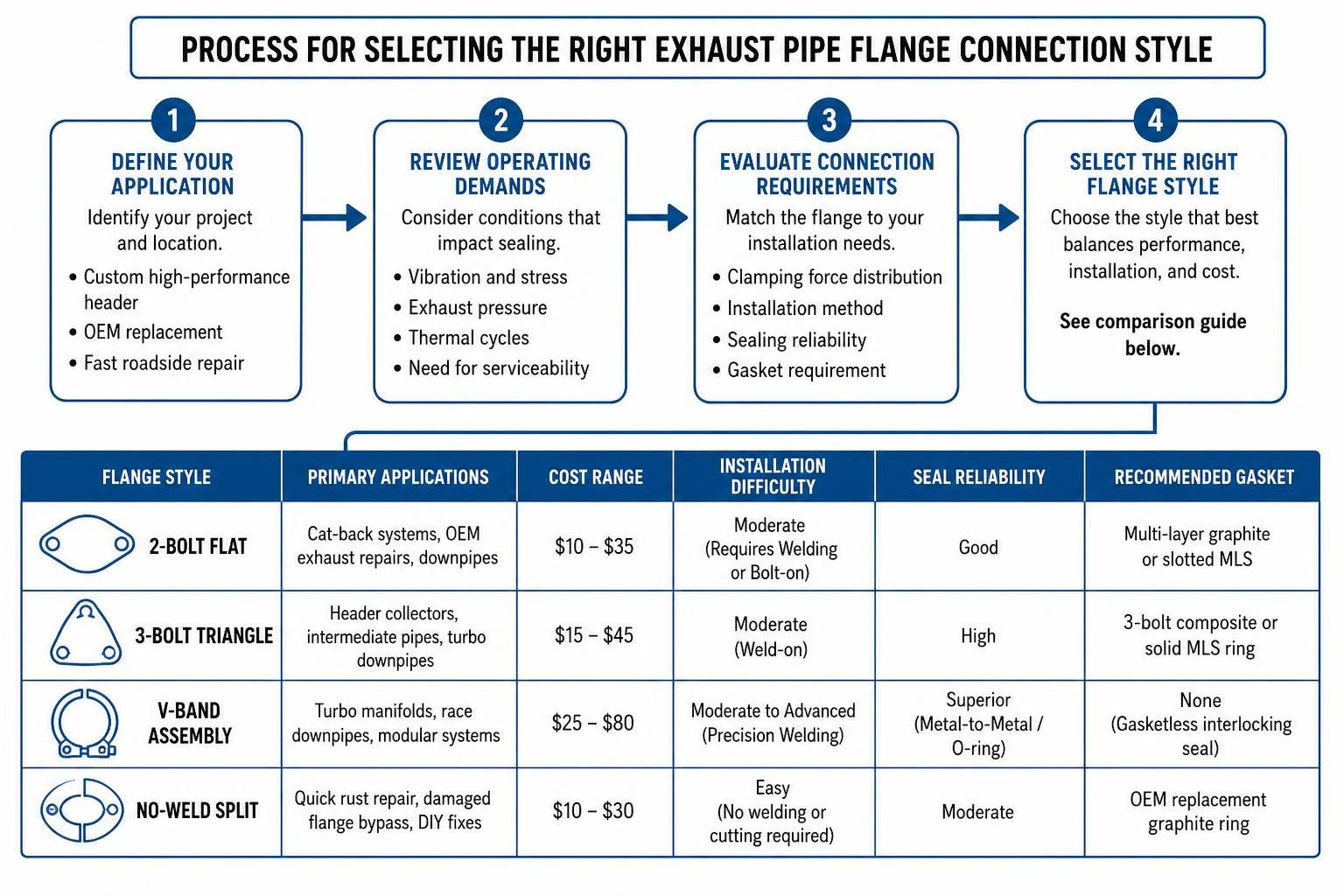
| Flange Style | Primary Applications | Cost Range | Installation Difficulty | Seal Reliability | Recommended Gasket |
|---|---|---|---|---|---|
| 2-Bolt Flat | Cat-back systems, OEM exhaust repairs, downpipes | $10 – $35 | Moderate (Requires Welding or Bolt-on) | Good | Multi-layer graphite or slotted MLS |
| 3-Bolt Triangle | Header collectors, intermediate pipes, turbo downpipes | $15 – $45 | Moderate (Weld-on) | High | 3-bolt composite or solid MLS ring |
| V-Band Assembly | Turbo manifolds, race downpipes, modular systems | $25 – $80 | Moderate to Advanced (Precision Welding) | Superior (Metal-to-Metal / O-ring) | None (Gasketless interlocking seal) |
| No-Weld Split | Quick rust repair, damaged flange bypass, DIY fixes | $10 – $30 | Easy (No welding or cutting required) | Moderate | OEM replacement graphite ring |
2-Bolt and 3-Bolt Exhaust Pipe Flange Configurations
Two-bolt flat (oval) and three-bolt triangular flanges represent the industry baseline for OEM production vehicles and budget aftermarket exhausts. Standard 2-bolt designs use two opposing fasteners along a single plane. They are popular on intermediate exhaust pipes, catalytic converter hookups, and muffler inlets. Premium aftermarket offerings feature heavy-duty 3/8-inch (9.5mm) thick laser-cut plates, such as the DIFtech 2.5-inch 2-bolt weld-on flange, which resist thermal deformation across long highway runs.
For applications subject to higher vibrations and torsional stress—such as header collectors and high-flow catalytic converters—the 3-bolt triangle configuration distributes clamping force across three points spaced 120 degrees apart. This geometry minimizes edge lifting between bolts, a common issue when running thinner 16-gauge tubing. Users consistently award precision-machined 3-bolt stainless flanges high praise, earning a 4.5 out of 5-star rating across 98 customer reviews for reliable sealing on aggressive road applications.
V-Band Clamp Systems vs Traditional Bolted Assemblies
When space is tight or you frequently pull your exhaust for transmission access or track maintenance, traditional multi-bolt flanges can be frustrating to service. V-band clamping systems solve this challenge through a clever 360-degree interlocking design.
A standard V-band assembly consists of two precision-machined rings featuring tapered outer shoulders and a matching single-bolt V-profile clamp. When tightened, the clamp draws the male and female interlocking lips together, forming a tight, gasketless seal capable of handling extreme exhaust gas pressures.
For custom turbo setups, universal weld-on options like the PPE 1.5-inch exhaust side V-band flange provide a solid, interlocking foundation in tight engine bays without sacrificing structural strength.
No-Weld Split Flanges and Slip-Fit Quick Repair Kits
Exhaust repairs do not always require firing up a TIG welder or taking your vehicle to an exhaust shop. When road salt, water, and heat rot away an OEM flange while the core pipe remains solid, a no-weld split flange provides an affordable, DIY-friendly solution.
Split flat flanges and oval split flanges come split into two interlocking halves that slide over the existing exhaust tubing directly behind the factory pipe flare. Once positioned, you bolt the two halves together, capturing the flared pipe end and restoring full clamping capability against the mating pipe.
For rotted pipe sections, universal slip-fit repair sleeves—such as 2.25-inch inside diameter (ID) to 2.25-inch outside diameter (OD) stainless steel replacement kits—slip over sound exhaust tubing. Secured with heavy-duty band clamps, they let you rebuild complete flange assemblies without cutting factory lines.
Material Selection and Sizing Specifications
Exhaust systems endure an unforgiving environment: interior gas temperatures routinely surpass 1,200°F (650°C), while exteriors face freezing rain, salt spray, and vibration. Selecting the right metallurgy and dimensional tolerances ensures your exhaust connection survives without warping or developing leaks.
Understanding the impact of temperature and pressure on flange selection prevents premature joint degradation and costly roadside repairs.
How to Measure an Exhaust Pipe Flange for Exact Fitment
Before purchasing replacement hardware, taking three precise measurements will prevent costly installation delays:
- Inside Diameter (ID): Measure the interior bore of the flange where the tubing inserts. For slip-fit weld-on flanges, the flange ID should match the outside diameter (OD) of your exhaust pipe (e.g., a 2.50-inch exhaust pipe requires a flange with a 2.50-inch ID slip fit).
- Bolt Hole Center-to-Center Spacing: Measure the exact distance from the center of one bolt hole across to the center of the opposite bolt hole. Standard 4-inch 3-bolt exhaust flanges, for example, typically share a 107.4mm bolt circle diameter.
- Flange Thickness: Measure the plate thickness. For weld-on applications, we recommend a plate thickness of at least 3/8-inch (9.5mm) to 11mm to prevent warping under thermal expansion.
A correctly sized flange paired with an application-specific gasket—such as the Fel-Pro 61338 exhaust pipe flange gasket—ensures a solid seal across diverse applications, with that single gasket design fitting 582 vehicles across 4 major makes (Acura, Honda, INFINITI, and Nissan).
Material Durability: 304 Stainless Steel, Mild Steel, and Titanium
When balancing longevity, budget, and weight, evaluating stainless steel vs carbon steel pipe fittings is a critical first step.
- 304 Stainless Steel: The premier choice for street and performance exhaust systems. Containing roughly 18% chromium and 8% nickel, 304 stainless provides outstanding oxidation resistance and mechanical strength under high heat. While costlier than mild steel, its longevity eliminates recurring replacement cycles. Learning how to avoid corrosion on flanges begins with choosing an alloy suited to your operating environment.
- Mild Steel / Aluminized Steel: Highly economical and simple to weld using standard MIG setups. Mild steel is a dependable budget choice, though raw surfaces will develop surface oxidation if not painted with high-temp ceramic coatings. Aluminized coatings add a protective layer against rust at a lower cost than stainless steel.
- Commercial Pure Grade 2 (CP2) Titanium: Engineered for professional racing and exotic builds where saving every ounce counts. CP2 titanium flanges drop connection weight by up to 45% compared to stainless steel while tolerating extreme thermal cycling. However, they demand specialized TIG welding setups with complete trailing argon shielding.
Engineering a Leak-Free Seal: Gaskets, Contours, and Welding Best Practices
A leak-free exhaust connection depends on matching bolt torque, thermal expansion characteristics, and surface flatness across both mating faces.

Understanding how flanges are manufactured makes it clear why laser-cut and CNC-machined plates deliver flatter sealing surfaces than thin, stamped alternatives.
Gasket Selection: Multi-Layer Steel, Graphite, and Composite
Choosing the correct gasket material bridges minor imperfections between mating flanges:
- Multi-Layer Steel (MLS): Built from stacked layers of embossed stainless steel coated with high-temp elastomers. MLS gaskets provide outstanding resilience in high-boost, high-heat environments like turbo downpipes.
- Multi-Layer Graphite: Flexible graphite bonded to a perforated steel core. These gaskets excel at filling microscopic surface irregularities on slightly warped or older flanges.
- Slotted Bolt Hole Gaskets: Designed with slotted mounting ears, these gaskets slide over bolts without complete disassembly, speeding up maintenance in the field.
For specialized industrial systems handling elevated line pressures, consult our high-pressure flange gasket selection guide to evaluate compression ratios and temperature ratings.
Preventing Flange Warping and Proper Pipe Welding Techniques
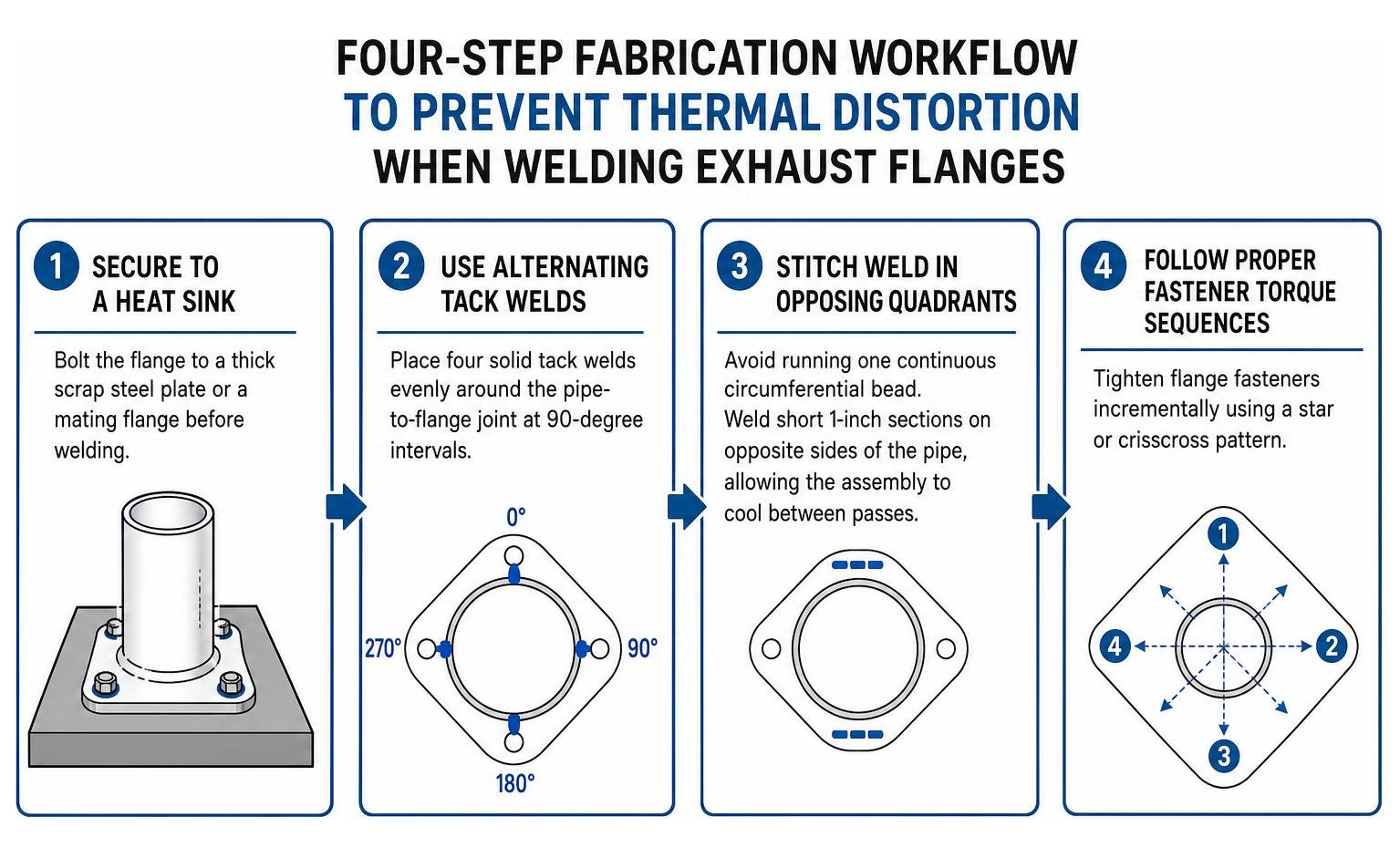
The primary cause of exhaust flange leaks right after installation is thermal distortion during welding. Excessive heat pulls the mounting plate out of true, leaving gaps between the fastener holes.
Follow these proven shop practices to keep your flanges flat:
- Secure to a Heat Sink: Bolt the flange to a thick scrap steel plate or a mating flange before welding. This mechanical restraint absorbs excess heat and holds the plate true.
- Use Alternating Tack Welds: Place four solid tack welds evenly around the pipe-to-flange joint at 90-degree intervals.
- Stitch Weld in Opposing Quadrants: Avoid running one continuous circumferential bead. Weld short 1-inch sections on opposite sides of the pipe, allowing the assembly to cool between passes.
- Follow Proper Fastener Torque Sequences: Always tighten flange fasteners incrementally using a star or crisscross pattern. Reviewing proper flange torque techniques ensures clamping load spreads evenly over the gasket face without crushing it unevenly.
Advanced Sealing Geometry and Patent Innovations
Modern flange engineering relies on patented geometric designs that maintain tight seals across extreme thermal cycles.
- Decoupled Pipe and Flange Gauges: As established in connection flange patent US 4,465,308, pairing a heavy-gauge flange (0.120″ to 0.170″ thick) with lightweight, thin-wall exhaust tubing (0.030″ to 0.060″ thick) optimizes structural rigidity at the joint while cutting overall chassis weight. This patent also details spherical and frustoconical mating faces that allow slight angular adjustment during installation without breaking the gas seal.
- Three-Dimensional Pressure Contouring: To solve edge-lifting between bolt locations, flanged joint patent US 8,336,668 introduces convex surface contours and intermediate rings. These contours focus bolt load between fastening sites, equalizing contact pressure around the entire circumference.
- Positive Robotic Assembly Stops: In automated manufacturing, pipe-to-flange joining patent US 6,068,302 integrates radial support stops spaced 120 degrees apart inside the flange bore. These stops keep exhaust pipes from tilting during automated assembly and fuse directly into the weld pool for consistent robotic joints.
Frequently Asked Questions About Exhaust Flanges
Why do exhaust flanges warp and leak over time?
Exhaust flanges endure extreme thermal cycling, expanding when hot and contracting as they cool. If a flange plate is thinner than 3/8-inch, this continuous movement—combined with uneven bolt torque, road corrosion, and engine vibration—eventually distorts the mating surface and blows out the gasket.
Can I install a split exhaust flange without welding?
Yes. Split exhaust flanges are purpose-built for weld-free repairs. They consist of two interlocking halves that slide over existing exhaust pipe flares behind a rusted or broken OEM flange. Once in place, bolting the halves together creates a secure clamping plate without cutting pipes or using a welder.
What flange thickness is best for high-temperature exhaust?
For general exhaust and collector applications, 3/8-inch (9.5mm) plate is the industry standard for preventing heat distortion. For turbocharger turbine outlets and high-performance downpipes running over 1,400°F (760°C), stepped 1/2-inch (12.7mm) CNC-machined flanges offer maximum stability against warping.
Conclusion
Upgrading or repairing your exhaust connection does not have to break the bank. By focusing on precise dimensional measurements, choosing the right alloy for your operating temperatures, and using thick, laser-cut plates, you can achieve a durable, leak-free exhaust seal on any budget.
Whether you need a universal split flange for a weekend driveway repair, an interlocking V-band for a high-boost turbo setup, or custom heavy-duty components for demanding operating environments, quality begins with precision engineering. Connect directly with the technical specialists at Lynco Flange & Fitting for reliable hardware tailored to your application’s exact specifications.