Choosing Copper Pipe Plumbing for Your Home
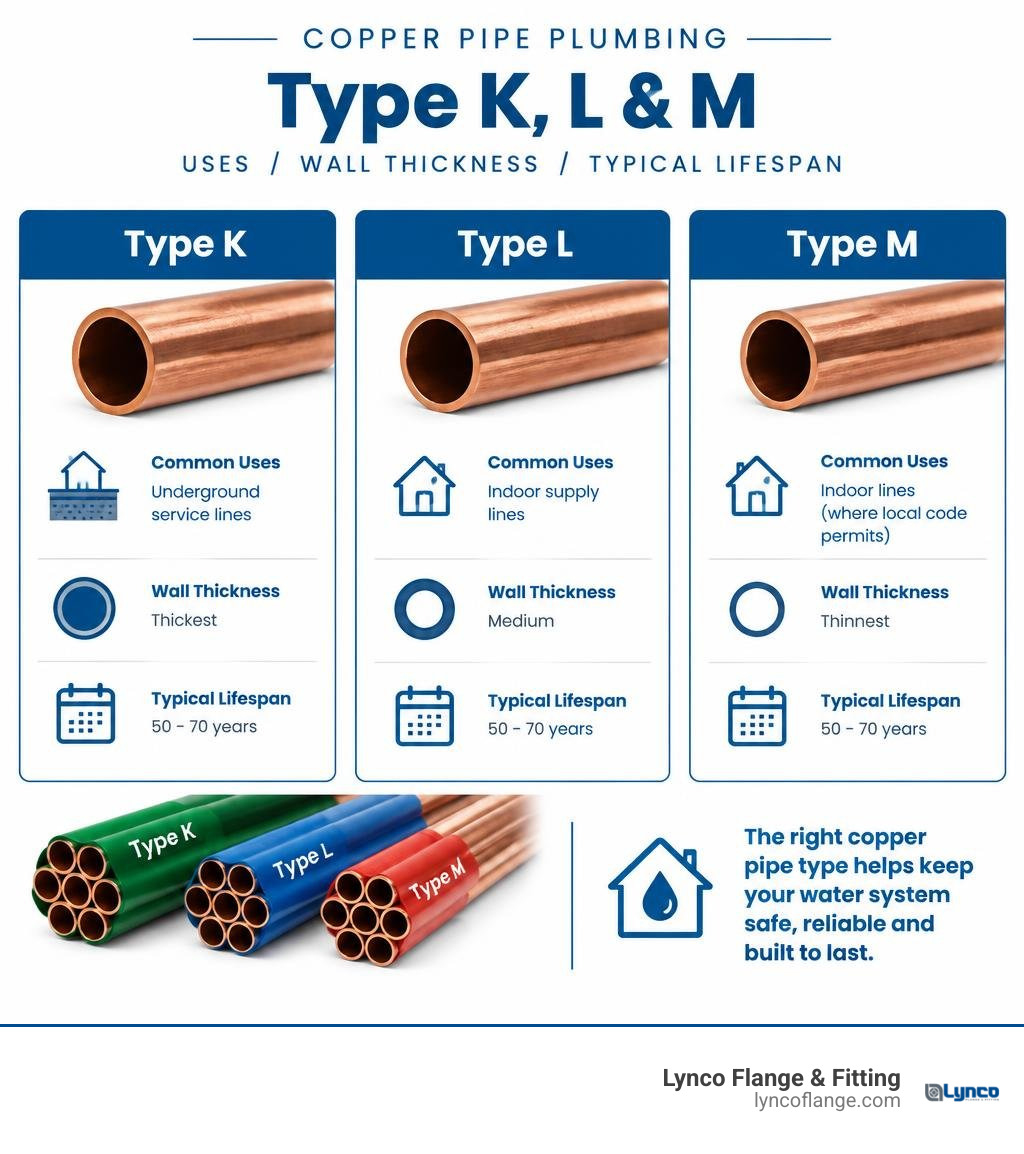
Copper pipe plumbing is a durable choice for hot and cold water lines. Type L is a common choice for indoor supply lines; Type K has thicker walls and is often used for underground service; Type M has thinner walls and may be allowed for indoor lines where local code permits. Copper can last 50 to 70 years, but water chemistry and installation quality matter.
This guide will help you compare pipe types, sizes, joining methods, and leak risks before you choose a system.
I’m Lance Vanover, CEO of Lynco Flange & Fitting, with over 26 years of experience in industrial pipe fittings and technical supply. I’ll use that background to explain the key choices in copper pipe plumbing without treating residential and industrial requirements as the same.
Types and Specifications of Domestic Copper Piping
When selecting piping for residential distribution, understanding metallurgy and dimensional standards ensures a safe, code-compliant install. Domestic copper tube is manufactured from high-purity, deoxidized copper—predominantly UNS alloy C12200 (phosphorus-deoxidized, high residual phosphorus)—which guarantees at least 99.9% pure copper content.
Copper tube is manufactured in two primary tempers:
- Drawn Temper (Rigid/Hard Copper): Pulled through sizing dies cold to achieve high tensile strength and rigidity. It is supplied in straight lengths (typically 10-foot or 20-foot sections) and is ideal for exposed, neat plumbing runs.
- Annealed Temper (Soft Copper): Thermally treated after drawing to restore ductility. Soft copper is sold in coils (often 60 to 100 feet), allowing it to be bent around framing members or snaked through existing walls and underground trenches without intermediate joints.
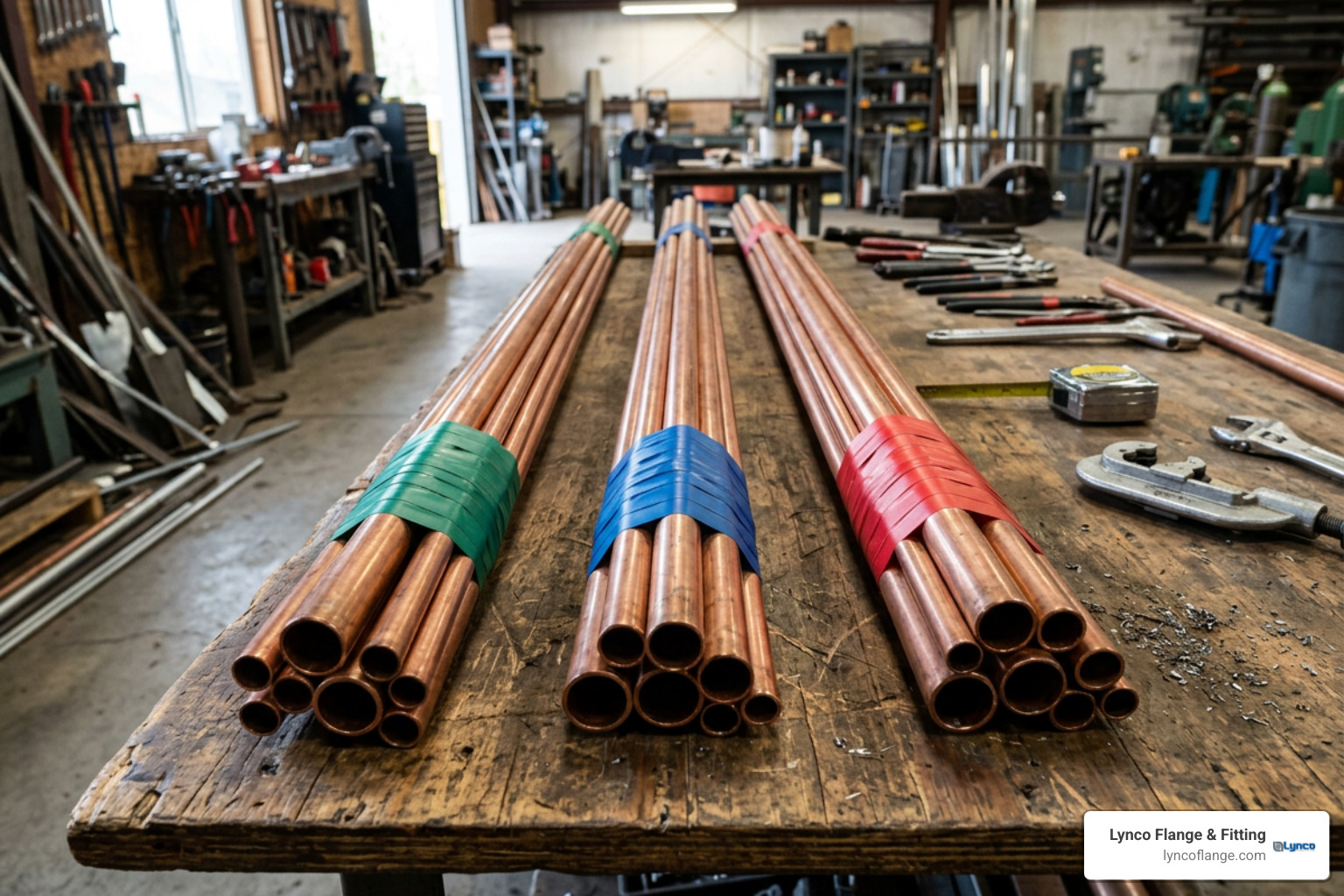
Copper tubes are categorized into standardized grades—Type K, Type L, Type M, and DWV (drain, waste, and vent)—distinguished by wall thickness.
| Tube Type | Color Code | Relative Wall Thickness | Common Residential Applications | Temper Options |
|---|---|---|---|---|
| Type K | Green | Thickest | Underground service lines, main water service, severe duty | Rigid Straight, Soft Coils |
| Type L | Blue | Medium | Interior water distribution, hot/cold supply branches, hydronic heating | Rigid Straight, Soft Coils |
| Type M | Red | Thinnest | Low-pressure domestic water branch lines (where code allows), hydronics | Rigid Straight (primarily) |
| DWV | Yellow | Very Thin (Non-Pressure) | Unpressurized gravity drainage, waste lines, plumbing vents | Rigid Straight |
Type K, L, and M Wall Thicknesses and Pressure Ratings
All three primary types (K, L, and M) share the identical outer diameter for any nominal diameter, ensuring they match standard fittings. The differentiation lies strictly in the internal wall thickness.
For example, looking at standard 1/2-inch nominal tube (which has an actual outside diameter of 5/8 inch, or 0.625 inches):
- Type K has a wall thickness of 0.049 inches.
- Type L has a wall thickness of 0.035 inches.
- Type M has a wall thickness of 0.028 inches.
Because burst pressure correlates directly with wall thickness, Type K offers the highest working pressure safety margins, making it mandatory for buried water lines subjected to soil load and external pressure. Type L serves as the residential workhorse, delivering a balance of pressure tolerance and material cost for interior walls. Type M provides a budget-friendly option for light-duty domestic runs where municipal supply pressures remain moderate.
Standard Dimensions and ASTM Compliance
Seamless copper water tube in North America is governed by ASTM B88 specifications. A standard rule of thumb for nominal ASTM water tubing is that the actual outside diameter (OD) is always exactly 1/8-inch (0.125 inches) larger than the nominal size designation.
- A 1/2-inch nominal pipe has a 5/8-inch (0.625″) OD.
- A 3/4-inch nominal pipe has a 7/8-inch (0.875″) OD.
- A 1-inch nominal pipe has a 1-1/8-inch (1.125″) OD.
Specialty applications use other specifications. For instance, ASTM B306 governs DWV drainage tubes (which have thinner walls and lower pressure ratings), while ASTM B280 and ASTM B819 define cleaned and capped lines for air conditioning, refrigeration (ACR), and medical gas piping.
Advantages of Copper Pipe Plumbing in Residential Systems
Copper remains a premier plumbing material due to its mechanical dependability and natural material characteristics, as outlined in the engineering specifications in the Copper Tube Handbook.
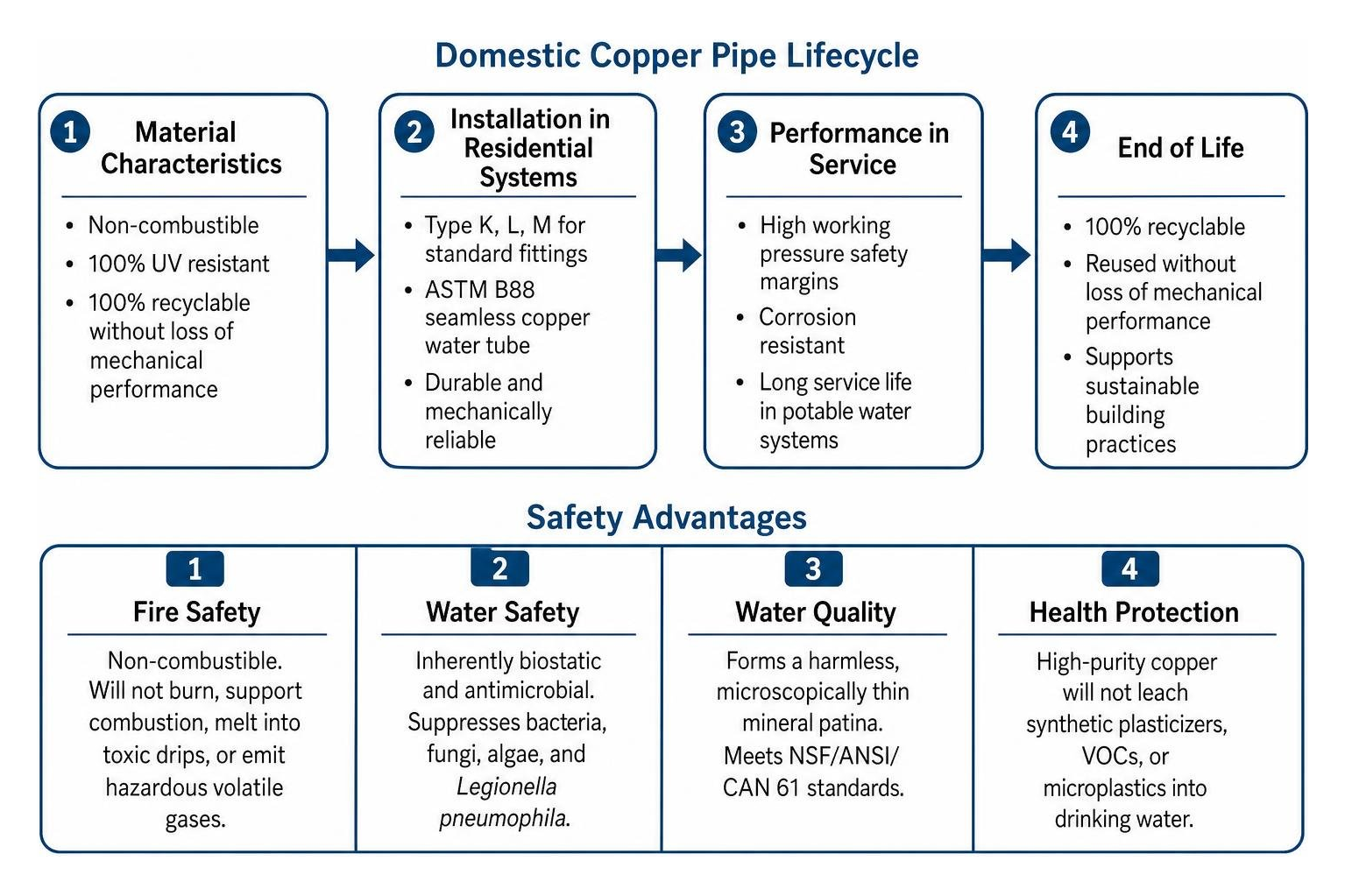
Unlike synthetic polymers, copper is non-combustible. In a residential structure fire, copper tubing will not burn, support combustion, melt into toxic drips, or emit hazardous volatile gases. Additionally, copper offers 100% UV resistance—meaning it will never become brittle when exposed to sunlight—and is 100% recyclable without any loss in mechanical performance.
Antimicrobial Properties and Water Safety
Copper is an inherently biostatic and antimicrobial metal. It naturally suppresses the growth of bacteria, fungi, algae, and dangerous waterborne pathogens like Legionella pneumophila.
When properly maintained under balanced water chemistry, copper forms a harmless, microscopically thin mineral patina that isolates potable water from direct metal exposure while meeting strict NSF/ANSI/CAN 61 safety standards. Unlike some plastics, high-purity copper cannot leach synthetic plasticizers, volatile organic compounds (VOCs), or microplastics into drinking water.
Thermal Resilience and Structural Durability
Copper handles extreme operating temperatures without warping or sagging. It retains ductile flexibility at cryogenic temperatures down to -452°F, actually increasing in tensile and yield strength as the temperature drops.
While water freezing inside any rigid pipe can cause rupture, copper’s natural ductility allows slight elastic expansion under minor freeze cycles before structural failure occurs, providing higher resilience than brittle plastic alternatives.
Copper vs. Plastic: Comparing Modern Piping Materials
Selecting the right piping requires evaluating key factors when selecting pipe fittings and pipe materials, balancing upfront cost against longevity.
| Performance Metric | Copper (Type L) | PEX (Cross-linked Polyethylene) | CPVC (Chlorinated Polyvinyl Chloride) |
|---|---|---|---|
| Typical Lifespan | 50 to 70+ years | 25 to 40 years | 20 to 30 years |
| Material Cost | High (market-tied) | Low | Moderate |
| Installation Labor | Moderate to High (skilled joining) | Low (fast mechanical crimping) | Low to Moderate (solvent cement) |
| Max Working Temp | 400°F+ (solder dependent) | 180°F to 200°F | 180°F to 200°F |
| UV Resistance | Impervious | Degrades rapidly (30-90 days) | Moderate (becomes brittle) |
| Rodent Damage Risk | Zero | Vulnerable to chewing/leaks | Minimal |
| Primary Failure Risk | Acidic pitting, high-velocity wear | Fitting dezincification, chemical oxidation | Brittle fracturing, solvent joint failure |
Durability and Long-Term Lifespan
Under neutral water conditions, copper plumbing systems regularly exceed 50 to 70 years of dependable service. Its rigid structure resists accidental nail punctures, will not sag between joists over time, and remains completely rodent-proof.
By contrast, flexible polymers like PEX can fall victim to rodent damage, and their mechanical properties can degrade if exposed to excess municipal chlorine or prolonged UV light during construction.
Installation Complexity and Material Costs
PEX and CPVC require lower upfront material investments and install quickly using flexible continuous runs and crimped fittings. Copper demands higher material expenditures and precise labor—requiring proper pipe sizing, burr removal, and heat or press joining. However, copper’s proven track record and scrap recovery value yield substantial long-term returns for homeowners building permanent equity.
System Design, Joining Methods, and Installation Best Practices

A reliable copper piping layout requires thoughtful engineering:
- Support Spacing: Support horizontal runs of 1/2″ to 3/4″ copper every 6 to 8 feet using copper-plated or plastic-coated hangers to prevent sagging.
- Expansion Loops: Copper expands approximately 1.1 inches per 100 feet for every 100°F temperature rise. Incorporate gentle offsets or U-bends on long, straight hot water lines.
- Preparation: Always cut square and deburr the inside diameter to maintain laminar flow.
Sizing Considerations for Copper Pipe Plumbing Systems
Proper pipe sizing balances flow velocity with supply demand. Plumbers use Fixture Unit (FU) calculations to convert fixture loads (sinks, showers, hose bibbs) into gallons per minute (GPM), referencing the importance of properly sized fittings for piping systems to minimize dynamic head loss.
Undersized tubing elevates flow velocities, creating noisy water hammer and stripping the metal’s internal protective layer, while oversized tubing adds unnecessary material cost and increases hot water delivery wait times.
Joining Techniques for Copper Pipe Plumbing
Selecting the correct joining technique prevents premature failures and avoids common mistakes when choosing pipe fittings.
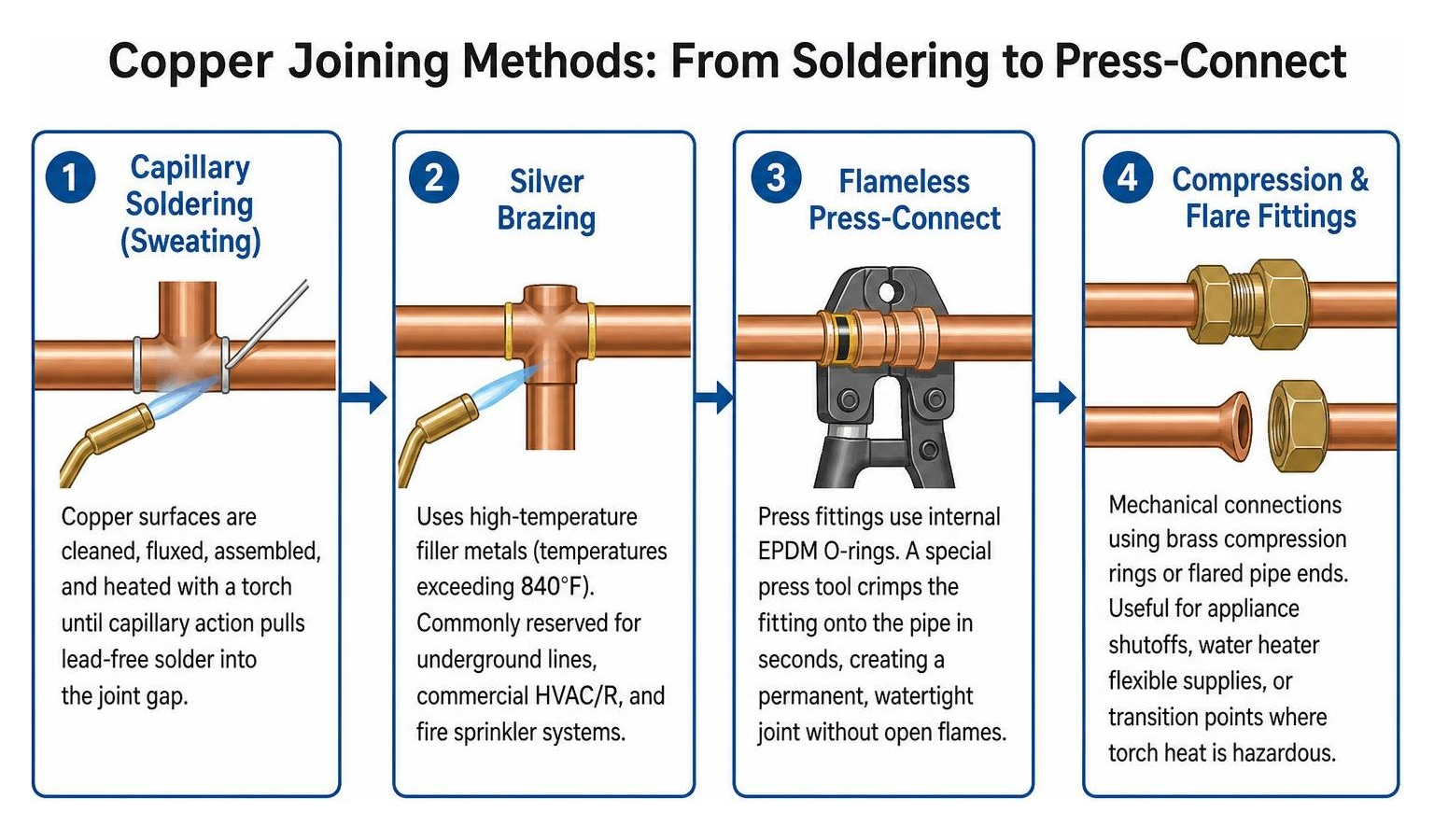
- Capillary Soldering (Sweating): The classic trade method governed by ASTM B828. Copper surfaces are cleaned with an abrasive pad, coated with a thin layer of lead-free water-soluble flux, assembled, and heated with a torch until capillary action pulls lead-free solder wire into the joint gap.
- Silver Brazing: Uses high-temperature filler metals (temperatures exceeding 840°F). Commonly reserved for underground lines, commercial HVAC/R, and fire sprinkler systems where extreme joint strength is required.
- Flameless Press-Connect: Modern press fittings utilize precision-engineered copper fittings with internal EPDM O-rings. A specialized mechanical press tool crimps the fitting onto the pipe in seconds, producing a permanent, watertight joint without open flames or hot work permits.
- Compression & Flare Fittings: Mechanical connections relying on brass compression rings or flared pipe ends. Useful for appliance shutoffs, water heater flexible supplies, or transition points where torch heat is hazardous.
Managing Water Chemistry and Preventing Pipe Corrosion
Copper owes its longevity to passivation—the spontaneous development of an internal cuprous oxide (Cu2O) film and mineral patina. When water is chemically balanced, this microscopic scale insulates the raw copper from dissolved oxygen, maintaining negligible corrosion rates (under 0.0003 inches per year).
However, aggressive water chemistry can disrupt this patina, as thoroughly documented in forensic research on copper pipe performance and corrosion.
Acidic Water, pH Levels, and Pitting Risks
- Low pH Waters: Water with a pH below 6.5 accelerates copper dissolution, leading to green staining in sinks, metallic tastes, and gradual pipe wall thinning. Installing a whole-home calcite neutralizing filter elevates pH into the safe 7.2 to 8.0 range.
- Cold Water Pitting: Well water high in dissolved carbon dioxide (over 17 mg/L) and low in mineral hardness can cause deep, localized pinhole pitting in cold lines.
- Flux-Induced Corrosion: Petroleum-based soldering flux does not dissolve in cold water. If an installer applies excessive paste, flux runs down horizontal pipe sections and settles on the bottom, generating concentrated under-deposit corrosion cells that can perforate the wall within a few years. Systems should always be flushed with hot water during commissioning.
Flow Velocity Limits and Erosion Control
When water moves too fast, turbulence strips the soft copper oxide patina from the tubing wall. This phenomenon—erosion-corrosion—leaves distinct horseshoe-shaped scour marks facing upstream.
To prevent hydrodynamic erosion:
- Limit cold water velocities to a maximum of 8 feet per second (fps).
- Limit hot water lines (temperatures up to 140°F) to 5 feet per second (fps).
- Keep velocities below 4 to 5 fps if supply pressure exceeds 80 psi.
- Always ream cut pipe ends to remove interior ridges that cause local turbulence.
- Install water hammer arrestors near fast-closing solenoid valves (like dishwashers and washing machines) to dampen hydraulic shock waves.
Frequently Asked Questions About Copper Plumbing
How long does copper plumbing typically last?
In homes with balanced water chemistry (pH between 7.0 and 8.0) and proper installation, copper plumbing routinely lasts between 50 and 70 years, with many systems functioning smoothly beyond 75 years. Highly acidic well water (pH below 6.5) can reduce useful service life to under 20 years if left untreated.
What causes pinhole leaks in copper water lines?
Pinhole leaks stem from localized pitting corrosion caused by three common triggers:
- Acidic well water or high dissolved carbon dioxide.
- Excessive petroleum-based soldering flux left uncleaned inside cold water pipes.
- Erosion-corrosion caused by water velocities exceeding 8 fps, often worsened by un-reamed pipe burrs.
Is Type L or Type M copper better for residential water supply?
Type L is generally superior for residential water lines. While Type M is slightly cheaper and allowed by some local codes for interior branching, its thinner wall makes it more susceptible to pitting perforation and physical damage. Type L provides thicker walls and higher burst strength, delivering greater long-term durability.
Conclusion
Copper pipe plumbing remains the gold standard for residential water supply systems, offering unmatched fire resistance, biostatic safety, and multi-decade structural performance. Ensuring longevity comes down to selecting the correct grade (such as Type L for interior supply and Type K for underground mains), deburring pipe ends, maintaining velocity thresholds, and testing your water chemistry.
At Lynco Flange & Fitting, we supply piping components and precision fittings to demanding industries across energy, marine, aerospace, and commercial construction. Whether managing residential water distribution or complex commercial projects, building reliable fluid networks starts with understanding what a complete piping system is made of to ensure every joint and fitting performs for decades to come.