How to Evaluate A671 CC65 CL22 Pipe
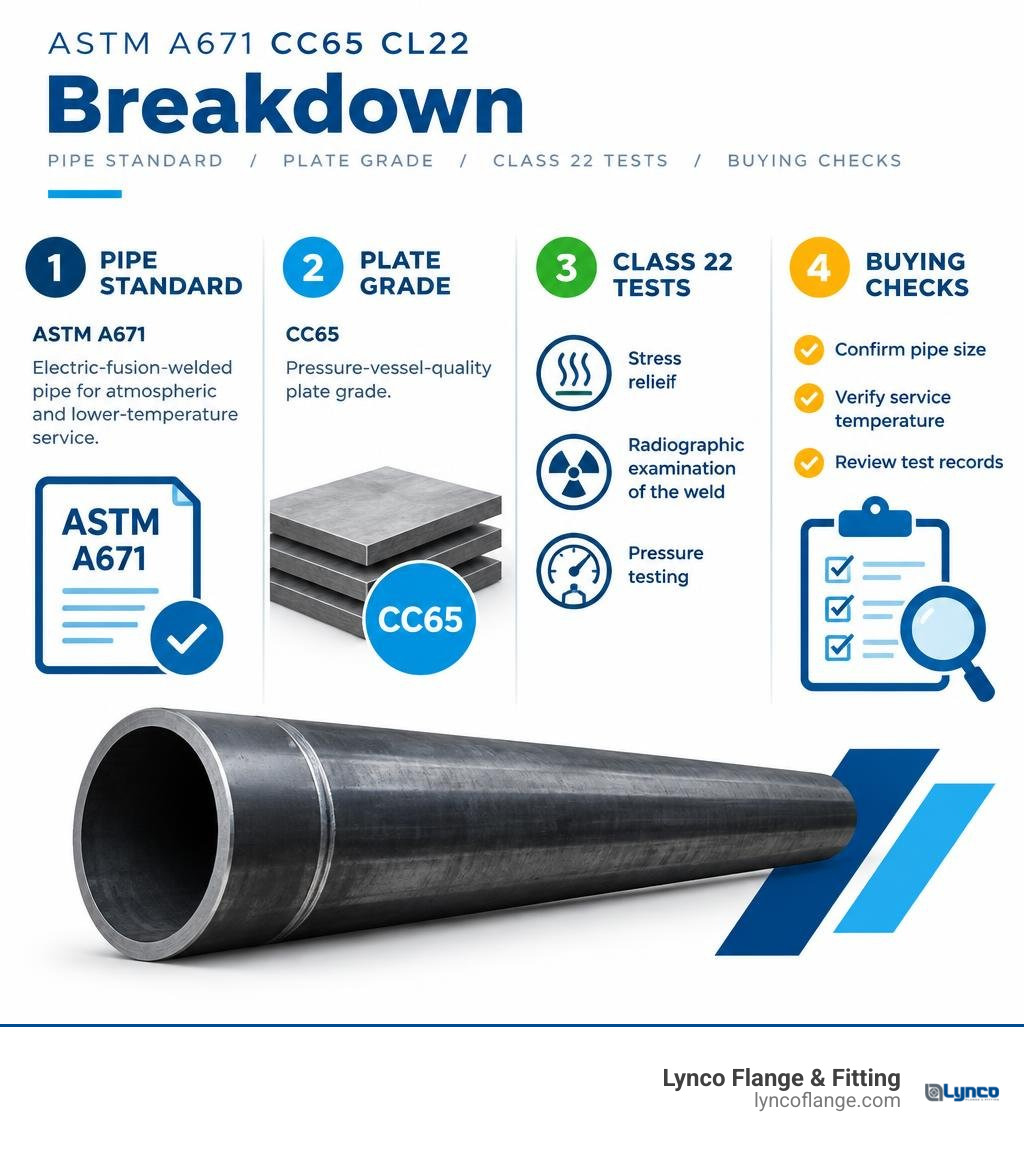
For a671 cc65 cl22 pipe, check more than the strength rating. ASTM A671 covers electric-fusion-welded pipe for atmospheric and lower-temperature service. CC65 identifies the pressure-vessel-quality plate grade; Class 22 calls for stress relief, radiographic examination of the weld, and pressure testing. Before ordering, confirm the pipe size, service temperature, and test records against your project requirements.
I’m Lance Vanover, CEO of Lynco Flange & Fitting. My 26 years in industrial flange and fitting operations help me guide buyers through the component and documentation details that matter when specifying a671 cc65 cl22 pipe.
The article editor does not render LaTeX. Do not write LaTeX commands or math delimiters in article copy. Explain calculations in plain language, or use an ordinary-text formula when useful, such as watts = volts × amps. Write units as readable text, such as ft³/hour or gallons/kWh. When asked to remove formulas or confusing mathematical notation, replace them with prose; do not substitute different equations or hide the notation in code.
Decoding the ASTM A671 CC65 CL22 Specification
When engineering teams design pressure systems operating in sub-zero atmospheric conditions, selecting raw materials requires clear traceability. The ASTM A671/A671M Standard Specification governs electric-fusion-welded (EFW) steel pipe manufactured with added filler metal. Unlike everyday structural tubing, this specification focuses explicitly on piping intended for atmospheric and lower-temperature service where pressure containment and notch toughness are mandatory.
Nominally, the standard covers pipe sizes 16 inches (400 mm) in outside diameter or larger, with wall thicknesses starting at 1/4 inch (6 mm) and scaling upward into heavy-wall regimes. Understanding these parameters is crucial because the impact of temperature and pressure on flange and fitting selection directly dictates how the connecting pipe must be specified.
The designation breaks down into three distinct tiers:
- ASTM A671: The overarching product standard for electric-fusion-welded pressure pipe.
- CC65: The material grade, which identifies the chemical composition and mechanical baseline of the pressure vessel plate used.
- CL22 (Class 22): The processing and quality class, defining mandatory post-weld heat treatment, non-destructive examination, and hydrostatic proof testing.
Chemical and Mechanical Properties of Grade CC65
The structural integrity of Grade CC65 originates from its base material: ASTM A516 Grade 65 plate. This is a fully killed carbon steel produced using fine-grain practice to ensure uniform microstructure and dependable low-temperature toughness.
Chemically, carbon content is strictly regulated according to plate thickness to preserve weldability while achieving targeted tensile values:
- Thickness 1/2 in. (12.5 mm) and under: Carbon is capped at 0.24% maximum.
- Thickness over 1/2 in. to 2 in.: Carbon is capped at 0.26% maximum.
- Thickness over 2 in. to 4 in.: Carbon is capped at 0.28% maximum.
- Thickness over 4 in.: Carbon reaches up to 0.29% maximum.
Manganese content spans from 0.79% to 1.30% (heat analysis), though standards permit an increase up to 1.60% if carbon content is proportionally decreased. Silicon is maintained between 0.13% and 0.45%, while phosphorus and sulfur are kept to stringent maximums (typically 0.035% each) to prevent embrittlement.
Mechanically, Grade CC65 delivers balanced performance across severe operating envelopes:
- Minimum Yield Strength: 35 ksi (240 MPa)
- Tensile Strength: 65 to 85 ksi (450 to 585 MPa)
- Elongation: Minimum 19% in an 8-inch (200 mm) gauge length, and 23% in a 2-inch (50 mm) gauge length.
What Class 22 Mandates: Heat Treatment, Radiography, and Pressure Testing
Why does steel sometimes get sent for thermal conditioning? You could say it just needs to relieve stress—and in Class 22, stress relief is serious business.
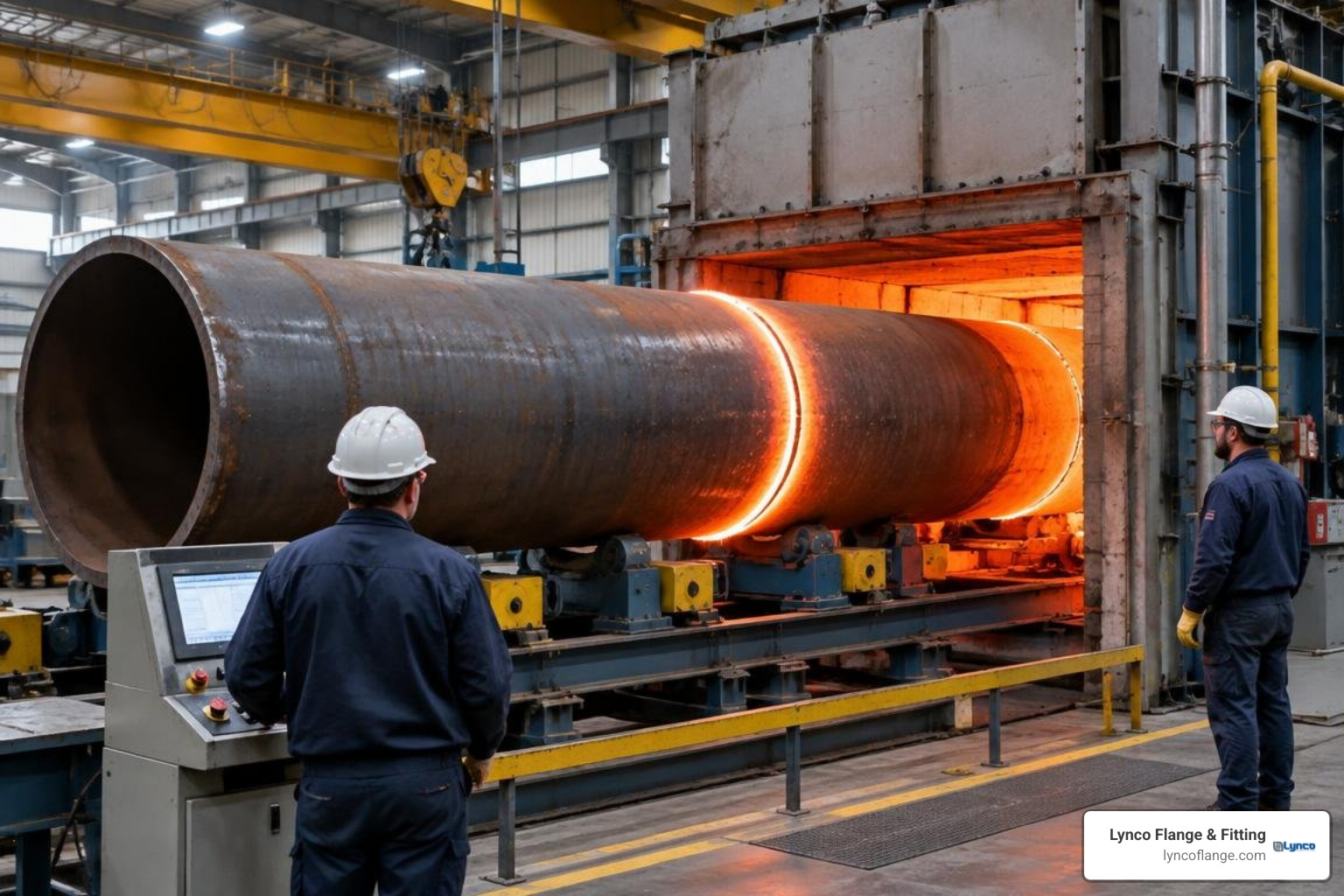
While the ASTM A671 standard contains over 20 class options ranging from Class 10 (as-rolled with no radiography) to Class 73 (quenched and tempered with full examination), Class 22 establishes a rigorous baseline for critical process environments:
- Post-Weld Heat Treatment (PWHT): The completed pipe must be uniformly stress relieved within a controlled temperature band of 1100 to 1200 °F (590 to 650 °C). The holding duration must be at least 1 hour per inch of wall thickness, or a minimum of 1 hour total, whichever is greater. This soaking cycle tempers the weld seam and dissipates peak residual stresses introduced during forming and welding.
- Radiographic Examination: Class 22 mandates 100% radiographic examination of the longitudinal welded seam in accordance with ASME Boiler and Pressure Vessel Code requirements. Every linear inch of the weld seam is inspected for inclusions, porosity, lack of penetration, or cracks.
- Pressure Testing: Following thermal treatment and radiographic inspection, each pipe section must undergo a factory hydrostatic test—typically rated up to 8.3 MPa (1200 psi) or a calculated test pressure determined by design equations—to validate pressure containment.
Manufacturing Route and Quality Standards
Producing an ASTM A671 CC65 CL22 pipe requires precision manufacturing controls to convert flat pressure vessel plate into high-integrity cylindrical pipe.
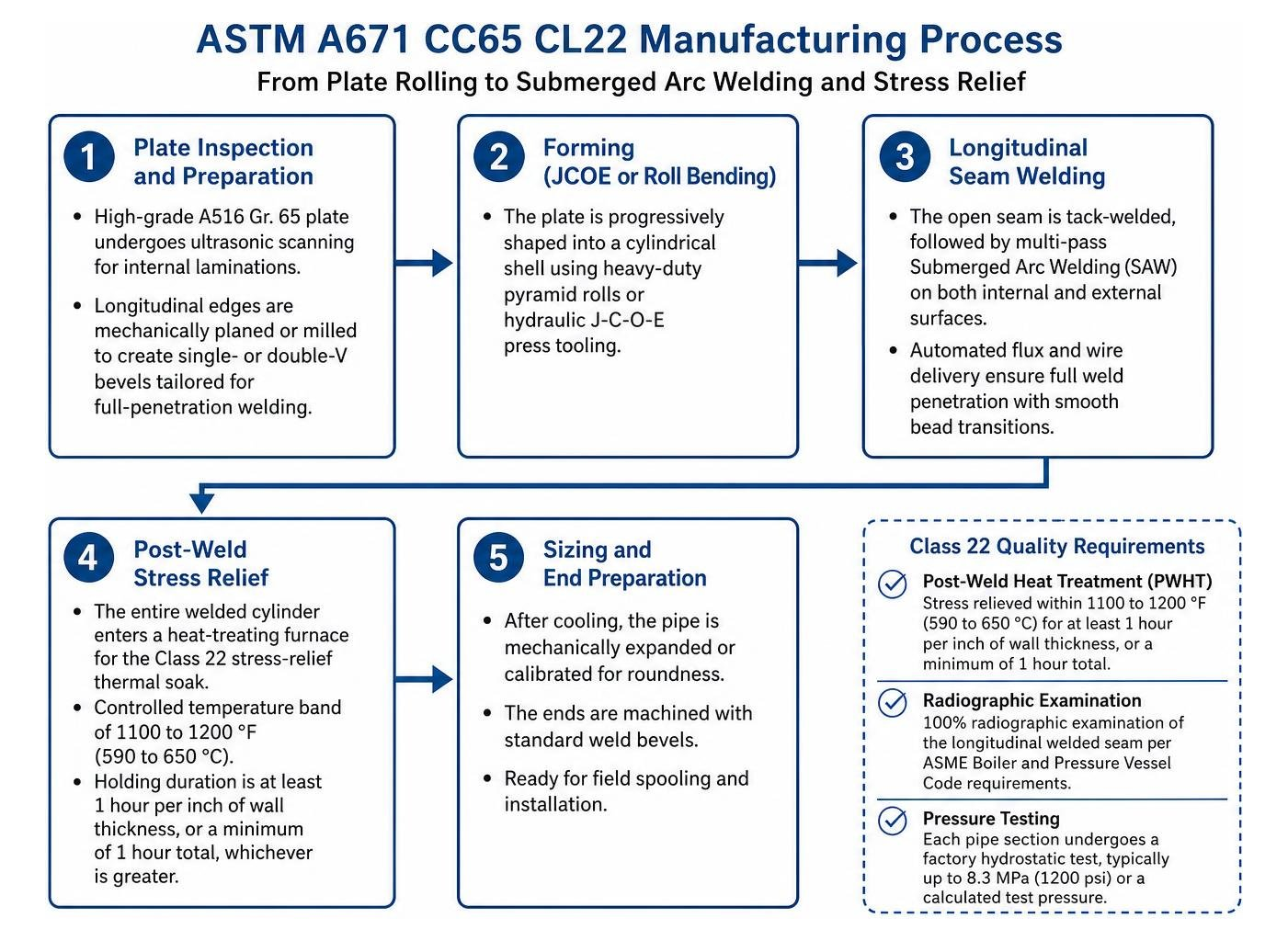
- Plate Inspection and Preparation: High-grade A516 Gr. 65 plate undergoes ultrasonic scanning for internal laminations. The longitudinal edges are mechanically planed or milled to create single- or double-V bevels tailored for full-penetration welding.
- Forming (JCOE or Roll Bending): The plate is progressively shaped into a cylindrical shell using heavy-duty pyramid rolls or hydraulic J-C-O-E press tooling.
- Longitudinal Seam Welding: The open seam is tack-welded, followed by multi-pass Submerged Arc Welding (SAW) on both the internal and external surfaces. Automated flux and wire delivery ensure full weld penetration with smooth bead transitions.
- Post-Weld Stress Relief: The entire welded cylinder enters a heat-treating furnace for the Class 22 stress-relief thermal soak (1100–1200 °F).
- Sizing and End Preparation: After cooling, the pipe is mechanically expanded or calibrated for roundness, and the ends are machined with standard weld bevels. When pairing these pipes in field spools, knowing how to choose the right weld fittings for your project guarantees seamless alignment and joint strength.
Dimensional Tolerances and Acceptance Criteria for A671 CC65 CL22
Because these pipes tie directly into heavy-wall headers, process vessels, and forged flanges, dimensional precision is non-negotiable.
- Outside Diameter (OD): Tolerances on the outer circumference remain tight. For large diameters, outer diameter variance is typically held within plus or minus 0.5% of the specified nominal size.
- Wall Thickness: The minimum wall thickness at any point must not drop more than 0.010 in. (0.3 mm) below the nominal specified thickness.
- Out-of-Roundness (Ovality): The difference between major and minor outside diameters is strictly limited, typically not exceeding 1% of the nominal diameter, ensuring fit-up with matching piping components.
- Weld Seam Alignment and Reinforcement: Radial offset (mismatch) of the plate edges at the longitudinal seam must not exceed code limits (typically 1/8 in. or less depending on wall thickness). Weld crown reinforcement must transition smoothly into the base metal without undercuts or sharp re-entrant angles.
- Bevel End Finish: Pipe ends are typically beveled to 37.5 degrees (plus or minus 2.5 degrees) with a root face of 1/16 in. (1.6 mm) to support field butt-welding.
Key Requirements for S2 Impact Testing on A671 CC65 CL22 Pipes
Although Grade CC65 provides dependable baseline toughness, severe low-temperature applications often call for Supplementary Requirement S2: Charpy V-Notch Impact Testing.
When S2 is invoked:
- Specimen Extraction: Test specimens are machined from the base plate, the weld metal, and the heat-affected zone (HAZ).
- Test Temperatures: Testing is commonly conducted at temperatures such as -50 °F (-45 °C) or -20 °F (-29 °C), depending on client design criteria.
- Energy Absorption: The material must absorb a specified minimum energy threshold (often 15 to 20 ft-lbs [20 to 27 J] minimum average) to demonstrate resistance to brittle fracture under dynamic shock loading.
Performance Comparison: ASTM A671 vs. A672 vs. A333
Engineers often weigh ASTM A671 against alternative specifications like ASTM A672 and ASTM A333. Selecting the correct standard depends on design temperature, manufacturing style, and operating stress.
| Parameter | ASTM A671 (e.g., CC65 CL22) | ASTM A672 (e.g., C65 CL22) | ASTM A333 (e.g., Grade 6) |
|---|---|---|---|
| Primary Service Focus | Atmospheric and lower temperatures | Moderate to high temperatures, high pressure | Low to cryogenic temperatures |
| Manufacturing Method | Electric-Fusion-Welded (EFW with filler) | Electric-Fusion-Welded (EFW with filler) | Seamless or Welded (without filler/ERW) |
| Base Material Source | Pressure vessel plate (ASTM A516 Gr 65) | Pressure vessel plate (ASTM A516 Gr 65) | Cast billets (seamless) or rolled strip (ERW) |
| Typical Size Range | Nominal 16 in. OD and larger | Nominal 16 in. OD and larger | Typically up to 24 in. OD |
| Heat Treatment Classes | Multiple classes (CL22 = Stress Relieved) | Multiple classes (CL22 = Stress Relieved) | Standardized (Normalized or Q&T) |
| Common Application | Large-diameter low-temp gas lines, headers | Power generation, high-temp steam lines | Small-to-medium process piping, sub-zero loops |
While ASTM A671 and A672 share similar plate origins and class numbering schemes, A671 is engineered specifically for atmospheric and sub-zero duties where notch ductility is preserved. Conversely, ASTM A333 covers smaller-to-medium diameter seamless or seam-welded lines. In these integrated pipeline systems, the role of flanges in ensuring pipeline integrity remains paramount to prevent localized stress concentrations at terminal joints.
Industrial Applications and Procurement Best Practices
Large-diameter A671 CC65 CL22 piping plays an indispensable role in heavy industrial infrastructure. You will find these pipes installed across:
- Refinery Low-Temperature Units: Fluid catalytic cracking gas recovery loops, alkylation units, and flare knockout systems. There are clear reasons why modern refineries rely heavily on ASTM A671 pipe for safe, long-term containment.
- Natural Gas Transmission and Processing: Large intake headers, cross-country pipeline manifolds, and compressor station discharge loops exposed to cold climates.
- Power Generation: High-capacity circulating water, auxiliary cooling lines, and low-temperature process steam manifolds.
- Pre-Fabricated Equipment Spools: Manifold connections built directly adjacent to pressure vessels where stress relief prevents structural distortion.
Inspection, Traceability, and Material Test Certificates
Procuring A671 CC65 CL22 pipes requires comprehensive quality verification. Because these components enter severe operating environments, document verification must be matched against physical stampings.
Engineers and procurement specialists must review material testing reports to confirm:
- Plate Pedigree: Heat number traceability tying back to the original ASTM A516 Grade 65 steel mill heat analysis.
- Weld Verification: Non-Destructive Testing (NDT) records certifying 100% radiographic examination (RT) acceptance per ASME Section VIII.
- Heat Treatment Charts: Time-at-temperature furnace logs showing uniform soaking between 1100 and 1200 °F.
- Hydrostatic Test Logs: Pressure holding charts proving the pipe held required pressure without drop or leakage.
- EN 10204 3.1 Certification: Documented chemical, mechanical, and dimensional sign-offs from the manufacturer’s quality inspection division.
Critical Checklist for Purchase Orders and Inquiries
To avoid delivery delays, field rework, or mismatched pipe ends, ensure your request for quotation (RFQ) and purchase order contain these essential specifications:
- Standard, Grade, and Class: State the complete designation clearly (e.g., ASTM A671 Grade CC65 Class 22).
- Exact Dimensions: Provide Outside Diameter (OD) and Nominal Wall Thickness (or Schedule), not just nominal bore.
- Length Requirements: Specify random lengths, double random lengths, or exact cut lengths for modular spools.
- End Preparation: State whether square cut, plain end, or beveled ends (with exact bevel angles) are required.
- Supplementary Requirements: Clearly list mandatory add-ons, such as S2 (Charpy V-Notch impact testing with target temperature and joule ratings).
- Hydrostatic Testing Conditions: Confirm test pressure requirements if exceeding standard factory defaults.
- Third-Party Inspection (TPI): Identify any client-appointed inspection agencies required to witness testing or review radiographs before dispatch.
Frequently Asked Questions About A671 CC65 CL22
What is the difference between ASTM A671 and ASTM A672?
ASTM A671 is specifically intended for atmospheric and lower-temperature service, prioritizing material toughness and ductility in cooler operating conditions. ASTM A672 is designed for moderate-temperature, high-pressure service (such as power plant steam and feed lines). Both use pressure vessel plates and identical class numbers, but their targeted service temperature ranges differ.
Is ASTM A671 CC65 CL22 pipe the same as standard LSAW pipe?
No. LSAW (Longitudinal Submerged Arc Welded) describes a general mechanical manufacturing method. ASTM A671 CC65 CL22 is a comprehensive product specification requiring pressure-vessel-quality plate (A516 Gr. 65), formal stress-relief heat treatment (Class 22), 100% weld seam radiography, and hydrostatic pressure testing. A pipe can be made via the LSAW process, but it cannot be designated as A671 CC65 CL22 without fulfilling these metallurgical and testing requirements.
Why is stress relief mandatory for Class 22 pipe?
Forming heavy plate and running multi-pass submerged arc welds generates intense localized residual stresses in both the weld deposit and the heat-affected zone (HAZ). If left untreated, these internal stresses make the pipe susceptible to brittle cracking at lower temperatures and stress-corrosion cracking in corrosive environments. Stress relief at 1100–1200 °F relaxes these microscopic strains, improves fracture toughness, and ensures dimensional stability during field welding.
Conclusion
Specifying high-strength piping for critical infrastructure demands absolute technical alignment. From verifying the fine-grain A516 Grade 65 plate chemistry to ensuring post-weld stress relief and complete radiographic weld verification, every facet of the ASTM A671 CC65 CL22 designation serves a defined engineering purpose.
At Lynco Flange & Fitting, our Houston-based team delivers deep technical guidance, ISO-compliant quality control, and rapid component delivery to support your most demanding pressure piping projects. Whether you are assembling complex process manifolds or evaluating structural supply lines, understanding fundamental material nuances—such as the key differences between carbon steel piping and black steel piping—ensures your piping systems operate safely and reliably for decades to come.