What Is a Copper Blind Flange Used For?
A copper blind flange is a solid, bolted plate that seals the end of a pipe or an unused opening. It stops flow so a line can be isolated for maintenance, testing, or future expansion. In practice, “copper” may mean a copper alloy such as bronze, not pure copper. That difference matters when you choose a flange for saltwater service, pressure, or potable water.
Before ordering, check the alloy, pipe size, pressure rating, bolt pattern, and gasket face against the mating flange and the system’s requirements. Do not assume that every copper alloy blind flange has the same rating or water-use approval.
I’m Lance Vanover, CEO of Lynco Flange & Fitting. After more than 26 years in industrial flange and fitting supply, I know that choosing a copper blind flange starts with matching its material and specifications to the job.
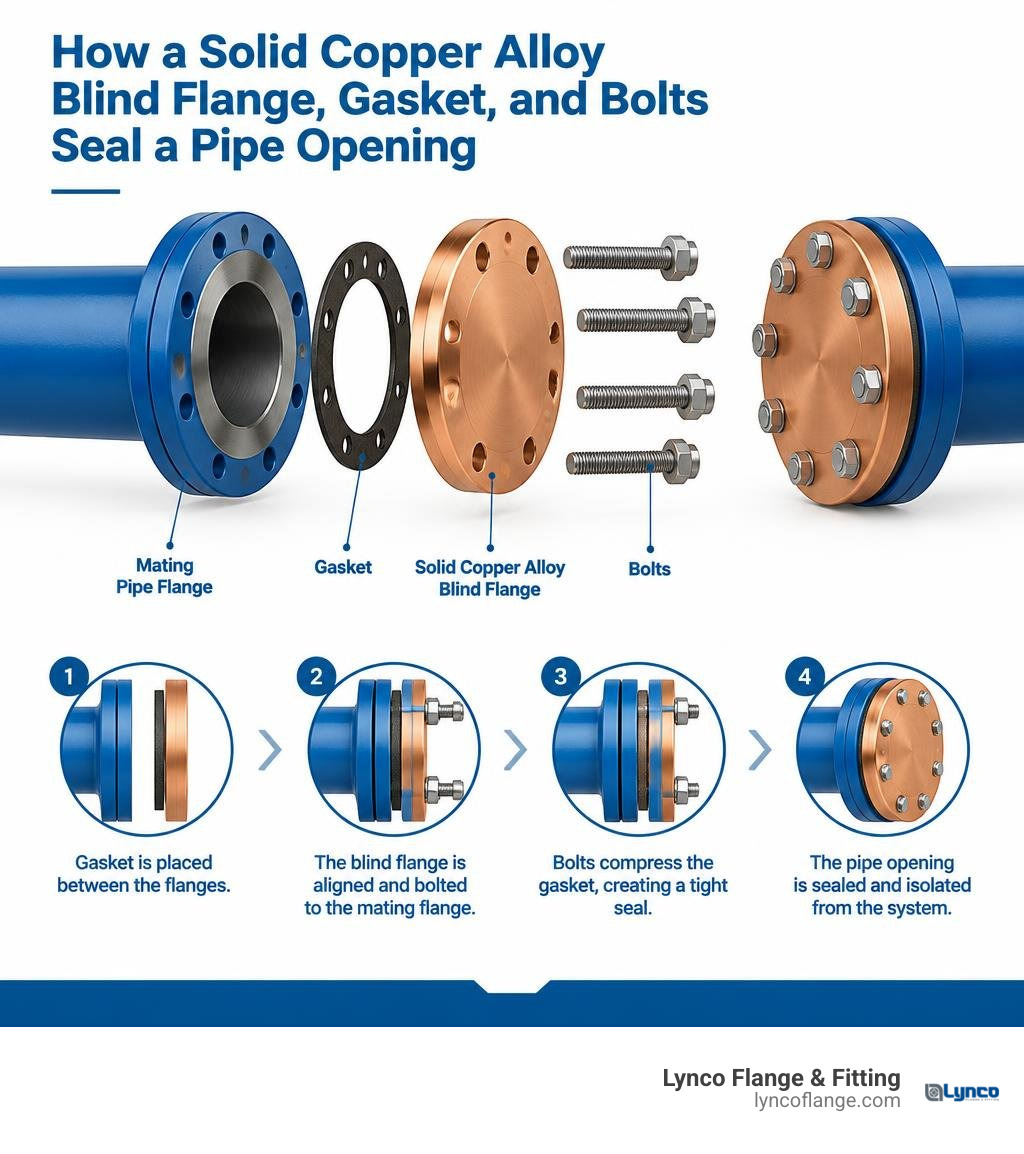
Fundamentals of Piping Isolation and Blind Flange Mechanics
In piping design, creating a reliable dead-end is just as crucial as maintaining continuous flow. Piping systems undergo hydrostatic pressure testing, routine inspections, phased maintenance, and line modifications. When field crews need to blank off pipe ends with blind flanges, they turn to solid disc fittings designed to act as impermeable pressure boundaries.
Unlike standard pipe fittings that route fluid through an internal diameter, a blind flange features no center bore. It bolts directly to a mating pipe flange, compressing a sealing gasket between the two flat or raised surfaces to contain internal line pressure. This solid barrier handles bending moments and axial forces exerted by pressurized fluids, making it one of the most mechanically stressed components in any piping loop.
Beyond basic line termination, these components provide critical non-destructive testing (NDT) access points. Engineers can unbolt the blind flange to insert borescopes, pull coupon samples, or flush out buildup without cutting into welded pipe assemblies. They also serve as strategic branch-isolation points, allowing future infrastructure expansion without shutting down entire multi-header loops.
Copper Blind Flange Design vs. Other Flange Types
Flange profiles vary significantly across industrial plants. Understanding what are the different types of flanges for piping helps clarify why solid disc geometry is selected for isolation over flow-through configurations:
- Blind Flanges: Characterized by a completely solid disc profile with bolt holes around the perimeter. They contain internal fluid pressure across their entire inner face without allowing flow.
- Weld Neck Flanges: Built with a long, tapered hub that matches the schedule and internal diameter of the mating pipe, engineered to minimize stress concentrations in high-pressure lines.
- Socket Weld Flanges: Feature a counterbore to accept the pipe end before a fillet weld is applied on the hub exterior, commonly used for smaller-diameter, high-pressure utility lines.
- Spectacle Blinds and Spades: Figure-8 or paddle-style steel inserts placed between two open flanges to provide a visual indicator of line shutoff or open flow without removing existing hub fittings.
Core Applications in Marine and Industrial Infrastructure
Copper and copper alloy blind flanges play an essential role across sectors where ferrous materials corrode prematurely. In marine piping infrastructure, ships and offshore platforms rely heavily on copper-nickel and bronze alloys for seawater cooling intakes, ballast transfer piping, and fire-main isolation. Seawater rapidly rusts conventional carbon steel, but copper alloys form protective oxide layers that prevent localized pitting and catastrophic wall loss.
In onshore industrial plants, these fittings seal potable plumbing headers, hydronic heating loops, pneumatic distribution lines, and industrial steam headers. Chemical processors frequently specify copper alloy blind covers over inspection ports on heat exchangers, boilers, and pressure vessels. These fittings resist biofouling, scale deposits, and aggressive mineral attack while remaining easy to unbolt during scheduled turnaround maintenance.
Material Comparison: Copper Blind Flange vs. Bronze and Steel Alloys
Selecting the correct metallurgy prevents costly maintenance shutdowns. While engineers loosely refer to “copper flanges,” pure elemental copper is rarely used for high-pressure isolation due to its low mechanical yield strength and soft metallurgical matrix. Instead, industrial piping systems rely on cast or forged copper alloys—primarily cast bronze (such as ASTM B62 / UNS C83600) or copper-nickel alloys (CuNi 90/10 and CuNi 70/30).
The table below highlights how pure copper, cast bronze, carbon steel, and austenitic stainless steel compare across primary physical and operational criteria when selecting a blind flange for critical industrial service:
| Material Specification | Tensile Strength (ksi) | Corrosion Resistance | Thermal Conductivity (BTU/hr·ft·°F) | Primary Industrial Applications |
|---|---|---|---|---|
| Pure Copper (C11000) | 30 – 38 | High (atmospheric, freshwater) | ~226 | Electrical grounding, low-pressure thermal headers |
| Cast Bronze (ASTM B62) | 30 – 36 (Yield ~14) | Exceptional (saltwater, steam) | ~42 | Marine seawater piping, commercial plumbing, steam lines |
| Carbon Steel (ASTM A105) | 70 – 90 (Yield ~36) | Poor (requires protective coating) | ~30 | Hydrocarbon processing, high-pressure steam |
| Stainless Steel (ASTM A182 F316) | 75 – 85 (Yield ~30) | High (acidic, marine, chemical) | ~9.4 | Corrosive chemical lines, pharmaceutical, marine splash zones |
Cast bronze combines the intrinsic corrosion resistance and antimicrobial qualities of copper with the structural stiffness needed to hold bolt torque and maintain gasket seating stress under 150 psi working pressures.
Corrosion Resistance in Saltwater and Acidic Environments
In marine and brackish water environments, carbon steel corrodes rapidly unless protected by sacrificial anodes or epoxy linings. Stainless steels (like 304 or 316) offer strong chemical resistance, but they remain vulnerable to crevice corrosion and pitting when submerged in warm, stagnant seawater where chlorides breach their thin passive chromium oxide layer.
Copper alloys solve this challenge through natural biofouling resistance and stable protective films. Cuprous oxide forms across the exposed metal surface, creating a barrier that deters micro-organism adhesion, algae, and barnacle colonisation. This natural biocidal property keeps intake manifolds and terminating blind plates free of bio-growth.
Furthermore, copper alloys provide reliable performance in acidic freshwater and low-pH condensate return streams, where carbonic acid corrodes mild steel. As long as fluid velocities stay within recommended design parameters (preventing turbulent erosion-corrosion of the cuprous film), copper alloy blind flanges provide decades of dependable containment.
Potable Water Standards and Lead-Free Requirements
When installing terminating flanges in municipal water mains, building service entries, or commercial drinking water systems, chemical compliance is non-negotiable. Modern public health regulations—such as NSF/ANSI/CAN 61 and the United States Safe Drinking Water Act (SDWA)—strictly mandate that wetted plumbing components meet maximum weighted lead content thresholds of 0.25%.
Traditional bronze formulations (historically termed “leaded commercial bronze” or 85-5-5-5 alloy under ASTM B62) contain up to 5% lead to boost machinability and casting pressure tightness. While standard ASTM B62 bronze remains widely used in marine and closed industrial heating loops, potable water installations require certified lead-free copper-bismuth or copper-silicon alloys (such as UNS C89836 or C87850). Engineers must review Certified Material Test Reports (CMTRs) to verify that any terminating flange specified for human drinking water complies with non-leaded statutory guidelines.
Engineering Specifications, Sizing, and Pressure Ratings
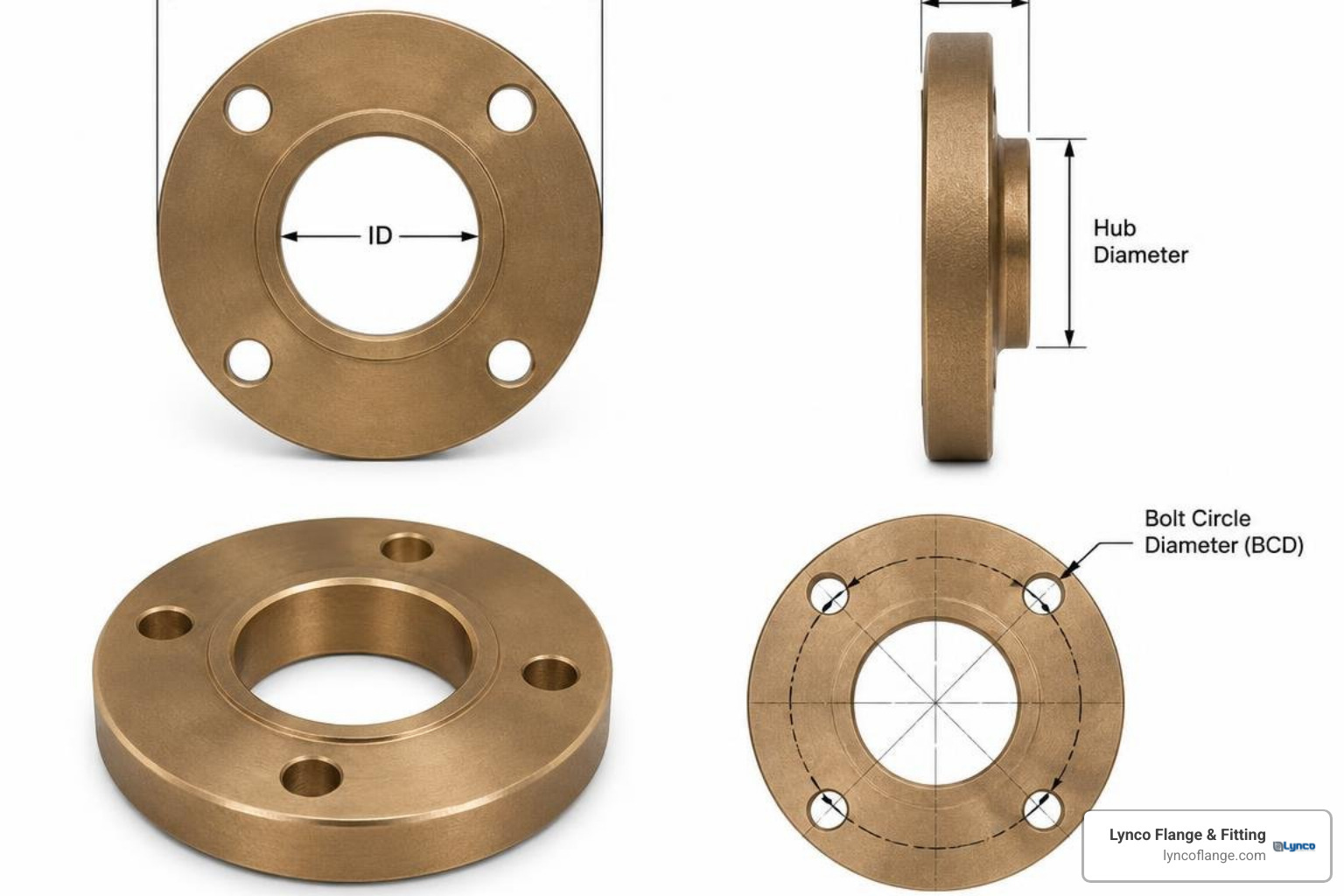
Copper alloy blind flanges are engineered to standard manufacturing dimensions to guarantee alignment with mating valves, pumps, and pipe stubs. The baseline pressure rating for cast bronze flanges follows ASME Class 150, often designated as Class 125/150 rating standards. In typical ambient fluid environments, a Class 150 bronze blind flange provides an allowable working pressure of 150 psi for saturated steam, water, oil, and pneumatic systems.
Standard nominal sizes for cast bronze and copper alloy blind fittings span from small-bore NPS 3/4 inch up to NPS 10 inch and larger. As the nominal diameter increases, the structural thickness and weight scale upward to withstand hydrostatic bending stress across the open pipe bore.
For example, a standard NPS 3-inch 150# bronze blind flange features an outside diameter of 7.50 inches, a thickness of 0.69 inches, and a benchmark weight of 10.98 lbs. Smaller NPS 3/4-inch flanges weigh approximately 1.0 lb, whereas heavy NPS 6-inch blind covers weigh roughly 32.5 lbs, illustrating the substantial metal mass required to ensure structural rigidity.
Dimensional Standards: ASME B16.24 and ASTM Classifications
To ensure dimensional interchangeability across piping systems, manufacturers produce copper and bronze fittings under strict national and international consensus standards. Having a solid understanding of flange standards and specifications ensures field assemblies align properly on site:
- ASME B16.24: The governing standard for cast copper alloy pipe flanges and flanged fittings (Class 150 and Class 300). It establishes outside diameters, flange thicknesses, bolt circle dimensions, and center-to-center hole tolerances.
- ASTM B62: Standard specification for composition bronze or ounce metal castings (UNS C83600), dictating mechanical properties (tensile strength, yield strength, elongation) and elemental chemistry.
- ASME B1.20.1: Applies when blind flanges incorporate central tapped NPT test ports for instrument gauges, pressure sensors, or drainage petcocks.
- UL Listed & ISO 9001: For critical fire-main and marine safety installations, Underwriters Laboratories (UL) listings and foundry ISO 9001 quality audits confirm that casting integrity, radiographic sound testing, and pneumatic pressure checks were verified prior to shipment.
Bolt Patterns, Gaskets, and Flat Face Machining
One defining characteristic of cast copper and bronze blind flanges is their Flat Face (FF) finish. Unlike high-pressure forged steel flanges that utilize a Raised Face (RF) to concentrate seating pressure on a narrow ring, bronze blind flanges are machined flat across their entire surface.
Reviewing the functional dynamics of raised vs flat faced flanges and their uses highlights an important engineering rule: never mate a raised-face steel flange directly to a flat-faced bronze flange without full-face backup support. Cast bronze has lower ductility and fracture toughness than forged carbon steel. Tightening bolts against a raised-face surface introduces cantilever bending moments that can snap the outer ears of a bronze casting.
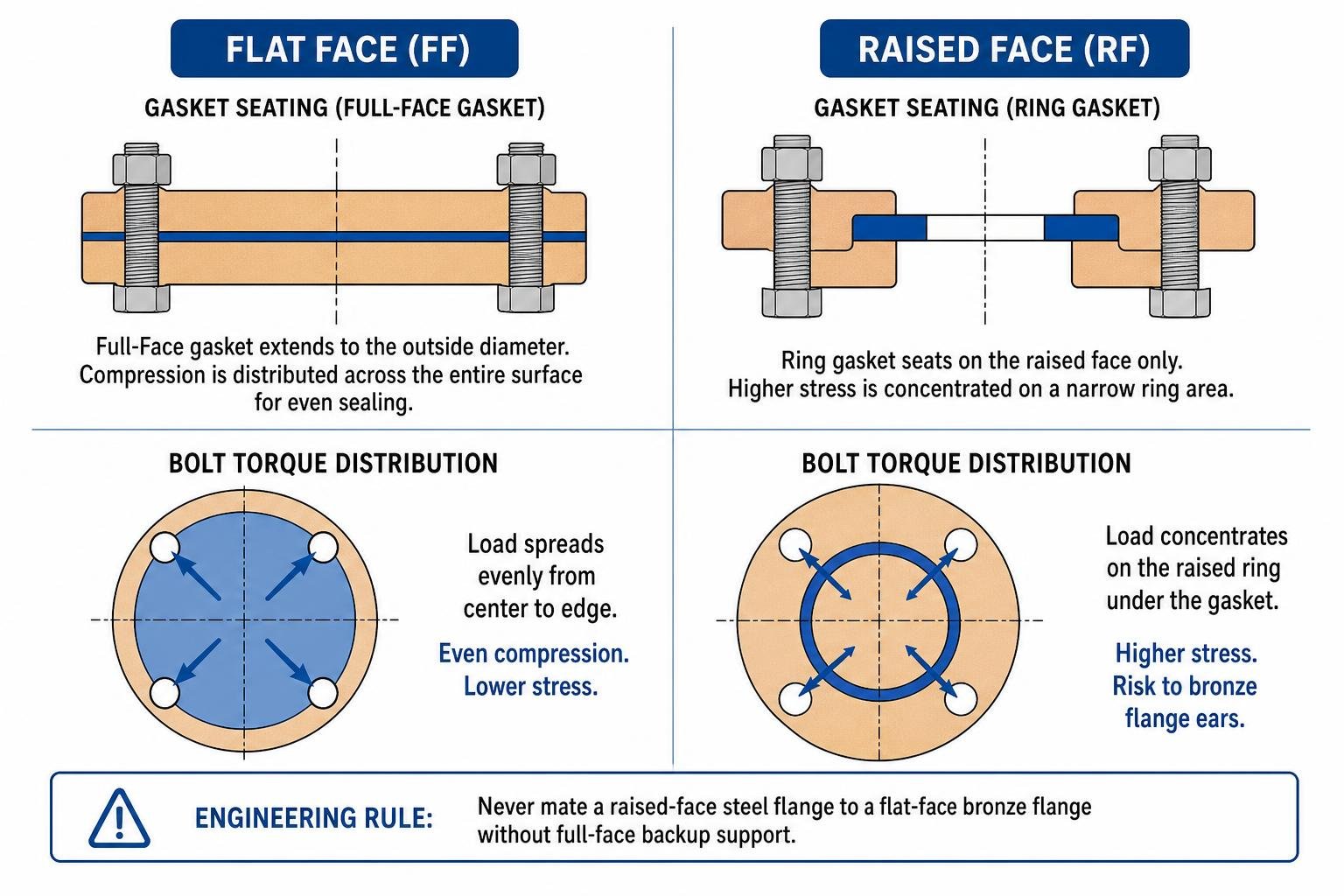
For flat-faced copper alloy flanges, always specify Full-Face (FF) elastomeric or synthetic fiber gaskets (such as EPDM, Neoprene, or compressed NBR). A full-face gasket extends from the pipe bore past the bolt holes to the outer diameter, distributing fastener compression evenly across the entire flange interface.
Installation Procedures and Sealing Best Practices
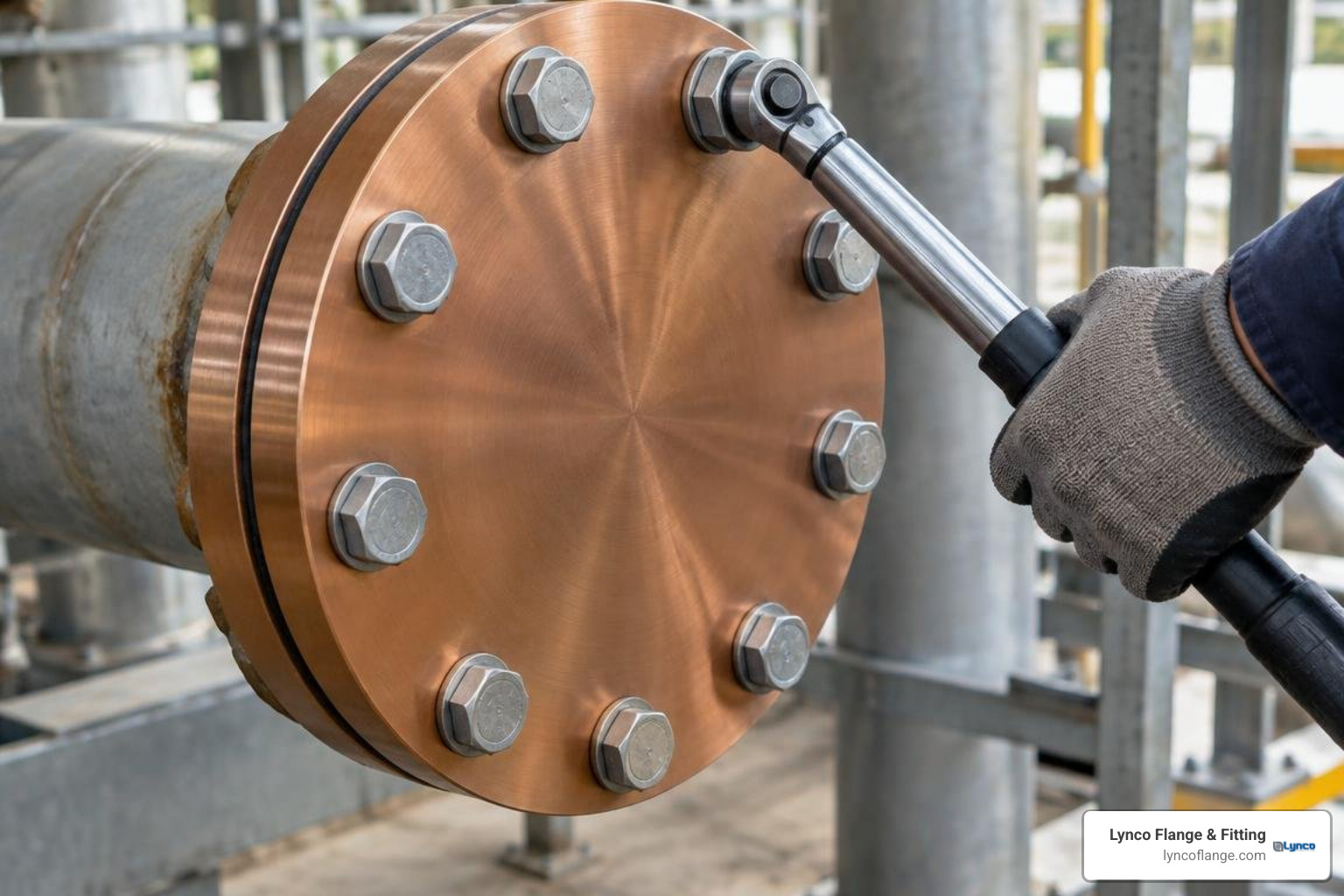
A copper alloy blind flange must be installed with careful attention to bolt tightening and gasket alignment. Because copper alloys are more ductile and susceptible to localized over-compression than heavy steel forgings, consistent torque sequencing is critical. Understanding why pipe flanges are essential for high-pressure conditions reminds us that an improperly torqued connection can compromise the structural integrity of the entire piping header.
Step-by-Step Installation for a Copper Blind Flange
Following a methodical, step-by-step installation sequence ensures a leak-free seal without damaging the flange casting:
- Inspect Mating Surfaces: Clean the mating flange and copper blind disc using a soft brass wire brush and solvent. Remove all old gasket material, scale, and grease. Ensure the flat sealing faces show no radial gouges or deep scratches.
- Verify Component Alignment: Confirm that the mating pipe flange is square and parallel. Do not use flange bolts to pull misaligned piping runs together, as this puts excess cantilever stress on the copper fitting.
- Select Compatible Fasteners and Gaskets: Use a soft, full-face elastomeric gasket (1/16-inch or 1/8-inch thickness) with bolt holes aligned to ASME B16.24. Use non-galling 316 stainless steel or silicon-bronze fasteners paired with lubricated, hardened flat washers.
- Apply Anti-Seize Lubricant: Lightly coat bolt threads and nut bearing faces with an anti-seize compound compatible with marine and copper environments (such as nickel-based or PTFE paste).
- Insert Bolts and Snug Hand-Tight: Center the full-face gasket between the flanges. Insert all fasteners and thread nuts hand-tight to verify uniform engagement.
Execute Star-Pattern Torque Sequence: Tighten the bolts in four progressive stages (30%, 60%, 100% of target torque, followed by a final circular verification pass) using a calibrated torque wrench in a cross-star tightening pattern:
Hydrostatic/Pneumatic Verification: Perform a low-pressure air test or scheduled hydrostatic pressure test to confirm joint integrity before bringing the line up to full operating capacity.
Maintenance, Re-Torquing, and Inspection Protocols
Piping systems with fluctuating fluid temperatures can experience bolt relaxation and gasket creep over time. Inspect flanged connections after initial thermal cycles and retorque to engineering specifications while the system is depressurized.
In marine and industrial service, field technicians should conduct visual inspections for signs of green patina buildup (copper carbonate) or galvanic white salt deposits around the bolt heads. If joining a copper alloy blind flange to a dissimilar metal (such as a cast iron pump housing or carbon steel valve), ensure dielectric isolation kits—consisting of mylar bolt sleeves, phenolic washers, and insulating full-face gaskets—are fully intact to prevent galvanic corrosion.
Cost Factors and Procurement Guidelines for Engineers
Procuring copper alloy flanges requires a clear understanding of non-ferrous metals market dynamics. When evaluating what to consider when choosing a pipe flange, non-ferrous components carry higher material baseline costs than common carbon steel forgings due to copper, tin, and nickel commodity pricing.
Costs scale based on raw alloy mass, foundry quality controls, and precision machining requirements. In global markets, smaller utility-grade cast copper alloy flanges range widely based on production origin, with small copper alloy fittings starting around ₹3,999 to ₹4,499 per unit for local regional distribution (such as non-critical commercial listings in India via sources like Dial4Trade).
By comparison, fully certified, domestic ASME B16.24 Class 150 pressure fittings built for high-spec marine and industrial environments reflect significantly higher investment costs. A precision-cast, UL-listed, lab-verified 3-inch 150# bronze blind flange commands a list price of $1,509.93, driven by certified ASTM B62 chemical tracking, strict pressure testing, and heavy-duty 10.98-lb casting mass.
Buyers should always verify foundry quality certifications (ISO 9001:2015), hydrostatic test documentation, and complete heat traceability to ensure parts perform reliably on the job.
Frequently Asked Questions About Copper Alloy Flanges
Can a copper blind flange be paired directly with carbon steel piping?
Direct metal-to-metal contact between a copper alloy flange and carbon steel piping in an electrolyte (such as water or humid marine air) creates a galvanic cell. The carbon steel acts as a sacrificial anode and will corrode rapidly near the connection.
To safely mate these materials, install a dielectric flange isolation kit. This setup uses a non-conductive full-face gasket, insulating bolt sleeves, and non-metallic dielectric washers to prevent electrical conductivity between the dissimilar metals.
What is the maximum operating temperature for an ASME B16.24 Class 150 copper flange?
Under ASME B16.24, Class 150 cast bronze (ASTM B62) flanges maintain a 150 psi pressure rating from -20°F to 150°F (-29°C to 66°C). As operating temperatures rise, allowable working pressure derates progressively.
At 400°F (204°C), maximum working pressure drops toward 100 psi, and the alloy reaches its upper structural limit near 450°F (232°C), beyond which copper-base castings experience softening and structural degradation. Always cross-reference your specific operating temperature against ASME B16.24 pressure-temperature derating curves.
How do engineers choose between cast bronze and forged copper flanges?
The choice depends on system design pressure, mechanical fatigue profiles, and dimensional requirements.
Cast bronze (ASTM B62 / B61) is the standard for water, marine cooling, and utility steam piping due to its cost efficiency, good machinability, and ready availability.
Forged copper or copper-nickel (such as CuNi 90/10) fittings are specified when systems require higher yield strength, structural density free of casting micro-porosity, and superior fatigue resistance under dynamic cyclic pressure surges (such as offshore naval hull penetrations and high-pressure chemical transfer lines).
Conclusion
Copper and bronze blind flanges provide dependable line termination and pressure containment across demanding marine and industrial piping systems. Their natural resistance to saltwater corrosion, biofouling, and acidic fluid attack makes them a practical choice where ferrous metals fail prematurely. Selecting the right component requires matching the alloy formulation, ASME B16.24 dimensional standards, and flat-face full-gasket requirements to your specific operating conditions.
To learn more about industrial blind flange specifications, pressure containment, and system isolation design, read our comprehensive guide on what you need to know about blind pipe flanges.
At Lynco Flange & Fitting, our Houston, Texas-based technical sales team pairs decades of hands-on piping experience with rigorous, ISO-compliant quality control. Whether your project calls for standard ASME B16.24 Class 150 bronze blind flanges or custom non-ferrous fittings, we provide direct engineering support, mill test traceability, and fast turnaround from our extensive industrial inventory.