Choose Cam Lock Pipe Fittings That Match the Job
To choose cam lock pipe fittings, start with the fluid, hose or pipe size, and connection type. Match a male adapter to a female coupler, then check the body and gasket materials against the fluid. Confirm the fitting’s pressure and temperature ratings before ordering. Do not use standard cam and groove couplings for compressed air or steam.
Cam locks make hose changes fast: the adapter slides into the coupler, and two cam arms close over its groove to hold it against a gasket. The right match helps prevent leaks without tools at the connection.
I’m Lance Vanover, CEO of Lynco Flange & Fitting. My 26 years in industrial fitting operations have taught me to check the details that matter when selecting cam lock pipe fittings; this guide starts with how the connections work.
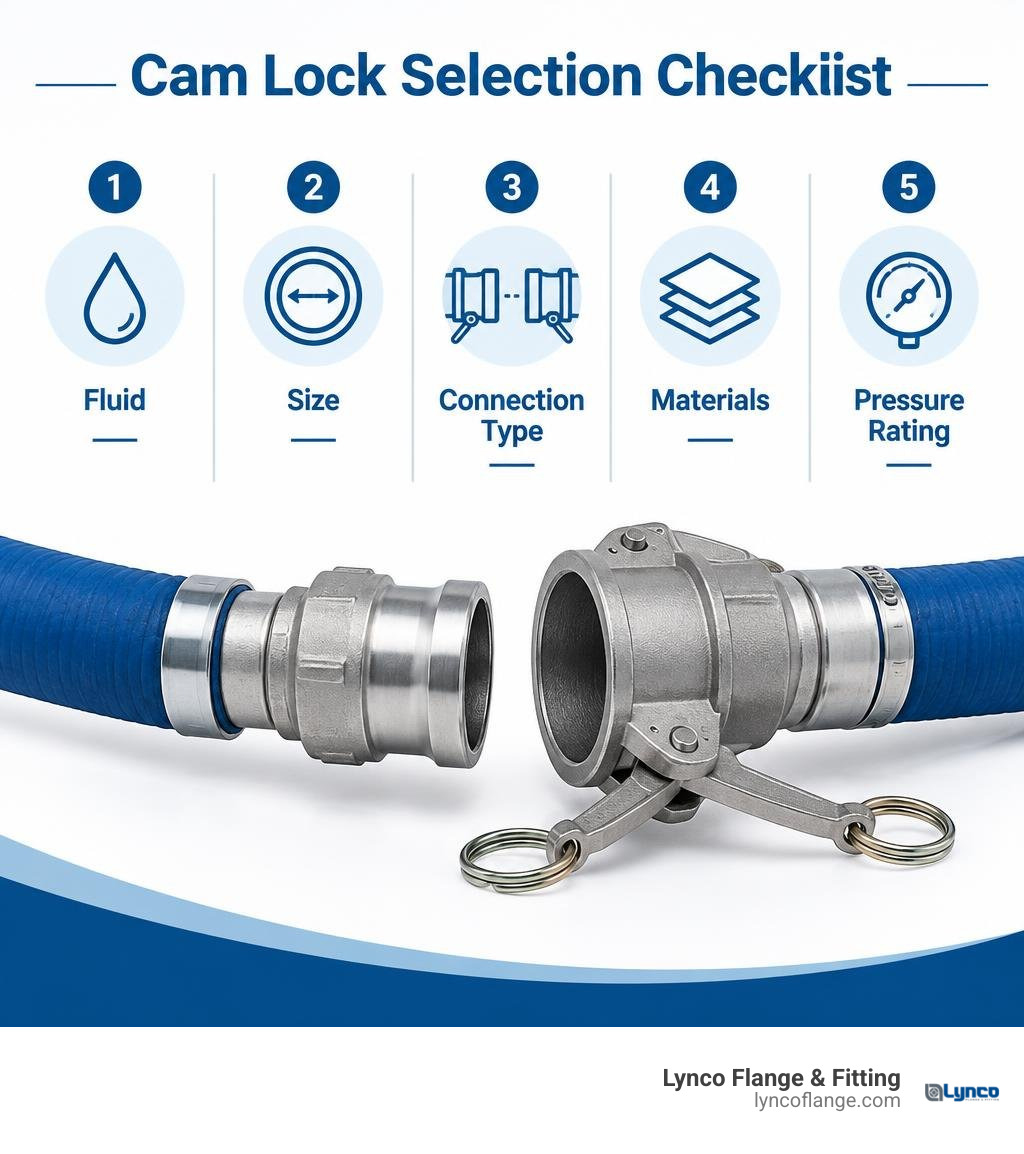
Understanding Types and Working Mechanisms of Cam Lock Pipe Fittings
Cam lock pipe fittings—often called cam and groove couplings—rely on a simple, mechanical lever action. The mechanism consists of two primary matching halves: a male adapter and a female coupler. The male adapter has an external groove running around its perimeter, while the female coupler houses internal cam arms (levers) and an elastomeric sealing gasket seated flat in its base.
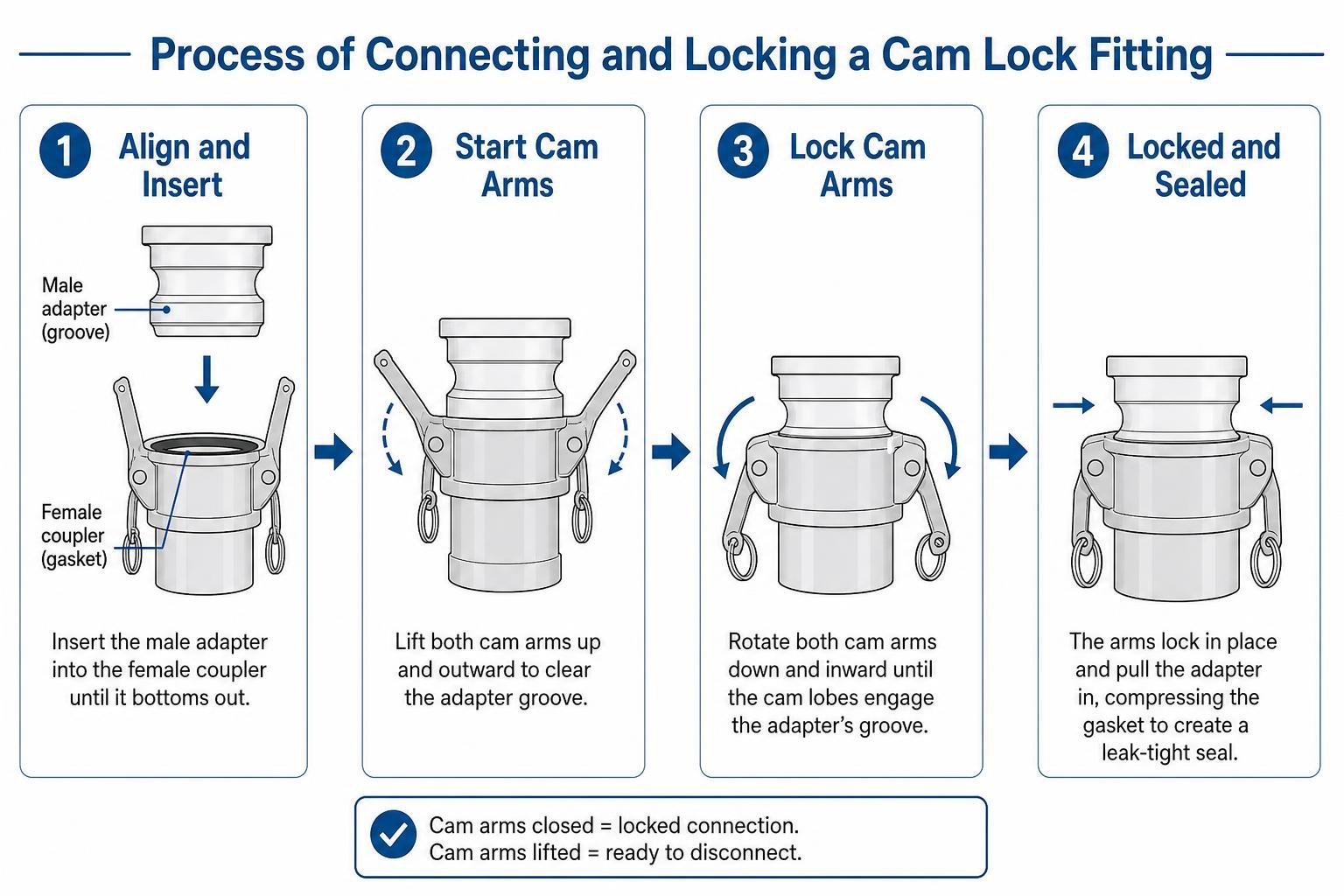
When you insert the male adapter into the female coupler and pull the cam arms down toward the body of the fitting, the cam lobes rotate into the adapter’s groove. This camming action pulls the flat face of the male adapter firmly into the coupler, compressing the internal gasket. This compression creates an immediate, liquid-tight seal without requiring wrenches, threading tape, or bolt tightening at the joint.
Most industrial cam and groove couplings follow the commercial specification A-A-59326D (which superseded the historical military specification MIL-C-27487). This standardization ensures that male adapters and female couplers of identical nominal sizes remain fully interchangeable across manufacturers. Whether you are transferring hydraulic fluid, liquid fertilizers, or process wastewater, understanding these configurations ensures you select the correct pairing. For broader connection architectures, our threaded pipe flange buyers guide from 12 inch to 3 inch connections provides insight into how threaded systems transition into rigid industrial lines.
Standard Coupling Configurations (Type A to Type DP)
Standard cam lock pipe fittings are categorized using an eight-letter designator system (Types A through F, plus dust caps and dust plugs). Each type indicates the specific mating configuration—combining male or female cam ends with female threads, male threads, hose shanks, or blank ends.
| Type | Coupling Half | Opposite Connection End | Primary Application |
|---|---|---|---|
| Type A | Male Adapter | Female NPT / BSP Thread | Screws onto a male pipe nipple to create a quick-connect male port. |
| Type B | Female Coupler | Male NPT / BSP Thread | Screws into female pipe ports, offering cam lever reception. |
| Type C | Female Coupler | Hose Shank (Barb) | Inserts into flexible hose ends, secured with hose clamps or bands. |
| Type D | Female Coupler | Female NPT / BSP Thread | Screws onto male threaded pipes or manifolds. |
| Type E | Male Adapter | Hose Shank (Barb) | Attaches directly into industrial suction or discharge hoses. |
| Type F | Male Adapter | Male NPT / BSP Thread | Screws directly into pump bodies or tank bungs. |
| Type DC | Female Dust Cap | Sealed Cap End | Seals off male adapters when lines are disconnected to prevent contamination. |
| Type DP | Male Dust Plug | Solid Plug End | Inserts into open female couplers to keep out dirt and debris. |
For specialized setups, reducers and expanding adapters combine different sizes (such as a 2-inch coupler to a 3-inch adapter), while jump-size fittings help bridge transitions between rigid piping and flexible transfer hoses.
Choosing the Best Materials and Gaskets for Severe Service
Selecting the right material for both the fitting body and the sealing elastomer is essential for plant safety and product longevity. Mismatches between conveying media and fitting metallurgy can cause rapid erosion, stress corrosion cracking, or sudden joint failure.
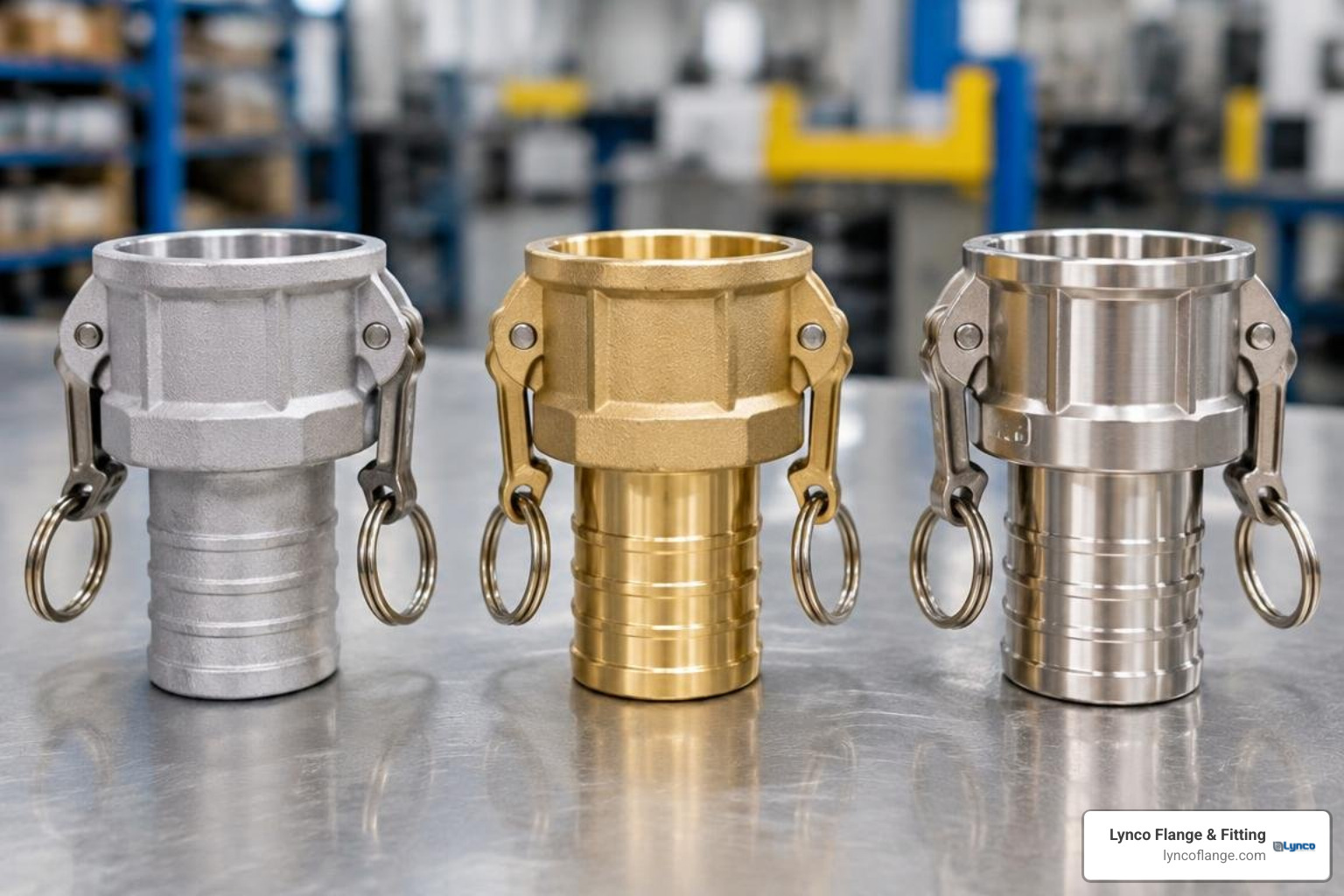
When handling aggressive chemicals, exploring corrosion resistant flanges alloy options for harsh environments can help you select matching materials across your entire fluid handling infrastructure.
Material Types for Cam Lock Pipe Fittings
Cam and groove fittings are manufactured across four core materials, each engineered for distinct industrial operating envelopes:
- 316 Stainless Steel: The premier choice for harsh, corrosive, and sanitary environments. Stainless steel camlocks offer superior tensile strength, abrasion resistance, and chemical compatibility. They are widely used in chemical processing plants, food and beverage facilities, breweries, and pharmaceutical production lines. A typical 316 stainless steel Type B coupling maintains an operating pressure rating of 250 PSI in sizes from 1/2″ up to 2″, easily enduring aggressive clean-in-place (CIP) regimens.
- Aluminum: Lightweight, economical, and durable, aluminum fittings are standard in petroleum tank truck loading, frac tanks, agricultural irrigation, and municipal dewatering. Aluminum couplings are available in sizes from 1/2″ up to 6″ or 8″. A standard aluminum Type F adapter provides a solid 250 PSI working pressure in common utility sizes while keeping hose handling manageable for field operators.
- Brass: Valued for its natural non-sparking properties and resistance to marine corrosion. Brass camlocks are standard equipment in marine bunkering, cooling water transfer, and fuel delivery (such as diesel, kerosene, and gasoline). Available from 1/2″ to 6″, brass resists galling and provides long service life in outdoor environments.
- Polypropylene: A lightweight, cost-effective thermoplastic reinforced with fiberglass for dimensional stability. Polypropylene fittings are suited for agricultural chemicals, liquid fertilizers, acid-transfer lines, and general water pumping. Available in sizes from 1/2″ up to 4″, polypropylene operates at lower pressure thresholds (typically 75 to 125 PSI depending on operating temperature).
When planning operating thresholds, reviewing the impact of temperature and pressure on flange and fitting selection helps ensure you account for pressure derating curves as system temperatures rise.
Gasket Compatibility: Buna-N, EPDM, and Viton
The cam lock mechanism compresses an internal gasket to establish its seal. Selecting an incompatible elastomer will cause the gasket to swell, soften, embrittle, or dissolve, leading to leaks.
- Buna-N (Nitrile): The standard factory gasket installed in most metal couplings. Buna-N provides resistance to petroleum distillates, hydraulic fluids, diesel fuel, lubricating oils, and water up to 212°F (100°C). It is unsuitable for strong acids or polar solvents.
- EPDM (Ethylene Propylene Diene Monomer): Designed for polar fluids, steam cleaning, hot water, dilute acids, and alkaline solutions. EPDM performs well across a temperature envelope of -40°F to 300°F (-40°C to 149°C), though it must never be exposed to petroleum-based fuels or aromatic hydrocarbons.
- FKM (Viton): The choice for aggressive chemical processing, high-octane fuels, aromatic hydrocarbons, and elevated temperatures (up to 400°F / 204°C). While more expensive, Viton prevents premature swelling in demanding chemical transfer environments.
- PTFE / Silicone (Food Grade): Sanitary applications, dairy pipelines, and home brewing require FDA-compliant seals. Solid PTFE or PTFE-encapsulated silicone/FKM gaskets offer broad chemical inertness and comply with strict food safety guidelines without imparting taste or odor.
Cam Locks vs. Flanged and Threaded Pipe Connections
Connecting piping assemblies requires balancing joint strength, assembly speed, and maintenance requirements. Understanding what are the different types of flanges for piping makes it clear where quick-disconnect fittings shine compared to permanent structural joints.
While cam locks allow an operator to swap a transfer line in five seconds without tools, bolted flanges remain the undisputed standard for high-pressure, hazardous, and permanent piping headers. For high-stress applications, understanding why are pipe flanges essential for high pressure conditions helps engineers avoid deploying quick-disconnect couplings where robust, bolted connections are required.
Installation and Maintenance of Cam Lock Pipe Fittings
Achieving dependable, leak-free operation with cam lock pipe fittings requires proactive inspection and proper coupling techniques:
- Inspect Mating Faces and Gaskets: Before connecting, clear any gravel, dirt, or dried product from the female coupler recess. Check that the elastomeric gasket sits flat against the shoulder and is free of cuts, tears, or permanent compression set.
- Align Directly: Insert the male adapter straight into the coupler body. Forcing an adapter in at an angle can dislodge the gasket, pinch the elastomer, and cause instant weeping under pressure.
- Engage Levers Simultaneously: Close both cam arms at the same time using steady, balanced downward pressure. Closing one arm entirely before the other can tilt the adapter face and result in an uneven seal.
- Lock Arm Security Pins: In high-vibration environments, insert safety clips (cotter pins or locking wire) through the pre-drilled holes in the coupler body behind the closed cam levers to prevent accidental release.
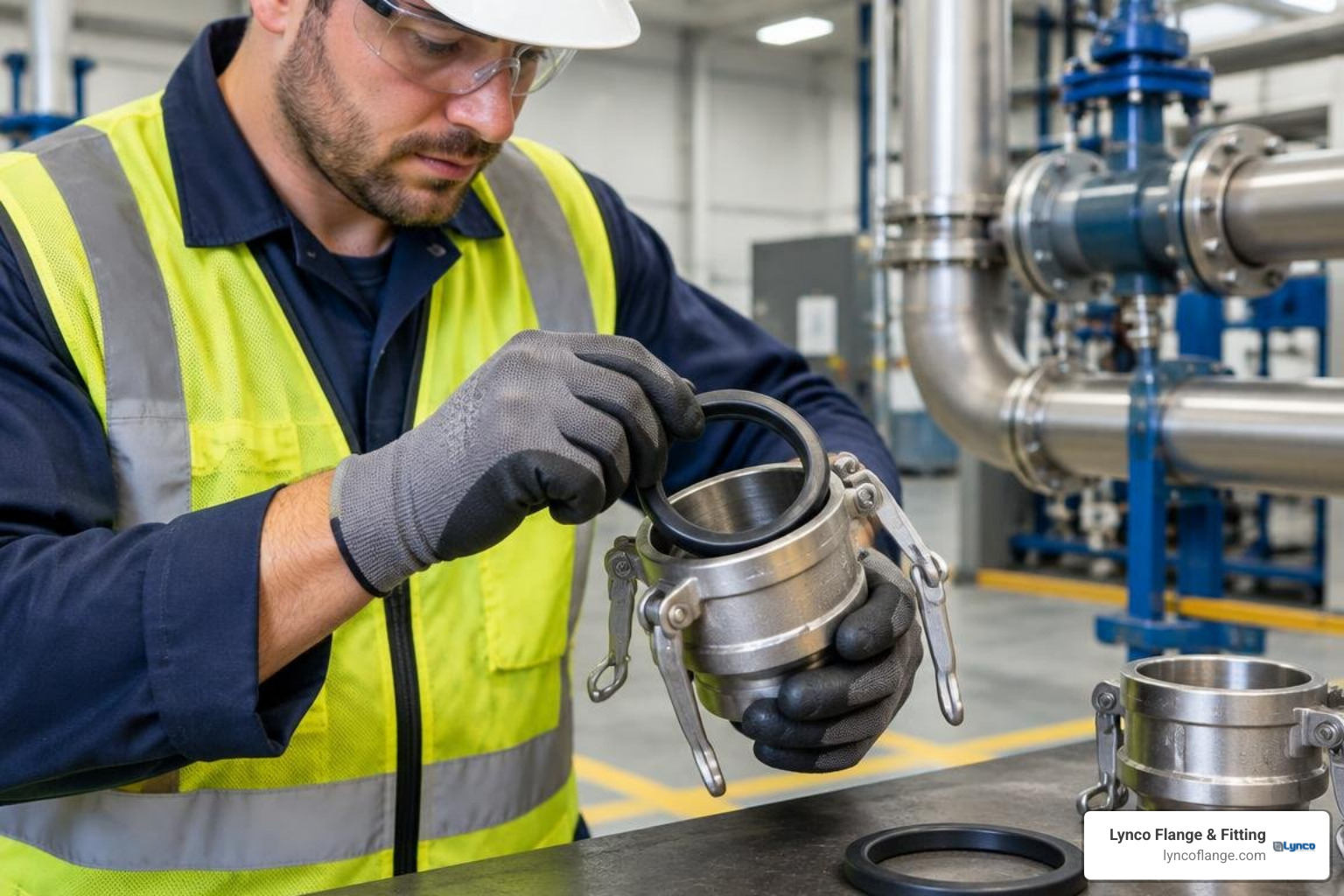
Routine maintenance should include checking the pivot pins on the cam arms for bending or play and inspecting the adapter’s groove for abrasion or flat spots. Applying the principles from preventing leaks best flange practices for high pressure oil and gas systems provides a reliable blueprint for maintaining connection integrity across all types of plant couplings.
Critical Safety Guidelines and Pressure Limitations
While cam locks are versatile, operating them outside their engineering limits can lead to serious hazards. The following safety parameters must be observed across all installations:
- Liquid Service Pressure Limits: Standard metal cam locks (aluminum, brass, 316 stainless) in sizes 1/2″ through 2″ are generally rated for up to 250 PSI at ambient temperatures (70°F). Larger sizes (3″ to 4″) typically derate to 150–200 PSI, while 6″ couplings are often restricted to 75–100 PSI. Special ductile iron restraint couplings used in heavy utility water mains can support pressures up to 350 PSI in sizes 3″ to 16″.
- NEVER Use with Compressed Air or Gases: Cam lock fittings must not be used for compressed air, nitrogen, or other compressed gas services. If a cam lever is accidentally released while transporting compressible gases, the stored pneumatic energy can cause an explosive release of the fitting, creating dangerous flying hazards.
- NEVER Use for Steam Service: Steam presents extreme burn hazards and rapid thermal expansion challenges that standard cam and groove elastomeric seals cannot safely contain. Steam systems should always use purpose-built, bolted boss-ground joint couplings or rigid flanged connections.
- Depressurize Before Disconnecting: Never pull the cam arms open while the line is under pressure. Always bleed internal line pressure, close isolation valves, and drain remaining fluid into an approved catchment system before uncoupling.
Understanding the role of flanges in ensuring pipeline integrity in the oil and gas industry reinforces how choosing the correct connection method protects personnel and maintains plant safety.
Frequently Asked Questions About Cam Lock Couplings
Can cam lock pipe fittings be used for compressed air or steam?
No. Standard cam lock pipe fittings should never be used for compressed air, compressed gases, or steam service. Compressed gases store dangerous pneumatic potential energy that can forcefully launch disconnected hoses if a cam arm is snagged. Steam rapidly degrades standard elastomers and risks severe thermal burn injuries upon uncoupling.
What is the difference between NPT and NPSH threaded connections on cam locks?
NPT (National Pipe Taper) threads are cut on a slight taper. As you screw the fitting into a port, the mating threads bind and crush together to form a seal along the thread profile (often aided by PTFE paste or tape). NPSH (National Pipe Straight Hose) threads are cut straight. NPSH fittings do not seal along the threads; instead, they rely on a flat washer or gasket compressed inside the female thread pocket to create the liquid seal.
How do you prevent cam arms from accidentally opening during fluid transfer?
To eliminate accidental disconnection from hose dragging, line pulsing, or pump vibration, operators use several proven safety mechanisms:
- Standard safety clip pins inserted through dedicated holes in the female coupler housing behind closed arms.
- Automatic self-locking cam couplers, whose levers click and lock into place and require a mechanical release latch to be depressed before opening.
- External hook-and-loop safety straps or security chains wrapped tightly around the closed levers.
Conclusion
Cam lock pipe fittings offer a reliable balance of speed, convenience, and sealing performance for fluid transfer lines. By matching the right fitting style (Type A through DP), selecting appropriate body metals (such as 316 stainless steel or aluminum), and choosing compatible sealing elastomers (Buna-N, EPDM, or Viton), industrial operators can maintain fast, leak-free hose connections year after year.
At Lynco Flange & Fitting, we distribute a comprehensive inventory of industrial piping components, including flanges, branch connections, weld fittings, and custom machined products. Our experienced technical sales team in Houston, Texas, provides direct engineering guidance and ISO-compliant quality control to help you spec the right hardware for every process line. Learn more about our high-pressure components by reviewing our guide to forged steel pipe fittings and industrial connections, or contact our team today to get the exact parts your facility needs.