How to Choose a Threaded Pipe Flange
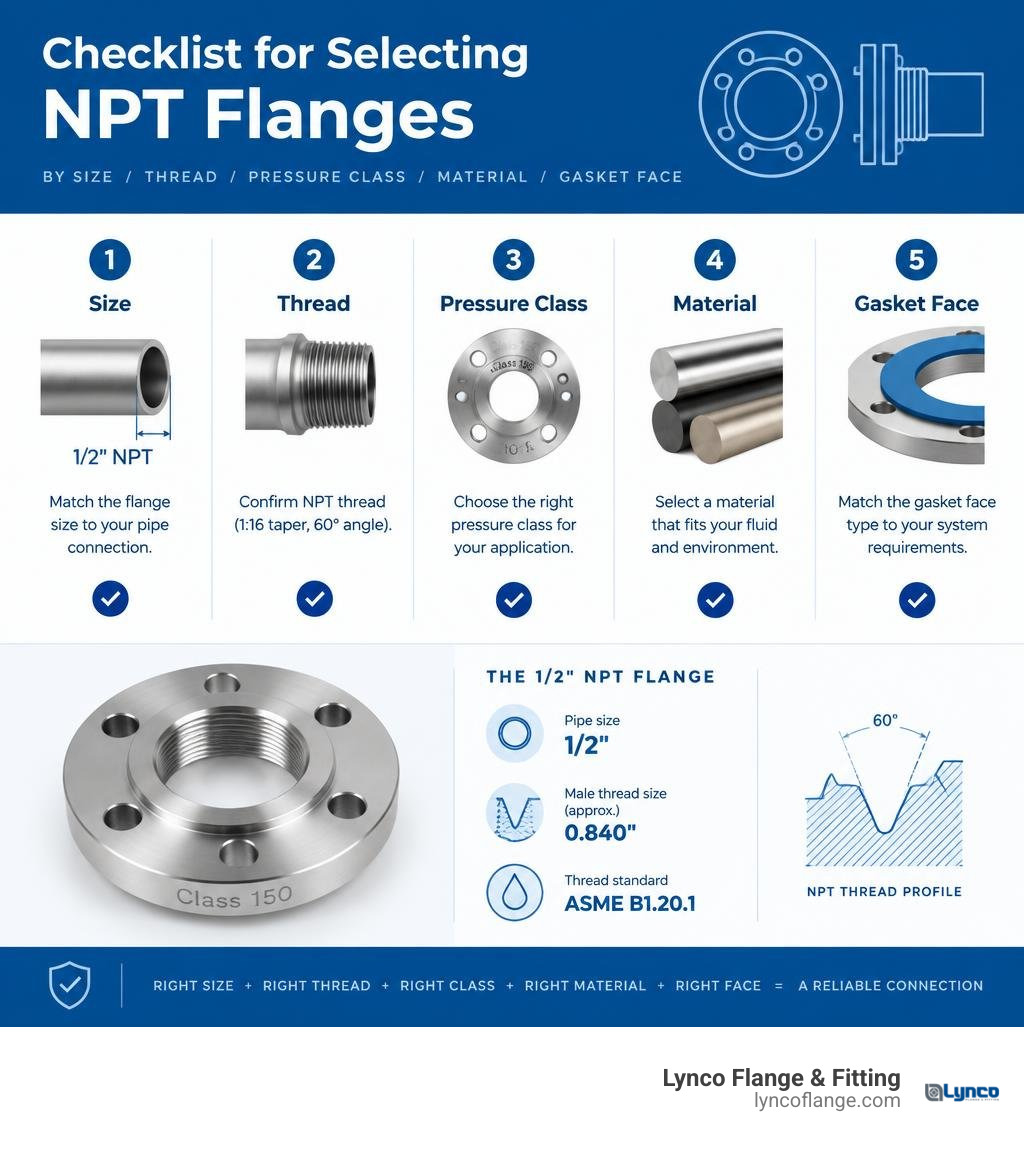
Start with the pipe size and thread standard. A 1/2-inch NPT flange fits a 1/2-inch nominal pipe connection, but the matching male thread measures about 0.840 inches across, not 0.500 inches. For any size from 1/2 inch to 3 inches, confirm the thread is NPT, then check the flange’s pressure class, material, and gasket face against your piping specification. Do not treat a Class 150 marking as a fixed 150 psi limit; allowable pressure depends on temperature and material.
A threaded flange connects without welding. Its tapered NPT joint normally needs a sealant suited to the fluid and service conditions, while the bolted flange face seals with a gasket. When specifying a 1/2-inch NPT flange, verify the thread standard, pressure class, and material before ordering.
I’m Lance Vanover, CEO of Lynco Flange & Fitting, with 26 years of experience in industrial flanges and fittings. When reviewing a 1/2-inch NPT flange request, I check the thread, pressure class, and material before moving to the quote.
Understanding the 1/2-Inch NPT Flange: Dimensions and Technical Specifications
Threaded flanges (often called companion flanges or screw-on flanges) allow piping systems to be assembled quickly without hot work. For small-bore pipe connections, the 1/2-inch NPT flange serves as a foundational component across process piping, instrumentation take-offs, and utility skids.
The governing standard for these threads is ASME B1.20.1 (Pipe Threads, General Purpose, Inch). It defines the geometry of National Pipe Taper (NPT) threads, which rely on a 1:16 taper ratio. That means for every 16 units of distance along the axis, the diameter changes by 1 unit—or 3/4 inch per foot. The thread profile features a 60-degree included Sellers thread angle with flattened crests and roots.
A common pitfall during field assembly involves nominal sizing. When engineers consult charts for the standard sizes of pipe flanges, they quickly notice that nominal pipe size (NPS) does not correspond to physical outside diameter (OD). For example, a 1/2-inch nominal pipe has an actual outside diameter of 0.840 inches (21.34 mm) with 14 threads per inch (TPI). If you put a caliper across the male thread entering a 1/2 NPT flange bore, you will measure roughly 0.840 inches, never 0.500 inches. Detailed dimensional breakdowns can be cross-referenced with technical data from ASME B1.20.1 NPT dimensions reference.
Critical Dimensions of a 1/2-Inch NPT Flange
To properly specify, machine, and inspect small-to-medium threaded flanges, engineers track several dimensional benchmarks:
- Major Diameter: The diameter across the crests of the thread at the gauge plane.
- Pitch Diameter: The diameter where the width of the thread ridge equals the width of the thread groove.
- Hand-Tight Engagement ($L_1$): The axial length a male pipe thread turns into the female flange bore by hand. For 1/2 NPT, this measures 0.320 inches (approximately 4.48 turns).
- Effective Thread Length ($L_2$): The total usable tapered thread length, measuring 0.534 inches for a 1/2 NPT connection.
- Tap Drill Size: The required minor diameter bore size before tapping. A 1/2 NPT thread requires a 23/32-inch drill (or 0.7188 inches).
The table below outlines thread specifications across the 1/2-inch to 3-inch NPT size range:
| Nominal Size (NPS) | Actual Pipe OD (in) | Threads Per Inch (TPI) | Pitch (in) | Hand-Tight Length $L_1$ (in) | Effective Length $L_2$ (in) | Tap Drill Size (in) |
|---|---|---|---|---|---|---|
| 1/2″ | 0.840 | 14 | 0.0714 | 0.320 | 0.534 | 23/32 |
| 3/4″ | 1.050 | 14 | 0.0714 | 0.339 | 0.546 | 59/64 |
| 1″ | 1.315 | 11.5 | 0.0870 | 0.400 | 0.683 | 1-5/32 |
| 1-1/4″ | 1.660 | 11.5 | 0.0870 | 0.420 | 0.707 | 1-1/2 |
| 1-1/2″ | 1.900 | 11.5 | 0.0870 | 0.420 | 0.724 | 1-47/64 |
| 2″ | 2.375 | 11.5 | 0.0870 | 0.436 | 0.757 | 2-7/32 |
| 2-1/2″ | 2.875 | 8 | 0.1250 | 0.682 | 1.138 | 2-5/8 |
| 3″ | 3.500 | 8 | 0.1250 | 0.766 | 1.200 | 3-1/4 |
Thread Profile Comparison: NPT vs. NPTF vs. BSPT
Understanding thread geometry prevents catastrophic field leaks. While these threads may look identical to the naked eye, their profiles, sealing mechanisms, and manufacturing tolerances differ significantly.
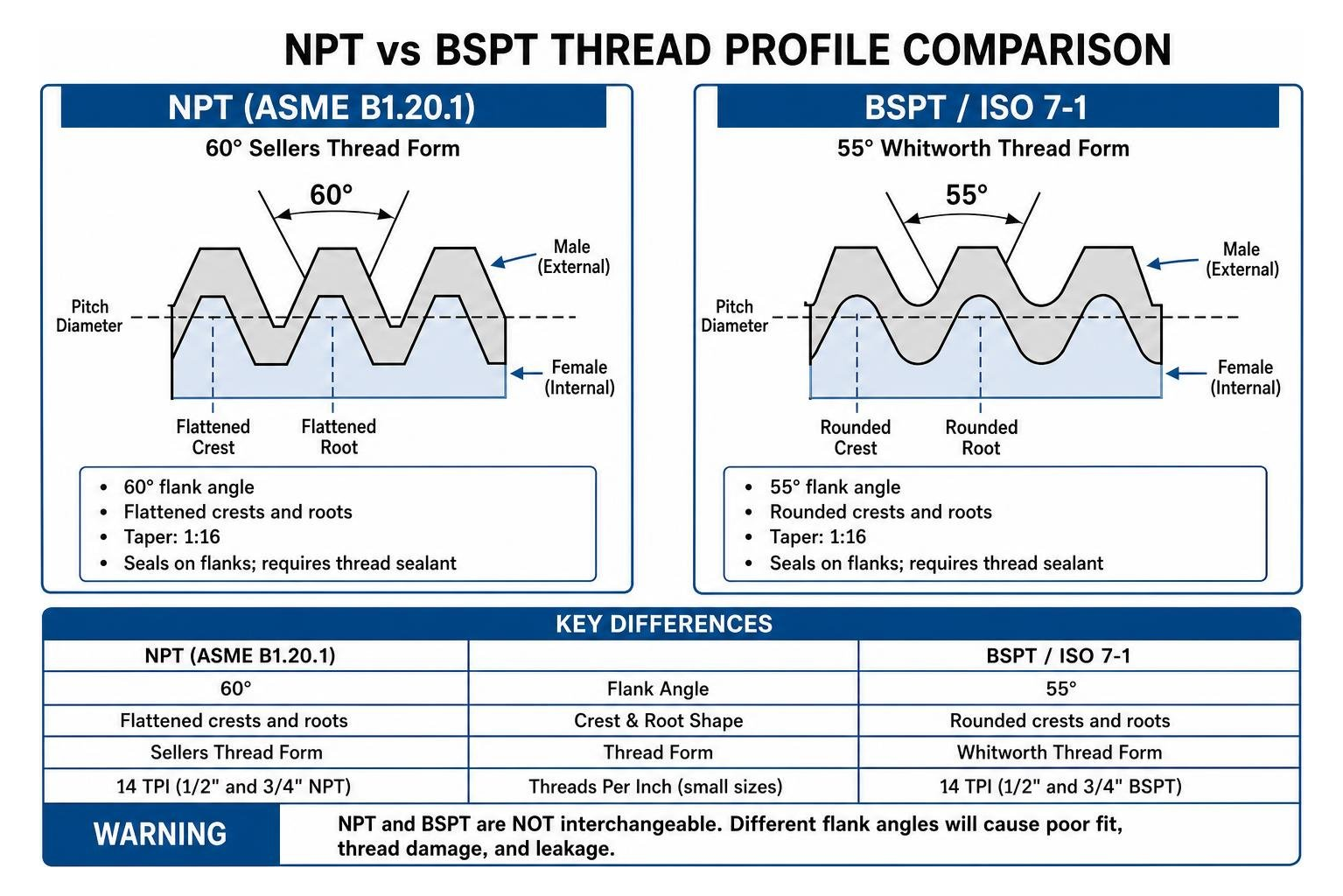
- NPT (ASME B1.20.1): Utilizes a 60-degree Sellers thread form. When screwed together, the flanks make contact, but clearance remains between the crests and roots. This clearance forms a continuous microscopic spiral leakage path, requiring PTFE tape or liquid sealant to make a pressure-tight seal. For an in-depth reference on taper dimensions, consult the ANSI B1.20.1 taper pipe threads guide.
- NPTF Dryseal (ASME B1.20.3): Uses the same 60-degree angle and 1:16 taper but incorporates tightly controlled truncation at the crests and roots. During makeup, the crests mechanically crush into the mating roots before the flanks contact, achieving an interference seal without thread tape.
- BSPT / ISO 7-1 (British Standard Pipe Taper): Employs a 55-degree Whitworth profile with rounded crests and roots. Even though 1/2-inch and 3/4-inch BSPT share the 14 TPI pitch of NPT, their thread flank angles differ by 5 degrees. They are not interchangeable. Mating an NPT male into a BSPT flange will strip the threads, damage the seating surfaces, and leak.
Before procuring components, take time understanding flange standards and specifications to confirm international thread compatibility.
Materials, Pressure Ratings, and Face Types
Selecting the correct flange requires matching the metallurgy and pressure boundary to your operating media.
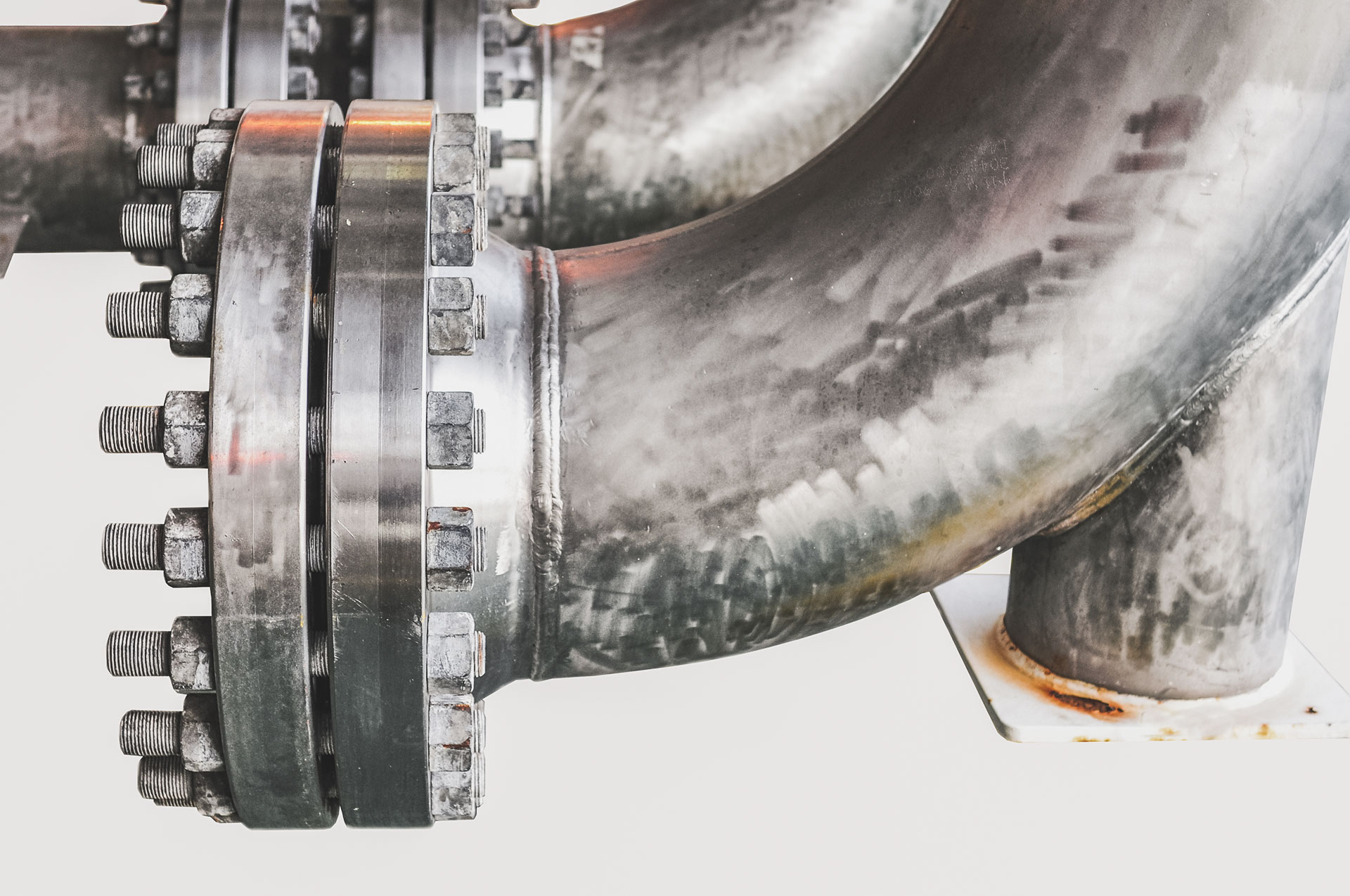
When selecting piping components, engineers must evaluate several parameters. Reviewing the 4 factors to consider when choosing flanges ensures your metallurgy, pressure class, facing, and operating environment remain aligned.
ASTM A105 Carbon Steel Properties and Quality Certifications
For forged carbon steel piping systems, ASTM A105 represents the industry baseline. It is a forged carbon steel grade intended for ambient- to high-temperature service in pressure piping systems.
- Chemical Composition: Max 0.35% Carbon, 0.60–1.05% Manganese, 0.035% Phosphorus, 0.040% Sulfur, and 0.10–0.35% Silicon.
- Mechanical Properties: Minimum tensile strength of 70,000 psi (485 MPa) and minimum yield strength of 36,000 psi (250 MPa).
- Machinability and Weldability: Excellent machinability allows for precise NPT single-point thread cutting. While threaded flanges eliminate field welding, A105 steel remains fully weldable if a seal weld is required down the line.
At Lynco Flange & Fitting, our quality control procedures mandate that every forging carry full heat-batch traceability. We supply complete EN 10204 Type 3.1 Material Test Reports (MTRs) upon request. A 3.1 inspection certificate provides independent validation from the manufacturer’s QA representative, verifying exact chemical heat analysis, mechanical tensile and yield results, and heat treatment records.
Pressure Ratings and Raised Face (RF) Configurations
Flange pressure classes are defined under ASME B16.5 (Pipe Flanges and Flanged Fittings: NPS 1/2 through NPS 24). Common pressure classes include Class 150, 300, 600, 900, 1500, and 2500.
A Class 150 flange is not limited to a flat 150 psi. In fact, an ASTM A105 Class 150 flange accommodates working pressures up to 285 psig at ambient temperature (-20°F to 100°F). As system operating temperatures rise, allowable working pressure drops according to ASME B16.5 pressure-temperature rating curves (e.g., approximately 170 psig at 500°F).
The Raised Face (RF) configuration is the most common mating surface:
- Height: Class 150 and 300 flanges feature a standard 1/16-inch (1.6 mm) raised face, while Class 600 and higher feature a 1/4-inch (6.4 mm) raised face.
- Serrations: The raised face surface is machined with concentric or phonographic spiral grooves (typically 125 to 250 micro-inches Ra roughness). When the flange bolts are torqued, these serrations bite into the gasket material (such as a spiral-wound or flexible graphite gasket), concentrating bolt load onto a defined gasket area to create a dependable, leak-proof seal.
Threaded Flanges vs. Alternative Pipe Connection Types
Choosing between a threaded flange, a weld neck flange, or a socket weld flange depends on installation restrictions, plant safety regulations, and fluid dynamics.
Understanding what are the different types of flanges for piping helps engineering teams pick the right joint style for their operational lifecycle.
Threaded Flanges vs. Weld Neck and Socket Weld Flanges
Threaded flanges offer distinct advantages, but they also have clear operational boundaries when compared to welded alternatives:
- Hot-Work Restrictions: Threaded flanges shine in volatile, active facilities—such as offshore drilling platforms, operating refineries, and gas plants—where open flames, welding arcs, and grinding sparks pose explosion hazards. Installing a threaded flange requires no hot-work permits or line purging.
- Cost and Inspection: Welded connections (Weld Neck and Socket Weld) require qualified welders, post-weld non-destructive examination (NDE) such as X-ray radiography or dye-penetrant testing, and potential post-weld heat treatment. Threaded connections reduce initial installation time and eliminate weld inspection costs.
- Fatigue Resistance and Stress: Weld neck flanges feature a tapered hub that smoothly transfers mechanical stress to the pipe wall, making them superior in severe cyclic loading, water hammer, and extreme temperature fluctuations. Threaded flanges induce stress concentrations at the root of the pipe threads and should be avoided in heavy cyclic-vibration services.
- Internal Corrosion: Socket weld and threaded joints leave small internal crevices between the pipe end and the fitting shoulder, which can harbor stagnant fluids and promote crevice corrosion. Weld neck flanges yield a smooth, continuous full-penetration bore that minimizes turbulence and erosion.
Sizing Beyond 1/2-Inch: Overview of 3/4-Inch to 3-Inch Flanges
As pipe diameters increase, the mechanical behavior of threaded joints changes:
- 3/4-Inch Flanges: Like 1/2-inch, 3/4-inch NPT connections use 14 TPI. They are common in cooling water tie-ins, chemical sampling points, and instrument enclosures.
- 1-Inch to 2-Inch Flanges: These sizes shift to 11.5 TPI, providing a coarser, deeper thread engagement capable of handling higher mechanical loads across utility air lines, pump manifolds, and steam traps.
- 2-1/2-Inch and 3-Inch Flanges: Stepping up to 8 TPI, these large threads require substantially higher makeup torque. In process plants, 3-inch threaded flanges are generally reserved for non-hazardous low-pressure utility lines (such as cooling water or plant air). For critical hydrocarbon process streams above 2 inches, welded flanges are usually preferred due to the physical difficulty of manually wrenching large threaded joints to full interference depth.
When designing complex utility headers, reviewing the most common pipe flange sizes and uses will help standardize your piping specs across skid packages.
Installation, Sealing, and Industrial Applications
A threaded flange is only as reliable as its assembly procedure. Because NPT connections have a spiral clearance between mating crests and roots, proper sealant application and controlled torque makeup are mandatory.
How to Properly Seal and Install a 1/2-Inch NPT Flange
To ensure a leak-free joint on small-bore threaded flanges, our engineering support team recommends this four-step installation procedure:
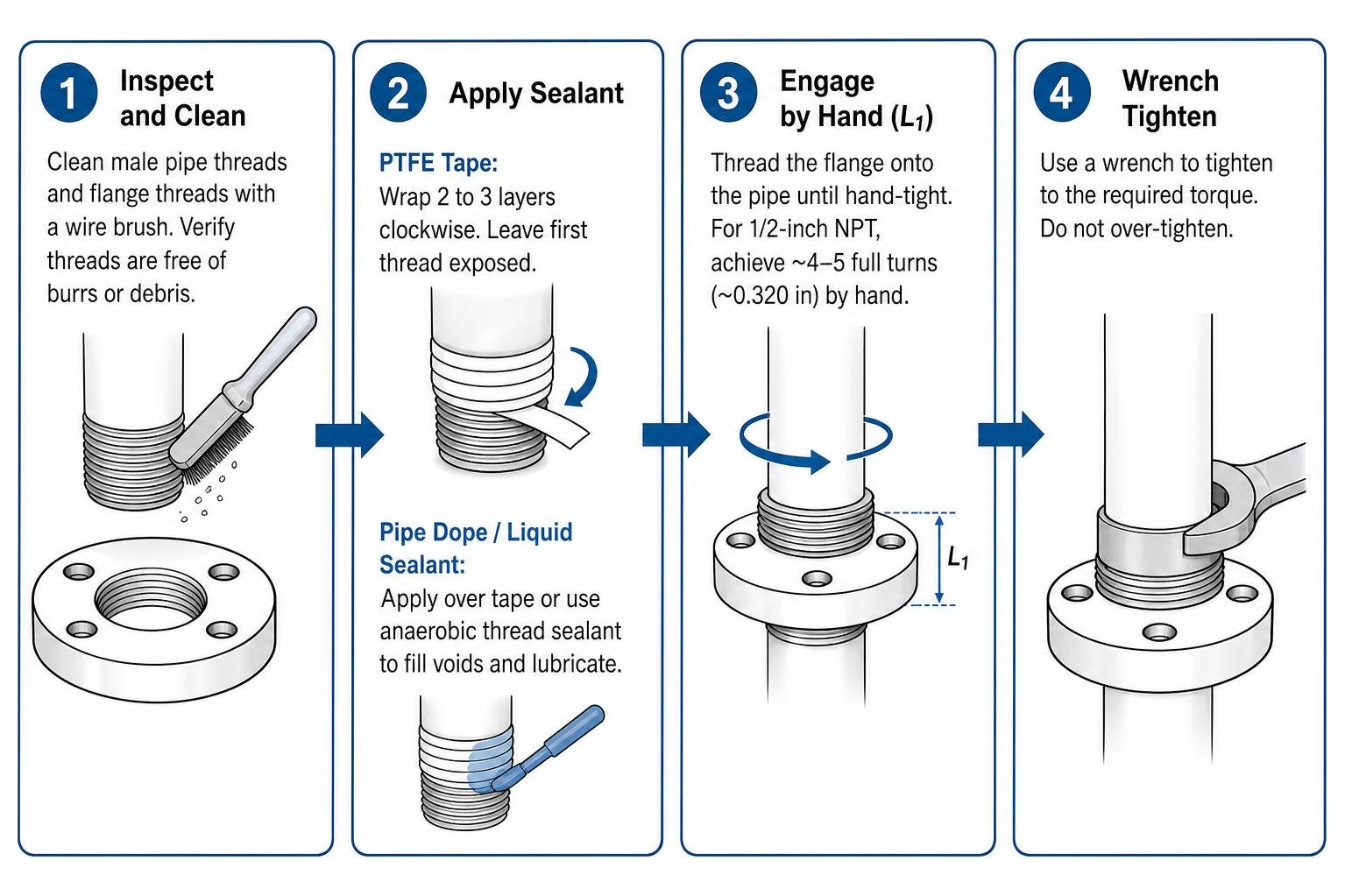
- Inspect and Clean: Clean both the male pipe threads and the internal flange threads with a wire brush to remove cutting oils, metal shavings, or dirt. Verify the threads are free of burrs or gouges.
- Apply Sealant:
- PTFE Tape: Wrap 2 to 3 layers of high-density PTFE tape in a clockwise direction (looking directly at the open face of the male thread). Wrapping clockwise ensures the tape remains flat and tight as the male pipe screws into the flange, rather than unraveling. Leave the first starting thread exposed to prevent sheared tape ribbons from entering the process stream.
- Pipe Dope / Liquid Anaerobic Sealant: For severe hydrocarbon or high-pressure gas service, apply a high-grade, non-hardening paste sealant over the tape, or use an anaerobic thread sealant. This fills all microscopic spiral voids and acts as an anti-galling lubricant during assembly.
- Engage by Hand ($L_1$): Thread the flange onto the pipe until hand-tight. For a 1/2-inch NPT connection, you should achieve roughly 4 to 5 full turns by hand (approximately 0.320 inches of axial depth).
- Wrench Tighten ($L_2$): Using a calibrated pipe wrench or backup wrench, tighten the joint 2 to 3 full turns past hand-tight. Avoid over-tightening; excessive torque expands the female flange hub, potentially cracking cast components or galling carbon steel thread flanks.
Industrial Applications and Piping Environments
Due to their versatility and ease of assembly, 1/2-inch to 3-inch NPT A105 flanges serve critical roles across heavy industry:
- Petrochemical and Refining: Pressure gauge connections, thermowell installations, bleed valves, and sampling ports on process bypass headers.
- Natural Gas Distribution: Regulator stations, meter runs, and low-pressure distribution manifolds where field welding is restricted.
- Compressed Air and Industrial Utilities: Plant-wide pneumatic supply lines, tool drops, and compressed air distribution loops.
- Marine and Offshore Utilities: Bilge pumping skids, fuel transfer metering manifolds, and deck utility connections where hot work requires expensive offshore vessel shutdowns.
For practical guidance on balancing pressure ratings, flange types, and materials across your facility, see our guide on how to pick out the right pipe flanges for your project.
Frequently Asked Questions About Threaded Pipe Flanges
Why does a 1/2 NPT thread measure 0.840 inches instead of 0.500 inches?
The 1/2-inch designation is a nominal size, not a direct physical measurement. Historically, in early iron pipe manufacturing, a 1/2-inch pipe had an actual internal bore diameter of approximately 0.500 inches with thick structural walls. To maintain standardized fitting compatibility across varying wall thicknesses (schedules), the pipe industry fixed the outside diameter at 0.840 inches. As manufacturing improved and pipe walls became thinner, the inside diameter expanded, but the standard outside diameter and matching 0.840-inch NPT thread size remained unchanged.
Can NPT and BSPT flanges be threaded together safely?
No. NPT and BSPT threads must never be mated directly in pressure piping. NPT uses a 60-degree Sellers thread angle, whereas BSPT uses a 55-degree Whitworth profile. Even though 1/2-inch and 3/4-inch sizes share 14 threads per inch, the 5-degree flank mismatch prevents proper flank engagement. Threading them together damages the metal surfaces, leaves an open spiral leakage path, and risks sudden joint blow-out under pressure. Always use a dedicated precision NPT-to-BSPT adapter.
What is the purpose of an EN 10204 3.1 material test report?
An EN 10204 Type 3.1 Material Test Report (MTR) provides certified verification that the manufactured flange complies with the chemical, mechanical, and testing requirements of the specified standard (e.g., ASTM A105 and ASME B16.5). The certificate is validated and signed by an inspection representative independent of the manufacturing shop floor. It guarantees full batch traceability, verifying heat numbers, tensile strength, yield limits, elongation, hardness, and heat treatment.
Conclusion
Selecting the right threaded pipe flange requires balancing nominal thread geometry, precise dimensional verification, material selection, and pressure-temperature curves. Whether you are outfitting an instrumentation line with a 1/2-inch NPT companion flange or designing a 3-inch utility header, understanding ASME B1.20.1 thread mechanics and ASTM A105 material properties ensures safe, leak-free operation.
At Lynco Flange & Fitting, our Houston-based engineering and sales teams bring decades of technical expertise to every inquiry. Backed by our extensive on-site inventory of carbon steel, stainless, and specialty alloy flanges, we deliver fully certified piping solutions with complete material traceability to keep your industrial operations running smoothly.