Where Aquatherm Blue Pipe Fits in Commercial HVAC
aquatherm blue pipe is a polypropylene piping system used to move water through commercial heating, cooling, and other mechanical systems. Its heat-fused joints create permanent connections, while the pipe itself resists corrosion. Fiber-reinforced versions also expand and contract less than standard polypropylene pipe, making them useful for long HVAC runs.
The right version depends on the system’s temperature, pressure, and exposure to sunlight. Those details also matter when the pipe connects to metal valves or equipment.
I’m Lance Vanover, CEO of Lynco Flange & Fitting. My 26 years in industrial flanges and fittings inform this guide to aquatherm blue pipe, especially the practical questions around selecting components for mixed-material systems.
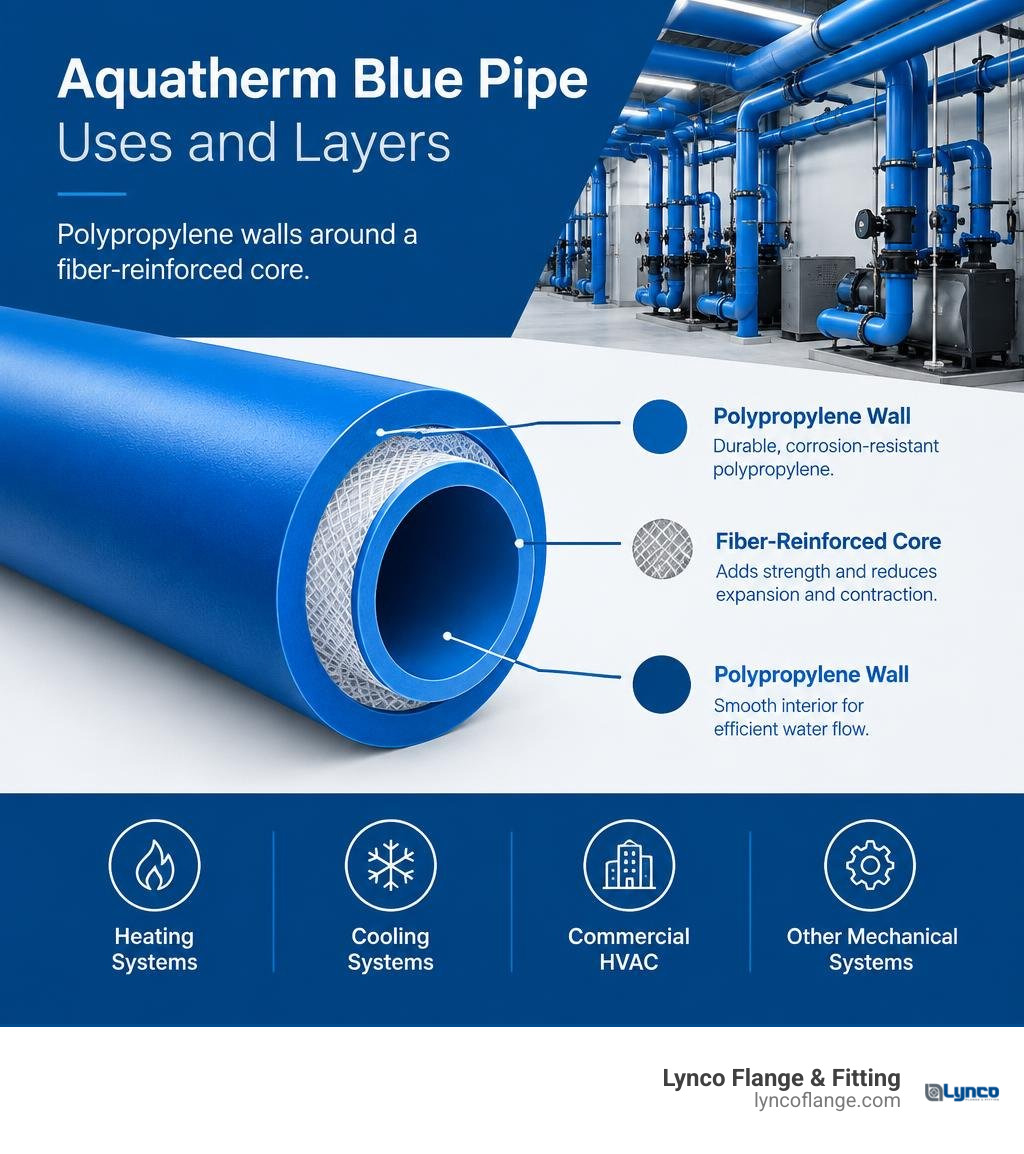
Quick aquatherm blue pipe definitions:
What Is Aquatherm Blue Pipe and How Does It Work?
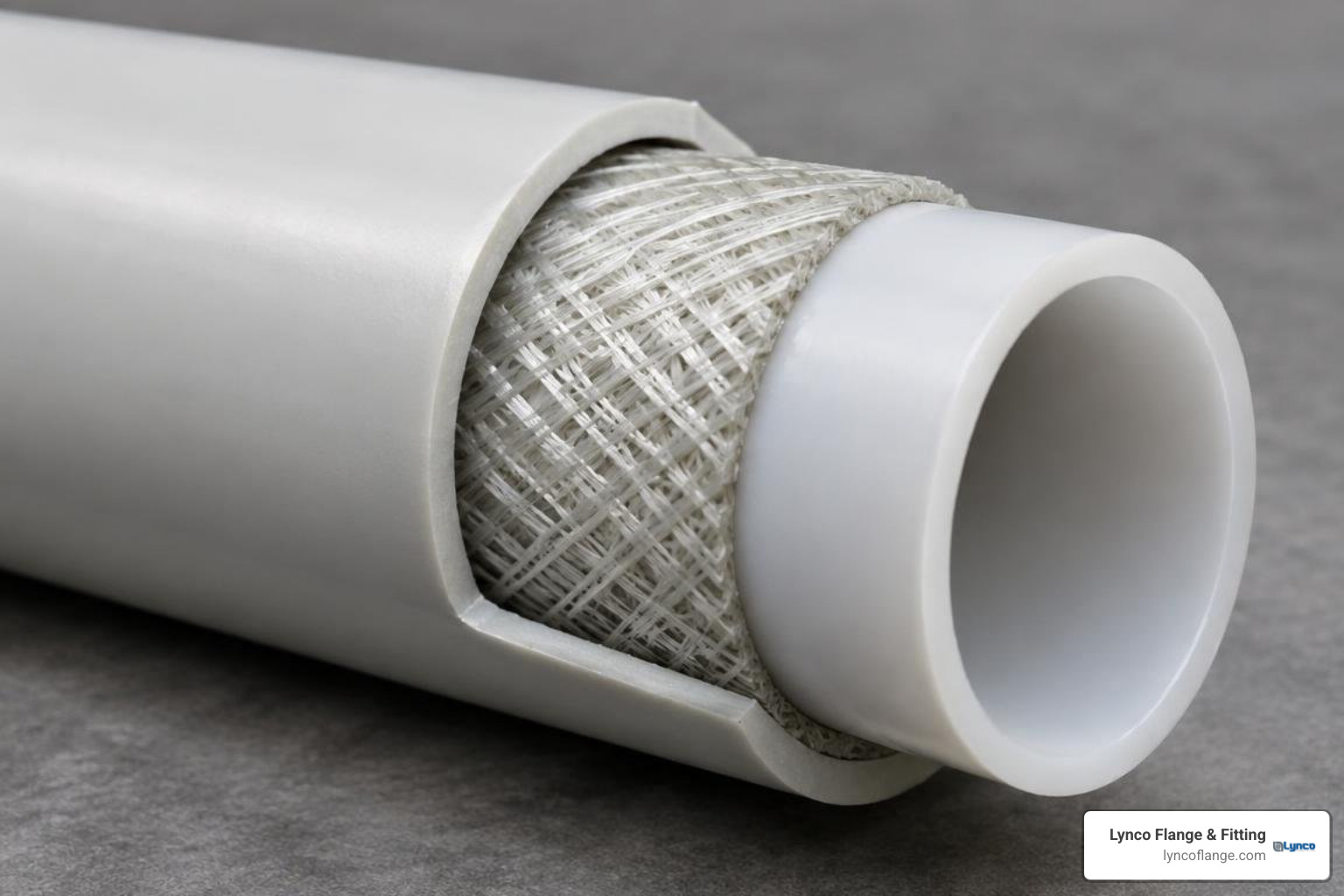
At its core, Aquatherm Blue is engineered specifically for hydronic heating, chilled water distribution, geothermal circuits, and closed-loop industrial process lines. Unlike conventional metallic piping that relies on mechanical threads, solders, or compression gaskets, this thermoplastic solution uses an engineered piping system for heating and cooling water lines – aquatherm manufactured from a specialized polypropylene resin called fusiolen PP-RCT (Polypropylene Random Copolymer with modified Crystallinity and Temperature resistance).
The fundamental working principle relies on thermal molecular heat fusion. When the pipe and its matching fitting are heated to their specific melting temperature and brought together, the polymer chains uncoil and interweave. As the joint cools, it solidifies into a single, continuous, monolithic piece of polypropylene. Because there are no mechanical gaskets to dry out, crimp rings to relax, or solder alloys to degrade, the risk of joint failure is practically eliminated.
The inner surface of the pipe is completely hydrophobic and chemically non-reactive. Scale, calcium deposits, and mineral build-up cannot cling to the smooth interior walls, ensuring consistent flow dynamics throughout its operating lifespan.
Material Science and Multilayer Formulation
The mechanical strength of this piping stems from advances in resin chemistry. Standard polypropylene (PP-R) relies on a random arrangement of comonomers, which delivers decent chemical resistance but requires thicker walls to handle elevated pressures at higher temperatures. In contrast, PP-RCT undergoes a specialized formulation process known as beta-nucleation.
Beta-nucleation alters the crystalline structure of the polypropylene matrix, creating smaller, more densely organized crystalline structures. This molecular refinement increases long-term hoop stress resistance and pressure retention at high temperatures by up to 50% compared to standard PP-R. As a result, pipes can be extruded with significantly thinner walls while maintaining identical or superior pressure classes.
| Performance Metric | Standard PP-R | Advanced PP-RCT (fusiolen) | Engineering Benefit |
|---|---|---|---|
| Tensile Strength | 25 MPa | 35 MPa | Higher structural stability under load |
| Modulus of Elasticity | 800 N/mm² | 1200 N/mm² | Increased pipe rigidity, reducing sag |
| Linear Expansion Coefficient | 1.50 × 10⁻⁴ K⁻¹ | 0.35 × 10⁻⁴ K⁻¹ (with MF) | 75% reduction in thermal expansion |
| Thermal Conductivity | 0.24 W/mK | 0.15 W/mK | Natural insulation and reduced condensation |
| Wall Thickness vs Flow Area | Baseline thick wall | Thinner wall profile | Up to 20% increase in hydraulic flow capacity |
| Water Absorption Rate | < 0.05% | < 0.02% | Zero internal fluid swelling or degradation |
Additionally, the resin is compounded with proprietary heat stabilizers and metal deactivators. These additives prevent heavy metal ions (which may enter the fluid stream from copper heat exchangers or iron boilers) from catalyzing oxidative degradation on the interior polymer wall.
Product Variants: S, MF, MF RP, UV, and OT
To address varied commercial installations, the system is manufactured across five distinct product variants, detailed in the manufacturer’s technical PARTS GUIDE:
- Aquatherm Blue S (Single-Layer): A single-extrusion, unreinforced pipe formulated for applications where fluid temperatures remain low and linear thermal movement is minimal. It is restricted to low-temperature operations (typically up to 25°C / 77°F), making it an option for direct-buried chilled water lines, snow-melt coils, and low-temperature geothermal distribution.
- Aquatherm Blue MF (Multilayer Faser): Features a co-extruded three-layer design. The inner and outer layers are composed of polypropylene, while the middle layer integrates a specialized glass-fiber composite compound. This middle layer restricts thermal movement, reducing linear expansion by 75% compared to standard plastics.
- Aquatherm Blue MF RP (Raised Pressure): Combines the glass-fiber composite core with advanced PP-RCT resin across all layers. This formulation delivers enhanced compressive strength, allowing thinner pipe walls to handle higher working pressures at elevated temperatures.
- Aquatherm Blue UV: Designed for external runs and mechanical rooftops. While standard polypropylene must not be stored outdoors unprotected for more than 6 months, the UV variant features an integrated high-density black polyethylene outer jacket that protects the structural core against solar degradation.
- Aquatherm Blue OT (Oxygen-Tight): Engineered specifically for closed hydronic heating loops. It features an integrated oxygen diffusion barrier layer that complies with DIN 4726, preventing atmospheric oxygen from permeating the pipe wall and causing corrosion in downstream cast-iron boilers, steel pumps, and carbon steel valves.
Technical Specifications and SDR Pressure Ratings
Thermoplastic piping performance is governed by the Standard Dimension Ratio (SDR), which defines the relationship between the pipe’s outside diameter and its minimum wall thickness:
SDR = Outside Diameter / Wall Thickness
Because SDR represents a fixed ratio, every pipe diameter within a specific SDR rating maintains an identical operating pressure capacity. This design differs from traditional North American steel pipe schedules (such as Schedule 40 or Schedule 80), where the internal working pressure rating steadily decreases as the nominal pipe diameter increases.
Selecting the appropriate SDR requires evaluating both operating temperature and pressure conditions, as thermoplastic materials undergo pressure derating when exposed to higher fluid temperatures. Understanding the impact of temperature and pressure on fitting selection ensures the entire mechanical network operates safely within its design parameters.
The continuous operating envelope for Aquatherm Blue spans from -5°F to 200°F (-20°C to 93°C), with compliance across global certifications including ASTM F 2389, CSA B137.11, NSF 14, and ISO 10508.
Standard Dimension Ratios and Sizing Dimensions
The piping is manufactured across standard outside metric diameters from 20 mm (1/2″ nominal) up to 630 mm (24″ nominal), supplied in 19-foot standard sticks, 38-foot double-lengths, or continuous 100-meter coils for small diameters.
| SDR Rating | Wall Profile | Primary HVAC Applications | Continuous Working Pressure at 68°F (20°C) | Continuous Working Pressure at 180°F (82°C) |
|---|---|---|---|---|
| SDR 7.4 | Heavy Wall | High-stress industrial loops, severe pressure surges | ~385 psi (26.5 bar) | ~140 psi (9.6 bar) |
| SDR 9 | Thick Wall | Commercial heating hot water loops up to 180°F, high-rise risers | ~320 psi (22.0 bar) | ~125 psi (8.6 bar) |
| SDR 11 | Medium Wall | Standard chilled water distribution, dual-temperature loops, process lines | ~230 psi (16.0 bar) | ~95 psi (6.5 bar) |
| SDR 17.6 | Thin Wall | Cooling tower condenser water, low-pressure district cooling, geothermal | ~130 psi (9.0 bar) | ~60 psi (4.1 bar) |
(Note: Segmented fittings fabricated from miter-cut butt-welded pipe sections carry an industry-standard derating factor of 0.75 / 25% reduction compared to molded fittings).
Managing Thermal Expansion in Aquatherm Blue Pipe
Unreinforced polypropylene exhibits a high coefficient of thermal expansion, expanding roughly ten times more than carbon steel over an equivalent temperature swing. To solve this, the multilayer faser-composite (MF) technology incorporates micro-fiberglass strands within the middle extrusion layer.
These microscopic glass fibers orient longitudinally during manufacturing. When heated fluid circulates through the pipe, the embedded fibers mechanically resist expansion and contraction, reducing total linear movement by 75%. This brings the linear expansion coefficient down to 0.35 × 10⁻⁴ K⁻¹, putting it on par with metallic piping systems like copper and steel.
Managing this movement involves clear design practices:
- Anchors (Fixed Points): Heavy-duty clamps installed around molded socket fittings to divide long runs into controlled segments and direct thermal expansion toward offset legs.
- Guide Brackets (Sliding Points): Pipe hangers that permit axial movement while preventing lateral buckling or sagging.
- Expansion Loops and Offsets: Z-bends, L-bends, and U-shaped loops engineered into continuous straight runs over 100 feet to absorb dimensional shifts without overstressing fusion joints.
Thanks to its natural material thermal conductivity of 0.15 W/mK (compared to 50 W/mK for carbon steel and 400 W/mK for copper), the pipe acts as an insulator. This low thermal conductivity minimizes exterior sweat and condensation beneath insulation jackets on chilled water headers, allowing engineers to reduce external insulation thickness requirements on commercial designs.
Commercial Applications and Performance Benefits
Switching from carbon steel or copper to engineered polypropylene offers clear operational and mechanical advantages. PP-RCT piping is up to 70% lighter than similarly sized Schedule 40 steel pipe. This substantial weight reduction decreases structural roof loading on cooling tower headers, speeds up field handling, and lowers jobsite hoisting and rigging costs.
Furthermore, polypropylene hydronic systems offer a 50+ year operational lifespan backed by a 10-year manufacturer warranty covering property damages up to €20 million per registered event.
From an operational standpoint, total immunity to rust and scale prevents the gradual drop in internal pipe diameter and rise in friction losses that commonly affect aged steel hydronic lines. The importance of non-corrosive materials becomes clear when understanding the importance of corrosion resistance in piping systems, especially in high-humidity mechanical rooms.
High-Density Data Center and Liquid Cooling Infrastructure
The expansion of artificial intelligence, machine learning, and hyperscale cloud computing has driven server rack power densities from historical baselines of 10–15 kW up to 65 kW to over 150 kW per rack. Air-cooling systems cannot efficiently remove heat loads of this magnitude, making direct-to-chip liquid cooling and rear-door heat exchangers the modern data center standard.
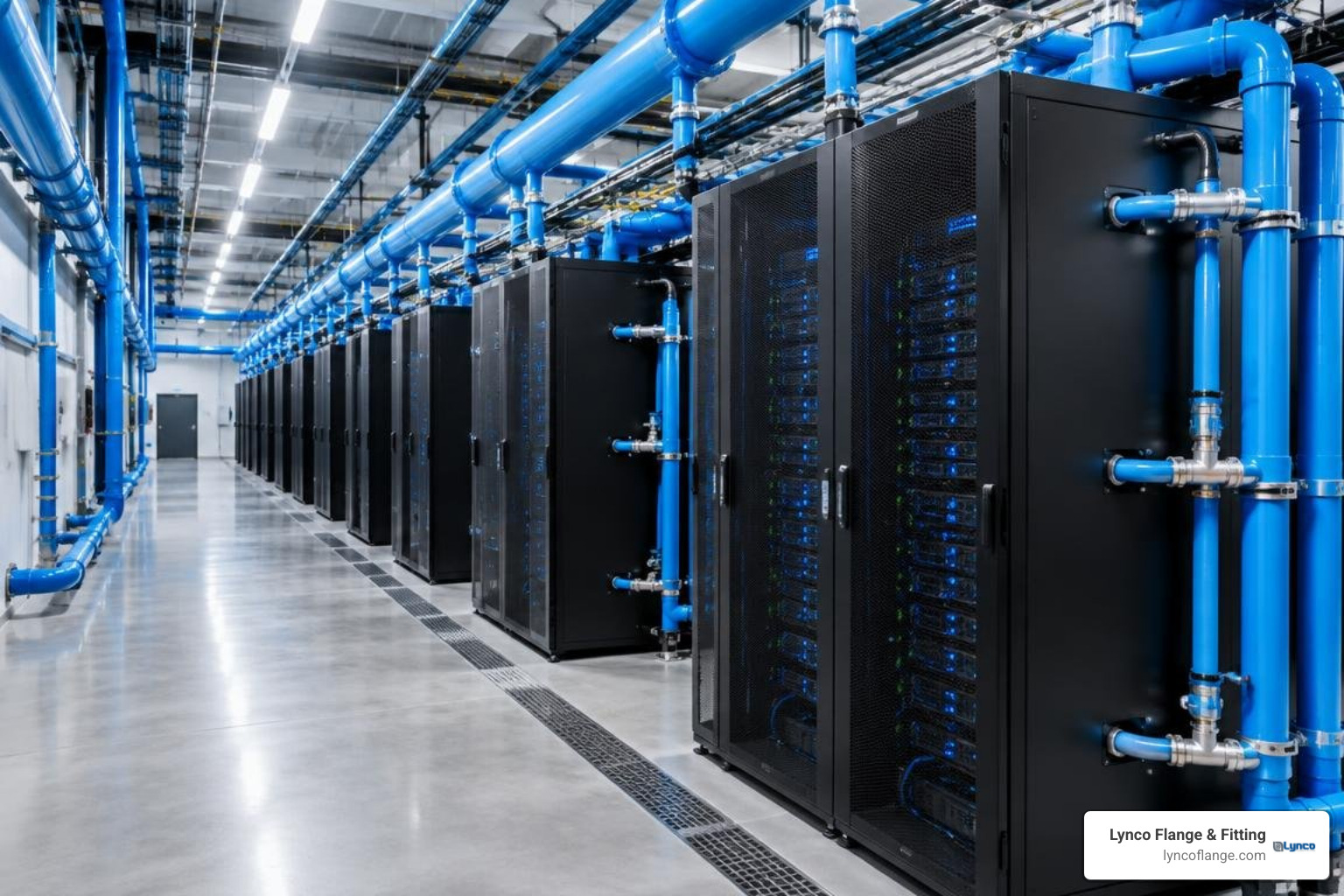
In these closed-circuit liquid cooling networks, water quality is critical. Conventional carbon steel lines slough off microscopic iron oxide flakes, rust scale, and welding slag. Even with fine strainers installed, this particulate debris can clog micro-channel cold plates resting directly on GPU and CPU dies, causing thermal throttling and hardware failure.
Aquatherm Blue eliminates rust formation, providing clean, particulate-free fluid delivery to mission-critical infrastructure. The non-metallic composition also eliminates galvanic corrosion loops between dissimilar metals across complex fluid distribution manifolds.
Hydronic Heating, Condenser Water, and Marine Systems
Beyond high-density data centers, PP-RCT piping excels in diverse commercial and marine environments:
- Commercial Boiler Loops: Handles supply water temperatures up to 180°F–200°F with SDR 9 or SDR 7.4 MF RP lines, resisting thermal shock and glycol degradation.
- Open-Loop Condenser Water: Withstands harsh chemical biocides, scale inhibitors, and chlorine treatments used in cooling towers without pitting, pinholing, or wall thinning.
- District Energy and Geothermal: Thin-wall SDR 17.6 pipes handle high flow volumes in direct-buried heating and cooling loops, safely absorbing ground shifting and seismic soil settling.
- Maritime and Hybrid Vessels: Eliminates salt-spray oxidation and topside weight on marine vessels. Systems can integrate with adsorption chillers capturing engine waste heat to help shipbuilders meet International Maritime Organization (IMO) carbon intensity indicators.
Heat Fusion Methods and System Integration
Aquatherm Blue pipes are joined using specialized thermal fusion techniques without open flames, solder pastes, solvent glues, or mechanical crimp rings. The installer’s technical guidelines in the official OCT2024 manual outline four distinct joining methods based on pipe diameter and layout:
- Socket Fusion (1/2″ to 4″ / 20 mm to 125 mm): The pipe end and molded fitting socket are inserted over heated male and female dies on a 500°F handheld iron. Once the dwell heating time is reached, the components are pushed together, fusing the overlapping joint as they cool.
- Butt Welding (6″ to 24″ / 160 mm to 630 mm): The square-cut pipe ends are clamped into an alignment machine, faced smooth, and pressed against a flat, coated heating plate at calibrated hydraulic pressures. Once an even melt bead forms, the plate is removed, and the pipe ends are hydraulically pressed together to form a double external weld bead.
- Sidewall Outlet Fusion (Branch Saddles): Allows drilling directly into the side of a distribution main and fusing a branch outlet saddle without cutting through the main run. This method reduces fitting costs and minimizes pressure drops compared to standard reducing tees.
- Electrofusion (Socket and Couplers): Incorporates embedded electrical resistance wires within factory fittings. When connected to a barcode-guided electrofusion processor, the internal coils melt the surrounding polypropylene to create a leak-free joint in tight overhead spaces where standard fusion tools cannot fit.
Certified Fusion Joining Procedures
Executing reliable heat fusion joints requires careful attention to installer craftsmanship, tool calibration, and strict adherence to technical procedures:
- Squaring and Cutting: Use sharp carbide circular saw blades (60–100 teeth) or heavy-duty plastic pipe shears. Never use dull blades that smear or melt the thermoplastic during the cut.
- Surface Cleaning: Wipe the exterior pipe insertion zone and the interior of the fitting with 91%+ isopropyl alcohol using lint-free cloths to remove grease, moisture, and dust.
- Depth Marking: Use a manufacturer depth gauge to draw a continuous line around the pipe circumference. This prevents over-inserting the pipe into the fitting, which can push molten resin inward and restrict fluid flow.
- Calibrated Heating: The fusion iron must be calibrated to 500°F (±18°F / 260°C ±10°C) and verified with an infrared or surface probe thermometer. Hold the pipe and fitting firmly against the heating dies without twisting.
- Cooling and Immobilization: Assemble the heated components smoothly without twisting. The joint must be held completely rigid for the specified dwell period (typically 15 to 45 seconds depending on pipe size) and allowed to cool completely before applying stress or running pressure tests.
Transitioning from Aquatherm Blue Pipe to Metal Flanges
Commercial mechanical rooms inevitably require connecting polypropylene headers to metallic components like cast-iron chillers, bronze balancing valves, stainless steel pumps, and carbon steel air separators. The safest method for transitioning between plastic and metal is an engineered flange assembly.
Polypropylene flange adapters feature a thick molded fusion socket on one end and a raised sealing face on the other. A loose steel backup ring (flange) slips over the adapter neck, clamping against the shoulder of the plastic face. The adapter is heat-fused directly onto the PP-RCT line, and the steel backing ring bolts up to the matching Class 150 ANSI/ASME B16.5 metallic flange on the equipment side.
To ensure long-term joint integrity when transitioning to metallic components:
- Galvanic Protection: Because polypropylene is completely non-conductive, it acts as a dielectric break, preventing stray electrical currents and galvanic reactions between dissimilar metals.
- Gasket Selection: Use full-face elastomeric gaskets (such as EPDM or Neoprene with 60–70 Shore A durometer) to create a tight seal across the plastic flange face without requiring excessive bolt compression.
- Torque Sequences: Thermoplastic flanges require lower torque values than raised-face steel flanges. Bolts must be lubricated and tightened in a crisscross pattern across multiple passes using a calibrated torque wrench. Over-tightening can crack the thermoplastic shoulder or warp the sealing face. Understanding how high quality metal flanges keep industrial systems running safely helps field teams avoid improper bolt loads and maintain leak-free transitions.
Frequently Asked Questions About Commercial Polypropylene Piping
What is the expected service life and warranty coverage for PP-RCT piping?
PP-RCT piping is engineered for a service life exceeding 50 years under continuous operating pressures and temperatures up to 160°F–180°F. The manufacturer backs installed, certified systems with an extensive 10-year warranty covering material defects, repair costs, and associated property damages up to €20 million per single occurrence.
Can PP-RCT pipe be stored outdoors without UV degradation?
Standard blue polypropylene pipe without UV protection should not be stored outdoors exposed to direct sunlight for more than 6 months. Extended UV exposure causes the outer resin to oxidize, resulting in chalking and micro-cracking.
For projects requiring outdoor staging or rooftop routing:
- Store non-UV pipe under opaque, light-colored, breathable tarps (avoid dark tarps that trap excessive heat).
- Specify Aquatherm Blue UV pipe, which features an integrated co-extruded black polyethylene protective jacket.
- For short exposed runs on standard pipe, wrap fittings and joints using approved 50% overlapping UV-resistant adhesive barrier tape.
How does PP-RCT achieve higher flow rates than conventional plastic pipes?
Thanks to the beta-nucleated crystalline structure of PP-RCT resin, pipe walls can be manufactured up to 30% thinner than standard PP-R pipes while handling the same design pressure.
This thinner wall profile expands the internal cross-sectional area, yielding an approximate 20% increase in fluid flow capacity under identical head-loss conditions. This improved hydraulic performance allows engineers to downsize pipe diameters on long hydronic headers, saving on material costs and reducing continuous pumping energy demands.
Conclusion
Aquatherm Blue Pipe has become a primary alternative to traditional metallic piping in modern commercial HVAC and industrial process systems. Combining the long-term corrosion resistance of advanced polypropylene, the structural stability of glass-fiber reinforcement, and the permanent security of heat-fused joints, it delivers exceptional lifecycle value.
Whether you are designing a high-efficiency chilled water loop for an AI data center or managing a major plant expansion, reliable mechanical performance ultimately depends on how smoothly your plastic piping integrates with metallic infrastructure.
At Lynco Flange & Fitting, our sales and engineering team brings decades of technical expertise to every project. We supply the ANSI flange backup rings, specialty transition fittings, high-yield alloy flanges, and custom machined components needed to connect your thermoplastic piping to pumps, chillers, and valves safely and reliably.
Explore our complete guide to industrial piping system components to learn how our inventory, ISO-compliant quality control, and engineering support keep commercial and industrial piping projects running smoothly.